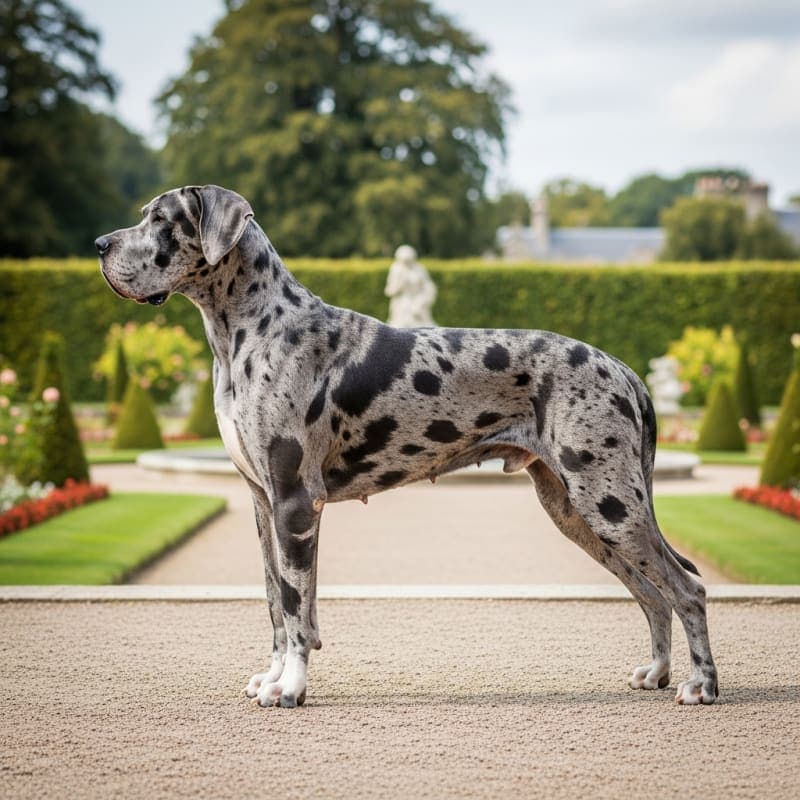
Great Dane
FCI Group
2• FCI 235
Size
Large
Origin Country
DE
Height
72-90 cm
Weight
45-70 kg
Lifespan
8-10 years
Temperament
Overview
Great Dane, also known as Deutsche Dogge, is a fascinating breed that combines impressive size with an incredibly gentle and friendly character. Originating from Germany, the Great Dane has a rich history dating back to the Middle Ages, when its ancestors – known as Bullenbeisery – were used for hunting large game such as wild boars and bears. Over time, the breed underwent significant transformations, and formal breeding began in 1878, helping to standardize its traits. Today, the Great Dane captivates with its majestic presence, elegance, and harmonious body proportions.
Known as the true Apollo among dogs, the Great Dane stands out with its powerful yet harmonious build. Its long and narrow head and intelligent gaze attract attention and add a noble expression to its face. The body of the Great Dane is muscular, with well-developed limbs and a strong back, emphasizing its athletic silhouette. The height at the withers for males ranges from 80 to 90 cm, and for females from 72 to 84 cm, making it one of the largest dogs in the world. Great Danes come in a variety of coat colors: fawn, brindle, black, blue, and the spectacular harlequin. Their coat is short, dense, and shiny, which adds to their charm and highlights their musculature.
Although their size may be intimidating, Great Danes are known for their calm and friendly temperament. These dogs become very attached to their owners, making them excellent family companions and true family members. Their loyalty, devotion, and willingness to protect their loved ones make them outstanding guard dogs. Moreover, Great Danes are patient and gentle with children, making them ideal companions for families with little ones. Towards strangers, they may be somewhat reserved, but they typically do not show unwarranted aggression. Therefore, proper socialization and training from a young age are essential to ensure good behavior in various social situations.
Great Danes require a moderate amount of exercise – daily walks and opportunities to play, which help them maintain health and well-being. Their gentle nature combined with high intelligence makes them relatively easy to train, especially when using positive training methods. However, they do require a consistent and patient approach, as they can exhibit some stubbornness. If you are interested in a Great Dane and are looking for a loyal, majestic companion with a gentle heart, we invite you to further explore this fascinating breed in the detailed sections of the guide.
Great Danes are dogs with an incredibly majestic appearance, attracting attention with their enormous stature, elegance, and harmonious proportions. Their silhouette is strong, muscular, and proportional, making them look like true living sculptures – real masterpieces of nature.
The head of a Great Dane is long, narrow, and distinctly outlined, with a well-defined stop between the forehead and the muzzle. The muzzle is deep and rectangular, with wide nostrils. The eyes are of medium size, with a lively and friendly expression, most often dark brown, which adds to the dog's intelligent and alert gaze. The ears are naturally hanging, set high, of medium size, and lie close to the cheeks. In some countries (though increasingly rarely), ear cropping is practiced, but in most of Europe, this procedure is banned.
The neck is long, well-muscled, and elegantly arched, emphasizing the noble silhouette of the dog and giving it an aristocratic appearance. The body is strong and compact, with a short and straight back and a deep and wide chest that provides a large lung capacity. The loins are slightly arched, and the hindquarters are wide and well-muscled.
The limbs are strong, straight, and perfectly muscled, providing the dog with stability, strength, and agility despite its large body mass. The paws are round, compact, with well-arched toes and strong claws. The tail of a Great Dane is long, reaching the hock, thick at the base, and tapering evenly towards the end. At rest, it hangs naturally, and during movement, it rises in a gentle arc.
The coat is short, dense, shiny, and closely adhering to the body, highlighting the musculature and athletic build. Great Danes come in five recognized colors: fawn (from light gold to dark gold), brindle (yellow background with distinct black stripes), harlequin (white background with irregular black patches), black (shiny black, with permissible white markings), and blue (steel gray color).
Dimensions: The height at the withers for males is a minimum of 80 cm (preferably 80-90 cm), and for females, a minimum of 72 cm (preferably 72-84 cm). The weight of an adult dog ranges from 50 to 90 kg, depending on gender and build. Great Danes are not only the largest dogs in the world but also among the most recognizable due to their impressive stature and elegant appearance, which inspires admiration and respect.
Great Danes are known for their friendly, gentle, and balanced temperament, making them ideal family dogs. Their personality is full of love, devotion, and affection, and their desire for closeness with their owners makes them extremely sociable and attached to household members. Great Danes often do not realize their own size and love to cuddle with their owners, seeking their closeness and attention.
These majestic dogs are usually calm, patient, and balanced, which makes them excellent companions for children. They show great tolerance towards the youngest family members and can be extremely gentle. However, due to their large weight and strength, it is important to teach them proper manners from a puppy age so that they are aware of their size and do not cause accidental discomfort or injuries during play.
Despite their gentleness, Great Danes have a strong protective and guarding instinct. They can be somewhat wary of strangers, which makes them excellent guardians of the home and family. They are great at analyzing situations and assessing potential threats, making them natural defenders. Their impressive appearance and deep voice are often enough to deter unwanted guests. However, it is important to provide them with proper socialization from a young age to avoid excessive distrust or undesirable reactions in the presence of new people and situations.
Great Danes are also known for not tolerating prolonged loneliness and may suffer from separation anxiety if left alone for extended periods. They need the company and closeness of their owners, which is why they feel best in homes where someone is around most of the day. Their strong bond with the family makes them incredibly loyal and devoted.
The intelligence of Great Danes makes them relatively easy to train, but they require a consistent approach based on positive reinforcement. They can be somewhat stubborn, so it is important to provide them with appropriate structure, clear rules, and consistency in daily life. Despite their powerful build, Great Danes are emotionally sensitive and do not respond well to rough treatment or shouting. Overall, Great Danes are gentle, dignified, and full of grace, yet loving and affectionate towards their loved ones – true gentle giants.
Great Danes, despite their impressive size and strength, are unfortunately prone to a number of health problems that can significantly affect their quality of life and longevity. The average lifespan of these dogs is between 8 to 10 years, which is relatively short compared to smaller breeds, so owners should be particularly aware of potential health risks.
One of the main health issues is joint disorders, including hip and elbow dysplasia. These hereditary conditions can lead to chronic pain, limited mobility, and movement problems, which are particularly challenging for dogs of such large body mass. Therefore, it is important for breeders to conduct appropriate screening tests on the parents before breeding.
An extremely serious and potentially fatal threat is gastric torsion (GDV – Gastric Dilatation-Volvulus), to which Great Danes are particularly susceptible due to their deep chest. This condition requires immediate veterinary intervention. To minimize the risk, it is recommended to divide meals into smaller portions (2-3 times a day), avoid intense exercise immediately before and after eating, and use slow-feeding bowls.
Great Danes are also prone to heart diseases, particularly dilated cardiomyopathy (DCM), which leads to weakening of the heart muscle and can result in heart failure. Regular cardiological check-ups are recommended, especially for older individuals.
Vision problems also occur in this breed, including entropion (inward rolling of the eyelids) and ectropion (outward rolling of the eyelids), which may require surgical correction. Additionally, cataracts and progressive retinal atrophy may be present.
Due to their large body mass, Great Danes tend to be overweight and obese, which further burdens their joints and heart, leading to additional health problems. Owners should pay particular attention to a proper diet, regularly monitor their dog's weight, and provide moderate, regular exercise tailored to their age and health status.
Additional conditions to be aware of include:
- Wobblers syndrome (cervical spinal instability)
- Neoplasms, particularly osteosarcoma (bone cancer)
- Hypothyroidism
- Cushing's syndrome
Great Danes are also sensitive to extreme weather conditions – both heat and cold can affect their comfort and health. Due to their short coat, they do not tolerate cold well and need warm shelter. Conversely, on hot days, they are at risk of overheating.
Key to maintaining a Great Dane's health are: regular veterinary visits, a proper diet tailored to age and activity, moderate exercise, weight control, and awareness of the symptoms of the most common conditions. Choosing a responsible breeder who conducts genetic testing also significantly increases the chances of a healthy puppy.
The care of a Great Dane is relatively easy and low-maintenance, thanks to its short and smooth coat, which requires minimal grooming compared to long-haired breeds. Nevertheless, regular grooming is important for keeping the dog healthy and in good condition.
Brushing: It is recommended to brush at least once a week using a rubber glove or a soft-bristled brush to remove dead hair, dirt, and to stimulate blood circulation and the production of natural oils. Great Danes tend to shed moderately, especially in spring and autumn when they lose their winter or summer coat. During these times, it is advisable to increase the brushing frequency to 2-3 times a week to keep the home clean and prevent hair accumulation on furniture.
Bathing: Great Danes do not require frequent baths – bathing them every 2-3 months or as needed when the dog gets dirty is sufficient. Bathing too often can dry out the skin and remove natural protective oils. Mild shampoos designed for dogs should be used.
Ear care: Ears should be checked regularly (weekly) and cleaned as needed to prevent the buildup of wax, dirt, and the development of infections. Due to their droopy ears, Great Danes may be more prone to ear infections, so proper ventilation and hygiene are important.
Dental care: Regular tooth brushing (ideally 2-3 times a week) is crucial for preventing tartar buildup, gum disease, and bad breath. A toothbrush and toothpaste for dogs or special dental chews can be used.
Nail trimming: Nails should be regularly checked and trimmed as needed (usually every 3-4 weeks), as overly long nails can lead to discomfort, walking problems, pain, and even paw deformities. If you can hear the nails clicking on the floor while walking, it means they are too long. It is also worth checking the so-called dewclaws (the fifth claws on the inner side of the paws), which do not wear down naturally.
Eye care: Eyes should be regularly checked and gently cleaned of discharge using a damp, clean cotton pad. Attention should be paid to redness, excessive tearing, or signs of irritation.
Skin fold inspection: Darker-colored Great Danes may have delicate skin folds that should be kept clean and dry to prevent irritation and infections.
Overall, caring for a Great Dane is straightforward and not very time-consuming, but regular attention and commitment from the owner are key to keeping the dog in excellent health, comfort, and well-being. Additionally, routine grooming provides a great opportunity to bond with the dog and to detect any potential health issues early on.
Great Danes, despite their impressive mass and size, have moderate exercise needs and are not as demanding as some sporting or herding breeds. The key is to provide regular, but tailored activity that keeps the dog in good physical and mental condition without overloading the joints and cardiovascular system.
Daily walks are absolutely essential for the health and well-being of a Great Dane. It is recommended to have 2-3 walks a day, each lasting about 30-45 minutes, at a moderate pace. Walks should be calm and adjusted to the age and condition of the dog – Great Danes are not marathon runners and prefer leisurely strolls over intense running.
Attention to puppies and young dogs: The time spent on physical activity should be particularly carefully adjusted to their age, especially for puppies and young dogs (up to about 18-24 months), whose joints, bones, and growth plates are still developing. Too intense or prolonged exercise at a young age can lead to serious orthopedic problems in the future, including joint dysplasia. Rule: a puppy should have about 5 minutes of exercise for each month of age, twice a day (e.g., a 3-month-old puppy – a maximum of 15 minutes of activity, twice a day).
Avoiding extreme temperatures: Owners should avoid overexerting their dogs, especially on hot days, as Great Danes are very sensitive to high temperatures and prone to overheating and heatstroke. In hot weather, walks should take place early in the morning or late in the evening, and the dog should have constant access to shade and fresh water. In winter, due to their short coat, Great Danes may need warmth in the form of a dog coat.
Access to space: Ideally, Great Danes should have access to a fenced garden or space where they can move freely, stretch, and play in a safe environment. However, it is important to remember that Great Danes are not dogs that can live outside – they need to live in a home, close to their family.
Diversity of activities: It is important to provide the dog with a variety of forms of physical and mental activity, such as:
- Ball games (avoid jumping and sudden turns)
- Calm tug-of-war
- Scent and search games
- Obedience training
- Gentle swimming (great for the joints)
Social aspect: Great Danes are very social and do not like to be left alone for long periods, which can lead to separation anxiety, boredom, and destructive behaviors (chewing, barking, destroying). Therefore, regular walks and active time spent with the family are essential not only for their physical health but, above all, for their emotional happiness and mental well-being.
Rest: Just as important as exercise is rest – adult Great Danes sleep about 12-14 hours a day, and puppies even more. It is essential to provide the dog with a comfortable sleeping place, preferably an orthopedic bed that relieves the joints and spine.
In summary: Great Danes need regular but moderate exercise, tailored to their age, health, and weather conditions. The key is quality, not quantity – shorter, frequent walks are better than one long and strenuous effort.
Training a Great Dane can be an incredibly rewarding experience, as long as it is conducted in a consistent, positive, and patient manner. These intelligent and eager-to-please dogs are relatively easy to train, especially when appropriate methods tailored to their sensitive nature are used.
Early Start: It is crucial to begin training and socialization from a young age – ideally from the moment the puppy arrives in its new home (around 8-10 weeks of age). The earlier you start, the easier it will be to shape desired behaviors and prevent behavioral problems in adulthood.
Positive Reinforcement: Great Danes respond best to positive reinforcement methods, such as rewarding with treats, verbal praise, petting, and play. They are emotionally sensitive dogs that do not tolerate rough treatment, shouting, or physical punishment well. All forms of abusive training should be strictly avoided, as they can lead to fear, loss of trust, reluctance to cooperate, and even behavioral issues.
Basic Commands: Owners should focus on teaching basic obedience commands, such as:
- Sit – basic control command
- Down – calming and control
- Stay – safety in various situations
- Come – crucial for the dog's safety
- Loose Leash Walking – extremely important due to the strength of the Great Dane
Leash Walking: Teaching loose leash walking is absolutely essential – an adult Great Dane that pulls on the leash is practically impossible to control due to its strength and size. It is worth investing time in puppy training before it grows to full size.
Socialization: Proper socialization is absolutely crucial for Great Danes. The dog should be regularly and safely exposed to a variety of stimuli, including:
- Other dogs (of various sizes and temperaments)
- Different people (adults, children, people in hats, uniforms)
- Various environments (city, forest, crowds, vehicles)
- Different sounds (cars, sirens, thunder, fireworks)
A well-socialized dog will be confident, balanced, and will not exhibit fearfulness or aggression in adulthood.
Puppy Classes: Participating in puppy classes is highly recommended – they provide a controlled environment for socialization with other dogs and professional trainer guidance.
Consistency and Structure: Great Danes need clear rules and consistent enforcement of boundaries. All family members should use the same commands and rules to avoid confusing the dog. Despite their gentle nature, Great Danes can be somewhat stubborn, so patience and consistency are necessary.
Mental Stimulation: Intelligent Great Danes also need mental stimulation to avoid boredom. Regular mental exercises, such as:
- Nosework
- Search games
- Learning new tricks
- Dog puzzles
- Basic agility (suitable for their size)
can be very beneficial for their mental health, physical well-being, and overall happiness.
Building Bonds: Remember that Great Danes are dogs that want to be close to their owners and live for their attention and approval. Training and time spent on shared activities are key to building a strong, lasting bond between the dog and its caregiver. Their greatest reward is the owner's satisfaction and the opportunity to spend time with them.
Professional Help: If you encounter behavioral problems or difficulties in training, do not hesitate to seek the help of a professional dog trainer or animal behaviorist, especially one with experience with large breeds.
In summary: the Great Dane is an intelligent, sensitive, and eager-to-learn dog that, with the right approach – based on positive reinforcement, consistency, and patience – will become a well-trained, obedient, and balanced life companion.
The diet of a Great Dane is one of the key aspects of its health, well-being, and longevity. Due to their impressive body mass, rapid growth of puppies, and specific nutritional needs of large breeds, proper nutrition requires special attention and a responsible approach.
High-quality food: It is recommended to feed a Great Dane high-quality food that is specifically tailored to its age (puppy, adult, senior), weight, size, and activity level. The food should contain:
- High-quality protein (meat, fish) as the main ingredient
- Healthy fats (omega-3 and omega-6 for skin and coat health)
- Complex carbohydrates (for energy)
- Vitamins and minerals (for overall health)
- Glucosamine and chondroitin (for joint support)
Owners should avoid feeding their dog low-quality foods that contain artificial additives, preservatives, fillers (corn, wheat in large amounts), or meat by-products of questionable origin.
Food for large breed puppies: Great Dane puppies have special nutritional needs and should be fed specially formulated food for large/giant breed puppies. Such food has controlled levels of calcium and phosphorus, which is crucial for proper bone and joint development and preventing orthopedic problems. NOTE: Too rapid growth caused by a calorie-dense diet can lead to dysplasia and other skeletal issues!
Transition to adult food: Great Danes should transition to adult food for large breeds at around 18-24 months of age, when they finish their growth period.
Meal division: It is extremely important to divide the daily portion of food into several smaller meals instead of giving one large meal:
- Puppies (2-6 months): 3-4 meals a day
- Young dogs (6-18 months): 2-3 meals a day
- Adult dogs: at least 2 meals a day
Dividing meals is key to preventing gastric torsion (GDV), which is one of the most serious health threats to Great Danes and can be fatal.
Preventing gastric torsion: In addition to dividing meals, it is important to:
- Avoid intense physical activity one hour before and two hours after meals
- Feed the dog in a calm, stress-free environment
- Use slow feeding bowls that slow down eating
- Avoid giving large amounts of water immediately after meals
- Do not allow the dog to jump or make sudden movements after eating
Weight control: Due to their large body mass, Great Danes tend to be overweight and obese, which further burdens their already susceptible joints and heart. Owners should:
- Regularly check the dog's weight (monthly)
- Adjust portions to the current activity level
- Limit treats and snacks to a maximum of 10% of daily calorie intake
- Avoid feeding table scraps
Hydration: The dog should have constant, unlimited access to fresh, clean water, especially on hot days, after exercise, and when feeding dry food. Dehydration can be dangerous, especially for such large dogs.
Prohibited products: Some products are toxic to dogs and should never be given, including:
- Chocolate
- Onion, garlic
- Grapes, raisins
- Xylitol (artificial sweetener)
- Avocado
- Alcohol, caffeine
- Cooked bones (can splinter and cause perforation)
Supplementation: For dogs with joint issues, a veterinarian may recommend supplementation with glucosamine, chondroitin, or MSM. Additionally, the following may be recommended:
- Omega-3 fatty acids (for heart, joint, and coat health)
- Probiotics (for gut health)
- Antioxidants (for overall health)
Consultations with a veterinarian: Regular health checks and consultations with a veterinarian to adjust the diet to the dog's individual health needs, age, and activity are absolutely crucial for ensuring a long, healthy, and happy life.
Dry vs. wet food vs. BARF diet: The choice between dry, wet, or natural diet (BARF) depends on the owner's preferences and the dog's needs. Each option has its advantages and disadvantages, and the most important thing is that it is balanced and of high quality. For a BARF diet, consultation with a veterinarian or animal nutritionist is recommended.
In summary: an appropriate, balanced diet tailored to age, weight, and activity, divided into several smaller meals, along with weight control and regular veterinary consultations, is the key to a long, healthy life for a Great Dane.
Characteristic Traits
Pros
- Gentle and friendly temperament
- Excellent family companion
- Loyal and devoted to owners
- Patient with children
- Good watchdog
- Majestic and elegant appearance
- Easy to care for
- Intelligent and easy to train.
Cons
- Short lifespan (8-10 years)
- Susceptibility to health issues (joints
- heart
- gastric torsion)
- High spatial requirements
- High maintenance costs (food
- veterinarian)
- Need for early socialization
- Cannot tolerate loneliness
- Sensitivity to extreme temperatures.
Behavioral Ratings
Breed History
The history of the Great Dane dates back to ancient and medieval times, although the formal shaping of the breed in its current form occurred only in the 19th century. The ancestors of modern Great Danes have a long and fascinating history, full of transformations and adaptations to the changing needs of humans.
Ancient roots: Dogs similar to Great Danes were known in ancient Egypt, Greece, and Rome. Ancient bas-reliefs and coins depict powerful, molosser-like dogs resembling today's Great Danes. They were primarily used as fighting, hunting, and guarding dogs.
Medieval times: In medieval Europe, especially in the areas of present-day Germany, the ancestors of Great Danes were known as Bullenbeisery (literally bull biters). These were powerful dogs used for hunting large game – boars, bears, and even bulls. Their task was to catch and hold the animal until the hunters arrived. These dogs were a cross between heavy English-type mastiffs and fast, agile greyhounds, resulting in a combination of strength and agility.
Hatzrüden and Saurüden: In the 16th to 18th centuries, dogs known as Hatzrüden (hunting dogs) and Saurüden (boar dogs) were also used, which were ancestors of modern Great Danes. Over time, as hunting large game became less popular, these dogs began to serve as guard dogs in noble courts and castles.
Different names: In the 18th and 19th centuries, there were various local varieties of these large dogs that were named Ulmer Dogge, English Dogge, Great Dane, Dänische Dogge (Danish dog), Grosse Dogge (big dog). They were classified by color, size, and origin, leading to terminological confusion.
The birth of the breed (1878): A pivotal moment in the breed's history was the year 1878, when a committee consisting of seven breeders and judges was established in Berlin under the leadership of Dr. Bodinus. This committee decided to combine all the mentioned varieties under one common name – Deutsche Dogge (German dog). This was the moment of the breed's birth in today's understanding.
The first breed standard (1880): In 1880, at a dog show in Berlin, the first official breed standard was adopted, describing the desired external and character traits of Great Danes. This standard was modified and improved multiple times over the following decades.
Deutsche Doggen Club (1888): In 1888, the Deutsche Doggen Club 1888 e.V. was founded, the oldest club dedicated to this breed, which played a key role in its development, promotion, and standardization. This club is still active today and is responsible for maintaining the breed standard.
Spread of the breed: By the end of the 19th and the beginning of the 20th century, Great Danes began to gain immense popularity not only in Germany but also in other European countries and in the United States. Their impressive appearance, combined with a gentle temperament, contributed to their rise in popularity as family, companion, and representative dogs.
The role of guard dogs: Although Great Danes were originally hunting dogs, over time their main role became guarding and representing the owner's property. Their impressive size and deep voice made them excellent guardians, while their dignified appearance symbolized prestige.
FCI recognition: The breed was officially recognized by the International Canine Federation (FCI) and classified in Group 2 (Pinschers and Schnauzers – Molossers – Swiss Mountain Dogs and Cattle Dogs), Section 2.1 (Mastiff-type Molossers), under the standard number 235.
Modern times: Today, Great Danes are primarily companion and family dogs, valued for their gentleness, loyalty, and majestic appearance. Their history as hunting and protective dogs still influences their temperament – they are brave, confident, yet calm and devoted to their family. The breed enjoys immense popularity worldwide and is recognized as a symbol of power combined with gentleness – a true gentle giant.
Historical curiosities: Great Danes have been the dogs of many famous individuals, including royal and aristocratic families. This breed has also appeared in popular culture, further increasing its recognition and popularity. The famous dog Scooby-Doo from cartoons is a Great Dane, and the dog Marmaduke from comics also represents this breed.