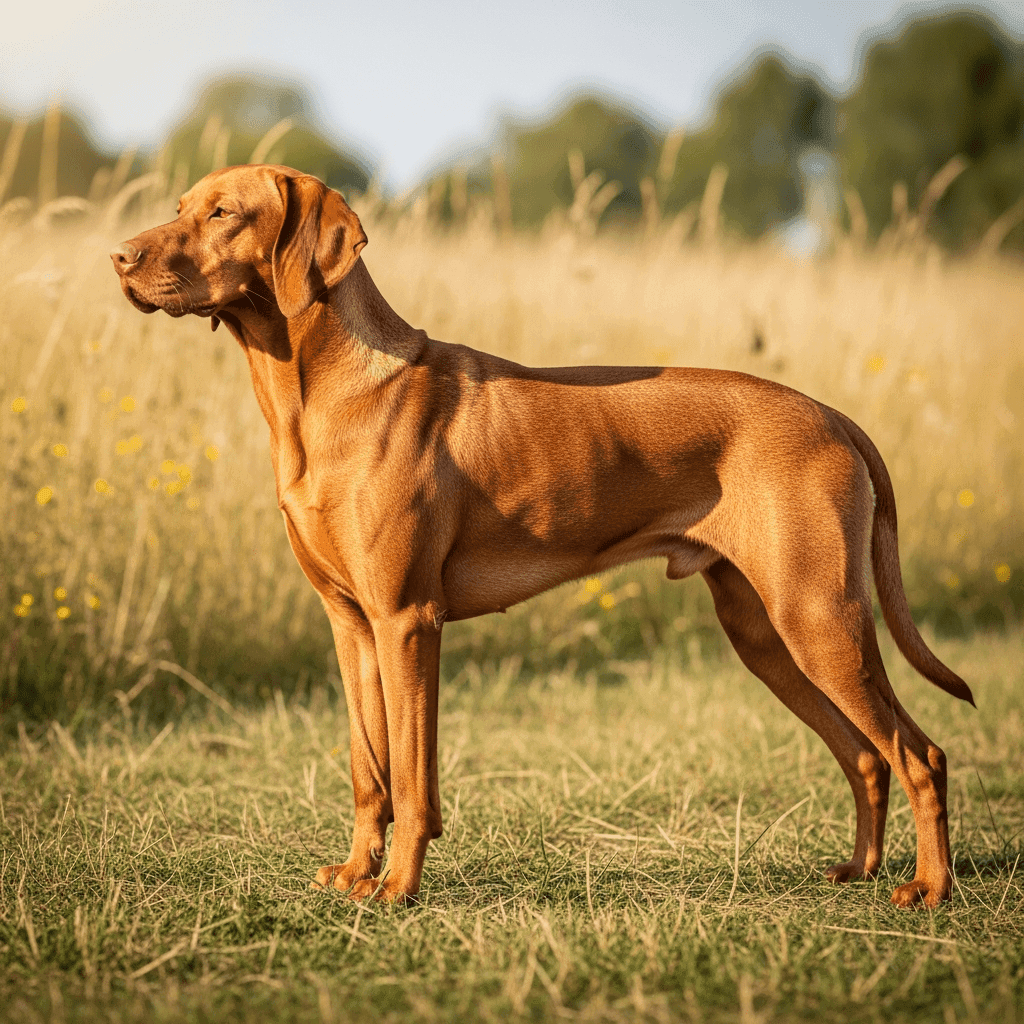
Hungarian Shorthaired Pointer
FCI Group
7• FCI 57
Size
Medium
Origin Country
HU
Height
54-64 cm
Weight
20-30 kg
Lifespan
12-13 years
Temperament
Overview
The Hungarian Shorthaired Vizsla, also known as Rövidszörü Magyar Vizsla, is a medium-sized hunting dog originating from picturesque Hungary. It fascinates with its elegance, versatility, and extraordinary hunting abilities. For centuries, it has enjoyed well-deserved recognition among hunters worldwide, and its popular nickname the golden dog of Hungary reflects the unique character of this breed.
The Hungarian Shorthaired Vizsla is distinguished by its excellent sense of smell, reliable retrieving ability, and determination in tracking scents. It can work in challenging conditions – in dense forests, open fields, and water, making it an indispensable companion for hunters. Its characteristic stance in pointing and enthusiasm for work in any weather conditions testify to its exceptional utility.
In addition to its hunting talents, the Hungarian Shorthaired Vizsla is known for its gentle and balanced temperament. Its friendly nature and natural need to be close to family make it an ideal companion for active owners. Intelligence and a strong motivation to cooperate with humans make it easy to train. This breed cannot stand loneliness – it needs close contact with its family and does not cope well with long periods of being alone.
This breed not only meets the requirements of hunters but also excels as a family and sporting dog. It adapts to various lifestyles as long as it is provided with the right amount of physical and mental activity. Its characteristic reddish-gold, short coat requires no complicated grooming, which is another advantage for busy owners.
The history of Hungarian Shorthaired Vizslas dates back to the Middle Ages. The ancestors of this breed arrived in Hungary with the nomadic Magyar tribes through the Carpathians. This is confirmed by documents and illustrations from the 14th century. In the 18th century, Vizslas gained increasing popularity among the Hungarian aristocracy, and their breeding began to intensify by the end of the 19th century. The first competitions for pointing dogs were already organized during this period. Modern breeding began in 1920, and in 1936, the breed was officially recognized by the FCI.
The Hungarian Shorthaired Vizsla is characterized by a harmonious body structure: a well-muscled back, elegant silhouette, and noble head with beautiful brown eyes that harmonize with its coat color. The activity and energy of this breed make it an excellent partner for running, swimming, trekking, and dog sports. Are you ready to discover more about this exceptional breed? Find detailed information on health, grooming, training, and many other aspects in our comprehensive guide.
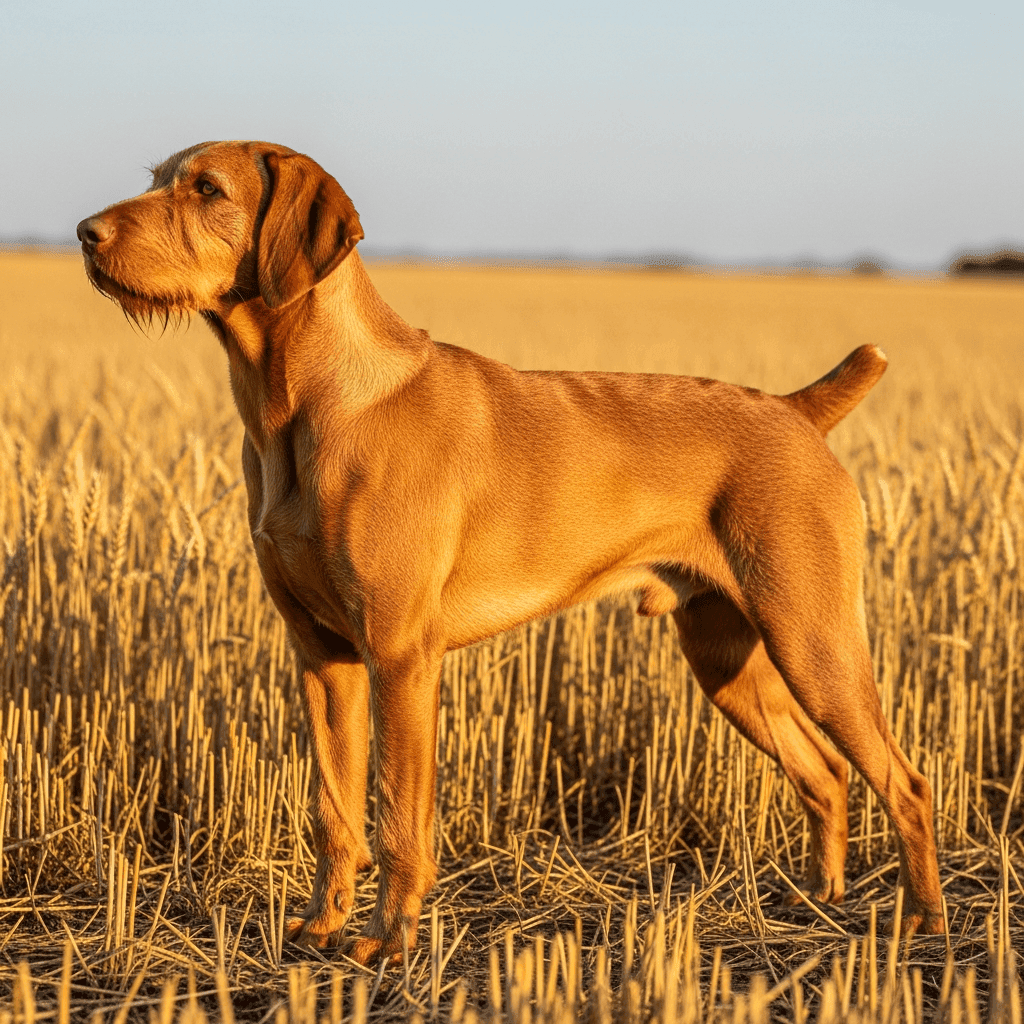
Hungarian short-haired vizslas are characterized by their elegant and harmonious body structure, which reflects their natural strength, agility, and beauty. They are medium-sized dogs with an aristocratic silhouette.
Dimensions and proportions:
- Height at the withers: males 58-64 cm, females 54-60 cm (according to FCI standard)
- Body weight: 20-30 kg, depending on gender and build
- Format: slightly elongated, silhouette slightly rectangular
Coat:
The coat is short, dense, and hard to the touch, lying close to the body. The characteristic coloration is various shades of golden-red (from wheat to dark red-gold). The absence of an undercoat means that the coat is easy to care for, although the dog is more sensitive to extreme temperatures. Small white markings are permissible on the chest and legs, although they are not preferred in show breeding.
Head and expression:
The head of the Hungarian vizsla is dry and noble, with a slightly arched skull and well-developed brow ridges. The muzzle is wide and square, with strong jaws. The eyes are brown (in a shade harmonizing with the coat), slightly oval, with an intelligent and lively expression. The vizsla's gaze is full of attention and devotion. The ears are long, set slightly back on the head, with thin flaps that lie close to the cheeks. The nose is brown and well-developed.
Body structure:
The neck is of medium length, strong, and slightly arched, without a throat, which adds elegance to the dog. The chest is deep and well-muscled, with well-arched ribs. The back is strong and straight, the loins are short and muscular. The tail is set moderately low, tapering towards the end. In motion, it is carried horizontally or slightly raised. In many countries, the tail is docked to 1/4 of its length (in countries where this is legally permitted).
Limbs and movement:
Hungarian vizslas have strong, muscular limbs that provide them with great agility, strength, and endurance. The paws are oval, with well-knit toes and strong pads. The movement is harmonious, free, and covering ground – typical of a hunting dog. In a gallop, they exhibit exceptional speed and flexibility.
Hungarian Vizslas are known for their friendly, balanced, and incredibly devoted temperament. They are dogs with an exceptionally strong bond with their family, who enjoy the presence of people and usually tolerate other animals well.
Main character traits:
- Sociality: Vizslas love being around people, are attached to their family, and do not cope well with loneliness
- Vitality: Their natural energy and enthusiasm make them active and eager to play
- Gentleness: Despite their hunting temperament, they are gentle and patient with children
- Intelligence: They learn quickly and are willing to cooperate with their handler
- Alertness: They carefully observe their surroundings and may initially be wary of strangers
Temperament and behavior:
Hungarian Vizslas exhibit exceptional versatility of character – they can be both energetic working dogs in the field and calm companions at home. Their natural vitality makes them excellent companions for families with children, with whom they can play for hours. At the same time, they possess a natural gentleness that makes them safe for the youngest family members.
Despite their friendly nature, Vizslas can be cautious around strangers, which makes them good watchdogs – they will alert with barking to the approach of unknown individuals. However, they are not typical guard dogs nor aggressive. After getting to know a new person, they usually quickly become friendly.
Social and emotional needs:
Hungarian Vizslas are dogs with very high social needs. They are often referred to as "velcro" dogs because they seek constant physical contact with their owner. They do not tolerate being left alone for long hours – this can lead to separation anxiety and behavioral problems (destruction, excessive barking, obsessive behaviors).
Owners should provide them with:
- Regular social contact and time spent with family
- Physical activity (at least 1-2 hours a day)
- Mental stimulation (training, scent games, tasks to complete)
- Consistent but gentle guidance
This breed is not suitable for people who spend most of the day away from home or prefer a less demanding dog. Hungarian Vizslas need an active, engaged owner who will dedicate time and attention to them.
Hungarian short-haired vizslas are generally a healthy and resilient breed, characterized by longevity. The average lifespan is around 12-14 years, although many individuals can live up to 15 years with proper care.
Most common health issues:
- Hip dysplasia (HD): a genetic condition that can lead to pain and lameness. Responsible breeders perform X-rays and select pairs free from dysplasia.
- Elbow dysplasia (ED): similar to HD, it can cause walking problems.
- Epilepsy: some breeding lines are prone to idiopathic epilepsy.
- Eye defects: cataracts, progressive retinal atrophy (PRA), retinal dysplasia.
- Hypothyroidism: can affect metabolism and coat condition.
- Neoplasms: particularly mast cell tumors and hemangiosarcoma.
Sensitivity to weather conditions:
Hungarian vizslas are relatively resistant to various weather conditions, but the lack of an undercoat makes them more sensitive to extremes. On hot days, they can easily overheat, so owners should:
- Provide access to shade and fresh water.
- Avoid intense training during the hottest hours.
- Monitor for signs of overheating (heavy panting, weakness, vomiting).
On cooler days, vizslas may need protective clothing, especially when spending extended time outdoors. Some individuals are more resistant to cold than others.
Health prevention:
- Regular veterinary visits: annual check-ups and vaccinations.
- Genetic testing: recommended testing for breeders on HD, ED, eye diseases before breeding.
- Weight control: overweight can lead to joint and cardiovascular problems.
- Proper diet: high-quality food tailored to age and activity level.
- Physical activity: regular exercise supports joint health and cardiovascular system.
- Dental care: regular brushing prevents tartar and periodontal disease.
With proper care, a balanced diet, and regular activity, Hungarian vizslas enjoy good health throughout most of their lives.
The care of the Hungarian Vizsla is relatively simple and low-maintenance, thanks to its short, close-lying coat without an undercoat. Nevertheless, regular grooming activities are important for maintaining the dog's health and appearance.
Coat care:
The coat of the Hungarian Vizsla does not require complicated grooming. Recommendations:
- Brushing: 1-2 times a week with a rubber glove or a brush with natural bristles to remove dead hair and stimulate the skin
- Shedding period: shedding is more intense in spring and autumn – daily brushing is recommended for 2-3 weeks
- Bathing: only when necessary (dirty coat, unpleasant odor). Too frequent baths can dry out the skin. 3-4 baths a year with a mild dog shampoo are sufficient
- Dry cleaning: a damp cloth is enough to remove mud after a walk
Ear care:
Vizslas have long, drooping ears, which can be prone to infections. Regular checks are crucial:
- Checking ears 1-2 times a week for redness, unpleasant odor, or discharge
- Cleaning with a special ear solution for dogs (available at the veterinarian)
- Gently drying ears after bathing or swimming
- Never insert cotton swabs deep into the ear
Dental care:
Regular oral hygiene prevents tartar buildup and periodontal disease:
- Tooth brushing: 2-3 times a week with dog toothpaste
- Dental chews: help with mechanical cleaning of teeth
- Veterinary check-ups: professional cleaning as needed
Nail trimming:
Nails should be trimmed every 3-4 weeks if they do not wear down naturally during walks on hard surfaces. Overly long nails can cause discomfort and walking problems. Use a dog nail clipper or seek the services of a groomer/veterinarian.
Paw checks:
After walks, especially in rough terrain, check the paws for:
- Wounds, scratches, or thorns
- Cracks in the paw pads
- Debris between the toes
In winter, it is advisable to apply protective cream to the paw pads against road salt. In summer, check that hot asphalt does not burn the paws.
Thanks to the simplicity of grooming, the short-haired Hungarian Vizsla is an ideal choice for those who appreciate natural beauty without the need for visits to a professional groomer.
Hungarian Vizslas are a very active and energetic breed that requires a significant amount of exercise every day. Their natural energy, endurance, and need for activity make them excellent companions for people leading an active lifestyle. Unmet exercise needs can lead to behavioral problems.
Minimum requirements:
- Time: at least 1-2 hours of intense activity daily
- Type: walks are not enough – vizslas need running, swimming, and playing
- Frequency: ideally 2-3 training sessions daily
- Intensity: activity should be intense enough to tire the dog out
Best forms of activity:
- Running: an excellent jogging partner (distances of 5-15 km with proper training)
- Cycling: an adult vizsla can run alongside a bike on longer routes
- Swimming: most vizslas love water – great exercise for the joints
- Fetching: playing with a ball or frisbee in open spaces
- Mountain trekking: long hikes in the terrain – a paradise for a vizsla
- Scent games: tracking scents, searching for hidden objects (engages the hunting instinct)
Dog sports:
Hungarian vizslas excel in various sports disciplines:
- Agility: obstacle courses that develop agility and cooperation
- Flyball: team play with balls and obstacles
- Canicross: running cross-country with a dog
- Bikejöring: pulling a bike by the dog
- Dog tracking: tracking – ideal for a hunting breed
- Working trials: competitions for hunting dogs
- Nosework: scent work (searching for scents)
Requirements at different ages:
- Puppies (up to 12 months): shorter sessions (15-30 min), avoid jumping and intense running (risk of joint damage). Socialization play and short walks
- Young dogs (1-2 years): gradually increasing intensity and duration of activity
- Adult dogs (2-8 years): full training load, peak condition
- Senior dogs (8+ years): adjusting intensity to fitness, more walks, less running
Mental stimulation:
In addition to physical activity, vizslas need mental stimulation:
- Obedience training and new tricks
- Strategic games (searching for hidden treats, dog puzzles)
- Changing walking routes (new scents and stimuli)
- Scent games and tracking
Consequences of insufficient activity:
A vizsla without enough exercise may exhibit:
- Excessive barking
- Destruction of furniture and objects
- Obsessive behaviors
- Concentration problems during training
- Hyperactivity and difficulty calming down
- Overweight and health issues
Important: The Hungarian Vizsla is not suitable for people who cannot or do not want to dedicate at least 1-2 hours a day to intense activity with their dog. This breed is for truly active owners!
Training a Hungarian Vizsla is usually a pleasure for both the dog and the handler, as this breed is known for its high intelligence, willingness to cooperate, and quick learning abilities. At the same time, Vizslas can be sensitive and require an appropriate approach.
Main features that facilitate training:
- High intelligence: they quickly understand commands and learn new behaviors
- Motivation to work: eagerness to cooperate with humans and receive praise
- Sensitivity: they respond to subtle signals and tone of voice
- Concentration: they can focus on a task for extended periods
- Versatility: they learn various disciplines (obedience, work, sports)
Training methods:
The key to success is positive reinforcement and consistency:
- Rewards: treats, praise, play with a favorite toy
- Consistency: clear rules that apply at all times (not just sometimes)
- Patience: regular, short sessions (10-15 minutes) are more effective than long ones
- Early start: socialization and basics from 8 weeks of age
Important: Brutal methods, yelling, or physical punishment are absolutely inadvisable. Vizslas are sensitive to criticism, and such an approach can lead to:
- Losing trust in the handler
- Fear and uncertainty
- Resistance to training
- Behavioral problems
Basic training (puppies 2-6 months):
- Socialization: contact with various people, dogs, environments, sounds
- House training: learning to relieve themselves outside
- Basic commands: Sit, Lie down, Stay, Here (recall)
- Leash walking: without pulling
- Control of biting: puppies bite everything – learning control
- Being left alone: gradually getting used to short absences
Advanced training (6-18 months):
- Improving obedience: executing commands at a distance and with distractions
- Recall: reliable recall in any conditions (key!)
- Off-leash walking: in a safe environment
- Advanced commands: Fetch, Search, Wait in motion
- Scent work: tracking, nosework
- Introduction to dog sports: agility, flyball
Specialized hunting training:
For Vizslas intended for hunting work:
- Pointing (pointer) – a natural trait requiring training
- Retrieving game from water and land
- Tracking and trailing
- Getting accustomed to gunshots
- Cooperation with the hunter in the field
- Work trials and utility tests
Typical challenges in training:
- Hyperactivity: young Vizslas can be scatterbrained – patience and short sessions are needed
- Strong hunting instinct: may chase birds, cats – requires recall training
- Sensitivity to loneliness: training to be alone should be a priority
- Stubbornness: some individuals may be stubborn – requires consistency
Tips for owners:
- Start training early (from 8 weeks of age)
- Enroll in group classes (socialization + learning from professionals)
- Practice regularly throughout the dog's life (not just as a puppy)
- Use a variety of rewards (not just treats)
- Keep training fun and positive
- Never end a session on a failure – always finish with success
A properly trained Hungarian Vizsla is a reliable partner in any situation – obedient, confident, and ready to cooperate.
A proper diet is crucial for the health, condition, and longevity of the Hungarian Vizsla. Due to its high activity and fast metabolism, this breed requires a balanced diet tailored to its age, weight, and activity level.
Basic nutritional requirements:
- Protein: 25-30% (for active dogs even 30-35%) – builds and repairs muscles
- Fats: 15-20% – source of energy, supports skin and coat health
- Carbohydrates: complex carbohydrates (rice, oats, potatoes) – long-lasting energy
- Vitamins and minerals: a full set for proper body function
- Omega-3 and Omega-6 fatty acids: healthy coat, proper brain function
Types of food:
1. Dry food (kibble):
- Convenient, long shelf life, helps clean teeth
- Choose premium or super premium foods with high meat content
- Avoid foods with fillers (excess corn, wheat)
2. Wet food (cans, pouches):
- Higher moisture content, more palatable
- Can be mixed with dry food
- More expensive option
3. BARF diet (raw meat and vegetables):
- Natural, rich in nutrients
- Requires knowledge and proper balancing
- Consultation with a veterinarian is advisable
4. Homemade food (cooked meat + additives):
- Full control over the composition
- Time-consuming, requires supplementation
Feeding amounts and frequency:
Adult dogs:
- Amount: 300-400 g of dry food daily (depending on weight and activity)
- Meals: 2 times a day (morning and evening)
- Adjustment: active hunting/sport dogs may need more
Puppies (2-12 months):
- 2-4 months: 4 meals a day (food for medium breed puppies)
- 4-6 months: 3 meals a day
- 6-12 months: 2 meals a day (gradually transitioning to adult food)
- Important: do not overfeed! Overweight puppies can lead to dysplasia
Senior dogs (8+ years):
- Senior food with reduced calories
- Additives supporting joints (glucosamine, chondroitin)
- Easier to digest ingredients
Water:
Fresh water must be available at all times! Hungarian Vizslas, especially active ones, need plenty of water:
- Change water daily
- The bowl should be clean
- On hot days or after intense exercise, the dog drinks more
- Take water on walks and training sessions
Treats and rewards:
Treats are useful in training but should make up at most 10% of daily caloric intake:
- Healthy options: dried meat, carrots, apple pieces, natural chews
- Avoid: sugar, chocolate, onions, garlic, grapes (toxic to dogs!)
- Proper dosing: subtract calories from treats from main meals
Weight control:
Overweight is a serious problem leading to:
- Dysplasia and joint problems
- Heart diseases
- Diabetes
- Shortened lifespan
Condition test:
- Ribs should be palpable under a thin layer of fat (not visible!)
- Visible waist seen from above
- Stomach tucked up (seen from the side)
If the dog is gaining weight – reduce portions and increase activity. If in doubt, consult a veterinarian.
Nutrition and activity:
- Do not feed immediately before intense exercise – risk of stomach torsion!
- Wait at least 1-2 hours after feeding before training
- After exercise, allow the dog to calm down before feeding (30 minutes)
A properly balanced diet is the foundation of health, energy, and long life for the Hungarian Vizsla.
Characteristic Traits
Pros
- Gentle and friendly nature
- High intelligence and ease of training
- Versatility in hunting and sports
- Minimal grooming requirements
- Excellent sense of smell and hunting instinct
- Loyalty and devotion to family.
Cons
- Requires a lot of movement and activity
- Struggles with loneliness and long separations
- May be too energetic for less active families
- Needs consistent and regular training
- Sensitive to extreme temperatures
- Strong hunting instinct may lead to chases.
Behavioral Ratings
Breed History
The history of the Hungarian Vizsla dates back to over a thousand years ago, making it one of the oldest hunting breeds in Europe. Its roots are deeply connected to the history of Hungary and the nomadic Magyar tribes.
The beginnings of the breed – arrival in Hungary (9th-10th century):
The ancestors of modern Hungarian Vizslas arrived in Hungary with nomadic Magyar tribes that traversed the Carpathians in the 9th and 10th centuries. These tribes led a hunting lifestyle and needed versatile dogs for hunting – fast, durable, and obedient. These early hunting dogs were the ancestors of today's Vizslas.
The Middle Ages – first mentions (14th century):
The oldest written descriptions and illustrations of dogs resembling Vizslas come from the 14th century. Documents from this period depict dogs of similar build, used by the Hungarian aristocracy for hunting. The breed was valued by the nobility and magnates, allowing it to survive through the centuries.
Development of the breed (18th-19th century):
In the 18th century, the significance of Hungarian Vizslas as hunting dogs began to steadily increase. The Hungarian nobility took care of breeding, striving to maintain the purity of the breed and its unique working traits. By the end of the 19th century, the first pointer dog competitions were organized, where Hungarian Vizslas achieved success. During this period, the breed began to be consciously shaped according to specific standards.
Modern breeding (20th century):
The true beginning of modern breeding of Hungarian short-haired Vizslas took place in 1920, after the end of World War I. Hungarian breeders began systematic work on the reconstruction and standardization of the breed, which had suffered during the war.
In 1936, the Fédération Cynologique Internationale (FCI) officially recognized Hungarian short-haired Vizslas as a separate breed, marking a milestone in its history. The FCI standard (No. 57) described the breed's characteristic features: build, temperament, and working abilities.
World War II – threat of extinction:
During World War II, the breed was on the brink of extinction. The fighting in Hungary, destruction, and economic difficulties led to a drastic decline in population. After the war, Hungarian breeders made heroic efforts to rebuild the breed from the few surviving individuals.
International expansion (1950s-1970s):
In the 1950s and 1960s, Hungarian Vizslas began to gain popularity outside of Hungary:
- United States: the first Vizslas arrived in the USA in the 1950s, quickly gaining recognition among hunters
- Western Europe: expanded breeding in Germany, Austria, the United Kingdom
- Australia and Canada: growing popularity as hunting and companion dogs
Modern times (21st century):
Today, the Hungarian short-haired Vizsla is valued worldwide both as a hunting dog and a companion. The breed is popular in:
- Hunting: used for hunting waterfowl and forest game
- Dog sports: agility, flyball, canicross, working trials
- Families: as an active, loyal companion
The breed's population is stable, and breeding is conducted according to high health and working standards. Hungarian Vizslas regularly achieve success in shows, working trials, and dog sports.
Historical curiosities:
- The name Vizsla comes from the Hungarian word meaning tracking/searching
- The rusty-golden coat color has been a distinguishing feature of the breed for centuries
- In the Middle Ages, Vizslas were dogs exclusively for the aristocracy – peasants were not allowed to own them
- There is also a wire-haired Hungarian Vizsla (Drótszörü Magyar Vizsla) – a separate breed developed in the 20th century by crossing with the German wire-haired pointer
The Hungarian short-haired Vizsla is a living monument to thousand-year Hungarian breeding tradition – a breed that has survived wars, crises, and political changes, preserving its unique working traits and character. Today, it is a national treasure of Hungary and one of the most versatile hunting breeds in the world.