Irish Setter
FCI Group
7• FCI 120
Size
Medium
Origin Country
IE
Height
55-67 cm
Weight
24-32 kg
Lifespan
12-14 years
Temperament
Overview
The Irish Setter, known worldwide as the Irish Red Setter, is one of the most recognizable and spectacular hunting dog breeds, attracting attention with its distinctive, intense chestnut-red coat reminiscent of mahogany and its elegant, athletic silhouette full of grace and power. Originating from the green Ireland, this magnificent hunting dog has enjoyed immense popularity since the 18th century as a reliable companion for hunters specializing in tracking and pointing game, as well as a loving family member endowed with a unique temperament and devotion.
Its energy, boundless enthusiasm for life, and extremely friendly disposition make it an excellent choice for active families who enjoy spending time outdoors, engaging in sports, and going on long hikes. The FCI standard describes the Irish Setter as racy and athletic - sleek and athletic, full of class, with a friendly expression. These words perfectly capture the essence of this breed - a combination of beauty, endurance, and good character.
By nature, the extremely lively, full of life, and almost inexhaustible energy Irish Setter requires regular, intense physical activity and constant mental stimulation. This is not a dog for people leading a sedentary lifestyle or preferring short walks around the block. Owners must provide it with appropriate conditions to run, explore the terrain, play, and work. At least 2 hours of intense exercise daily is the absolute minimum for a happy and balanced Irish Setter.
Its innate intelligence, natural curiosity about the world, and strong desire to cooperate with humans make it a relatively easy dog to train, although it may sometimes display a certain stubbornness or independence of thought - a trait typical of hunting dogs that must make independent decisions in the field. The key to success in training an Irish Setter is patience, consistency, and a positive approach - this breed is sensitive and does not respond well to harsh methods or coercion.
The Irish Setter gets along great with children and is known for its patience and gentleness towards the youngest family members. It is also sociable with other dogs and enjoys playing with its four-legged friends. However, its vivacity and high energy may be too intense for very small children (under 5-6 years), who might get accidentally knocked over during enthusiastic play. Therefore, interactions with the youngest children should always be supervised.
Despite its friendly and gentle nature, the Irish Setter may bark excessively if not properly occupied and becomes bored. A bored Setter is a destructive Setter - it may start chewing furniture, digging holes in the garden, or seeking its own entertainment. Therefore, it is important to offer it plenty of stimuli for play, learning, and work.
This breed also requires regular and systematic grooming. The long, silky coat of the Irish Setter should be brushed at least 2-3 times a week (daily during heavy shedding) to prevent matting, tangling, and excessive dirt accumulation. With proper grooming, its coat will be shiny, healthy, and spectacular - a true adornment of the breed.
The Irish Setter feels best in homes with a large, fenced garden, where it has plenty of space to run freely, explore, and play. Living in a small apartment without access to regular, long walks and open spaces will be insufficient for it and may lead to behavioral problems. Its need for movement and friendly, loving personality make it an ideal dog for active families who can dedicate a lot of time, attention, and commitment to it.
In return for attention, care, and love, the Irish Setter rewards with absolute loyalty, devotion, and boundless love, making the lives of its owners full of joy, laughter, and unforgettable moments. Its lifespan, ranging from 12 to 14 years (and sometimes even longer with proper care), attests to its relatively good health, provided it receives a proper diet, regular exercise, and routine veterinary check-ups.
The Irish Setter is a dog for true enthusiasts - for those who desire an active, intelligent, beautiful companion ready to share every adventure with them, whether hunting, on long hikes in the mountains, or simply during family weekends in nature.
The Irish Setter is a dog with a noble, racing, and athletic silhouette that exudes class, elegance, and strength at the same time. The FCI standard emphasizes that it should be balanced and in proportion - balanced and proportional in every aspect of its build. It is a medium to large-sized dog, with a height at the withers of:
- Males: 58-67 cm (ideal height around 62-65 cm)
- Females: 55-62 cm (ideal height around 57-60 cm)
The body weight usually ranges from 27-32 kg for males and 24-29 kg for females, although weight may vary depending on the dog's build and condition. It is important for the Irish Setter to be slim, muscular, and athletic - it should not be too thin or too heavy.
The head of the Irish Setter is long and slender, not thick at the ears. The muzzle and the brain part of the skull are of equal length and are on parallel lines - this is a very important proportion defined in the FCI standard. The skull is oval (from ear to ear), with a large brain space and a clearly defined occipital bump. The stop (the transition from the skull to the muzzle) is well defined.
The nose is dark - mahogany, dark chestnut, or black, with widely opened nostrils. The nose should be moist and cool, indicating good health. The muzzle is moderately deep, quite square at the end, with clearly defined lips that are well fitting and not hanging.
The eyes of the Irish Setter are dark chestnut or dark brown, oval in shape, neither protruding nor deeply set. They have a smart, friendly, and gentle expression, which is one of the breed's distinctive features. The eyes reflect the Setter's temperament - full of life, curious, yet gentle and sensitive.
The ears are medium-sized, thin, set rather low and far back on the head, hanging in soft folds close to the head. The ears are covered with long, silky hair, creating beautiful fringes. The length of the ears - when stretched - should reach approximately to the nose.
The neck is moderately long, very muscular, but not thick, slightly arched, without a throat (loose skin under the neck). The elegant line of the neck harmoniously transitions into well-sloped shoulders, emphasizing the dog's athletic silhouette.
The body is proportional and athletic:
- The chest is deep (reaching to the elbows or slightly below), quite narrow at the front, which allows freedom of movement while running. The ribs are well arched, providing ample space for the lungs and heart.
- The back is strong, straight, and muscular.
- The loins are muscular and slightly arched.
- The croup is wide, strong, and muscular, slightly sloping from the hips to the base of the tail.
The front limbs are long, straight, well-defined, and muscular, with well-developed bones. The shoulders are long and well sloped. The elbows hang freely along the body, not turned outward or pressed inward. The paws are small, very compact, with strong toes that are well arched and compact.
The hind limbs are wide, strong, and muscular:
- The thighs are long, muscular, and well developed.
- The knee joints are well bent.
- The hock joint is set low, not too bent.
- The hind paws are small, compact, similar to the front ones.
The tail is set rather low (in line with the back or slightly below), of moderate length, proportional to the body size. The tail is carried at the level of the back or below, never above. It is abundantly feathered with long, silky hair, creating a spectacular plume. When in motion, the tail is in constant, joyful movement - a characteristic feature of the Irish Setter.
The movement of the Irish Setter is free, fluid, graceful, and energetic. During walking, the front limbs are raised high, adding elegance to the movement. During a gallop, the Setter moves with great speed and efficiency, covering large distances with ease. The movements are light, springy, and full of vigor - typical of a racing and athletic dog.
The coat of the Irish Setter is one of the most distinctive features of the breed:
- On the head, front sides of the limbs, and tips of the ears, the coat is short and dense.
- On the remaining parts of the body, the coat is of medium length, smoothly fitting, free of waviness or curl.
- On the ears, chest, belly, back of the front limbs, back of the thighs, and tail, the coat is long, silky, and creates beautiful feathering.
- There is also hair between the toes.
The coat should be silky to the touch, shiny, and healthy. It should not be too soft or fluffy - it should have a natural sheen and smoothness.
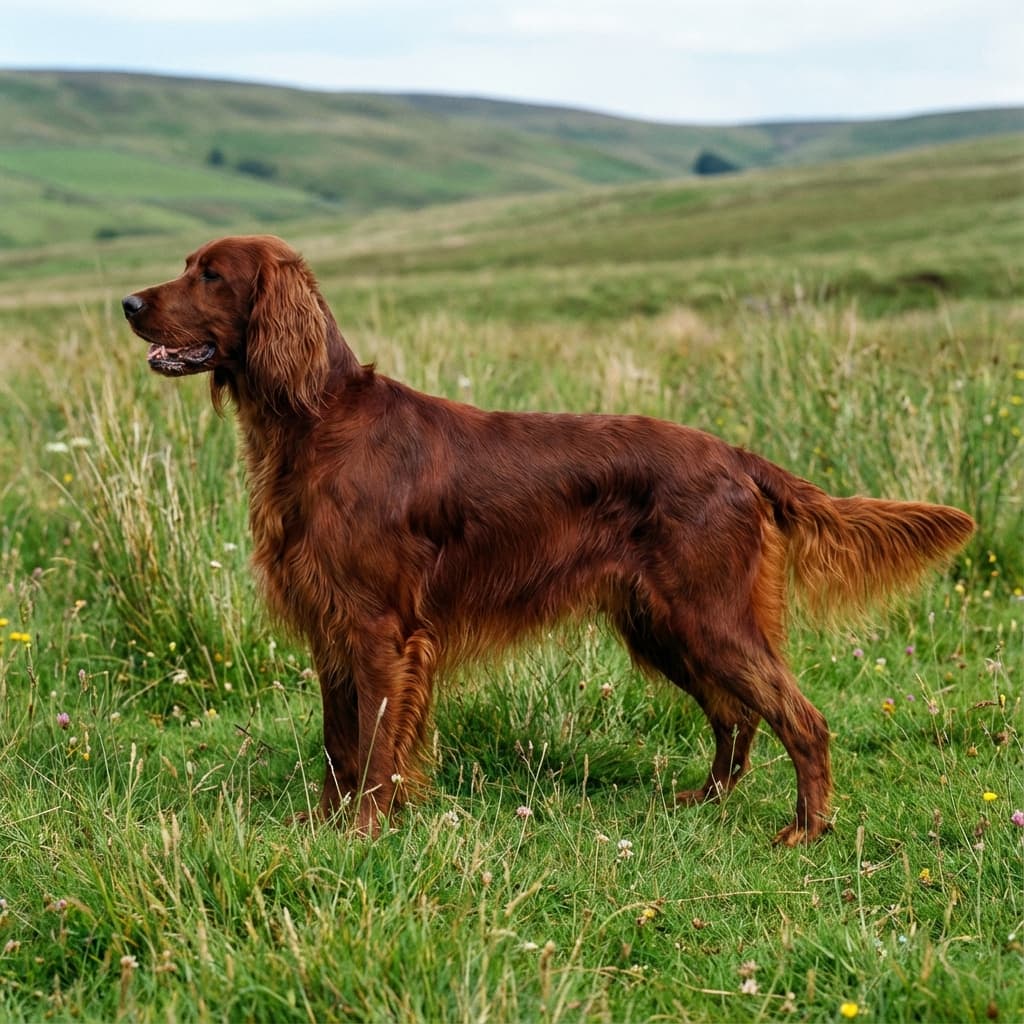
The color of the Irish Setter is its trademark - intense chestnut-red color (chestnut, mahogany red) without any black hairs. Small white markings are permissible:
- A white star on the forehead.
- A white stripe on the nose or face.
- Small white marking on the throat.
- White markings on the chest.
- White toes.
However, the fewer white markings, the better - the most desirable is a solid, intense chestnut-red coat without any white hairs. This spectacular color, combined with long, silky hair and an athletic silhouette, makes the Irish Setter look not only elegant and noble but also absolutely unique - a true ornament of the hunting dog world.
The Irish Setter is a dog with a remarkably friendly, energetic, and lively disposition, which is a true joy for its family. The FCI standard describes the breed's temperament as keen, intelligent, energetic, affectionate, and loyal - alert, intelligent, energetic, affectionate, and loyal. These words perfectly capture the essence of the Irish Setter's character - a combination of enthusiasm, intelligence, and deep attachment to people.
It is very sociable and loves spending time with people - family is everything to it. The Irish Setter is not a dog that can live in isolation or stay alone for long - its nature requires constant contact with beloved people and participation in family life. Long periods of solitude can lead to separation anxiety, excessive barking, and destructive behaviors.
It shows great loyalty to its family and is willing to do anything to spend time with them. This is not a dog that will be satisfied with being in the background of family life - the Irish Setter wants to be at the center of events, participating in all activities and being close to its people at all times.
Despite its vivacious and energetic character, the Irish Setter is also very emotionally sensitive, which means it does not respond well to harsh training methods, yelling, or coercion. It needs a gentle, patient, and positive approach - scolding or a heavy hand can break its spirit and destroy the natural joy of life that is the essence of this breed.
This breed is known for its strong hunting instinct - it was bred as a pointing dog (pointer/setter), so it will naturally track scents, point at birds, and react to the movement of small animals. This can lead to it chasing after birds, squirrels, cats, or other small animals during walks. For this reason, it is important for the Irish Setter to be well-socialized from puppyhood and to have appropriate recall and impulse control training.
Despite its lively temperament and high energy, the Irish Setter is very friendly and patient with children, making it an excellent companion for families with kids. It enjoys playing together, is gentle, and tolerant. However, due to its size and exuberance, it may accidentally knock over very small children (under 5-6 years old) during enthusiastic play or greetings. Therefore, interactions with the youngest children should always be supervised.
The Irish Setter gets along great with other dogs and is very sociable with its four-legged friends. It loves playing, running, and frolicking with other dogs. Its friendly disposition means it rarely shows aggression or dominance towards other dogs. When it comes to other pets (cats, rabbits), early socialization is crucial - without it, the hunting instinct may take over.
This breed is also known to be prone to destructive behaviors if it does not receive enough physical and mental stimulation. A bored Irish Setter is an unhappy Setter that will seek its own entertainment:
- Chewing furniture, shoes, cushions
- Digging holes in the garden
- Excessive barking or howling
- Jumping over fences in search of adventures
- Distracting attention and difficulty concentrating
Therefore, it is absolutely crucial to provide the dog with adequate amounts of activity, tasks to perform, and mental stimulation. A tired Irish Setter is a happy, calm, and well-behaved dog at home.
The Irish Setter is a dog that loves to be the center of attention and enjoys entertaining its family with its antics, funny behavior, and boundless enthusiasm for life. Its joyful, lively, and almost childlike character makes it a wonderful companion that brings joy, laughter, and positive energy into the home.
When it comes to strangers, the Irish Setter is usually friendly but may be a bit cautious upon first contact. This is not an aggressive or overly territorial breed - after a brief moment of realizing that the person poses no threat, it quickly becomes friendly and may try to make contact. This is not a typical guard dog - it may alert with barking at the arrival of strangers, but rather out of curiosity and a desire to greet than out of defensive aggression.
Proper upbringing, consistent training based on positive reinforcement, appropriate socialization, and above all, a huge amount of love, attention, and quality time spent together will help develop a balanced, obedient, and happy Irish Setter that will be an excellent companion for its family for many wonderful years.
The Irish Setter is a breed of dog that generally enjoys relatively good health, with an average lifespan of 12 to 14 years, which is quite a good result for a medium to large-sized dog. Some Irish Setters can live even longer - up to 15 years - with proper care, diet, and regular exercise. However, like any breed, Irish Setters can be prone to certain health issues that potential owners should be aware of.
Hip Dysplasia (HD) is one of the most common orthopedic problems that can affect Irish Setters. It is a hereditary condition characterized by the abnormal formation of the hip joint, which can lead to pain, limping, arthritis, and limited mobility. Responsible breeders conduct hip X-ray examinations of the parents before allowing them to breed, significantly reducing the risk of this issue in the offspring. When purchasing a puppy, it is always worth asking about the HD test results of the parents.
Epilepsy is a neurological condition that can occur in Irish Setters. It manifests as seizures of varying severity. It can be hereditary or acquired. Epilepsy usually appears between 6 months and 3 years of age. Although it is not curable, it can be effectively controlled with anticonvulsant medications, allowing the dog to lead a normal life.
Gastric Dilatation-Volvulus (GDV) is a potentially life-threatening condition that large dogs with deep chests, including Irish Setters, are at risk for. Bloating occurs when the stomach fills with gas and may twist (gastric torsion), cutting off blood supply. It is a medical emergency requiring immediate veterinary intervention. Symptoms of bloating include:
- Restless behavior, pacing
- Enlarged, hard, drum-like abdomen
- Attempts to vomit without success (unproductive vomiting)
- Heavy, shallow breathing
- Excessive drooling
- Weakness, pale gums
To minimize the risk of bloating, it is advisable to: divide the daily meal into 2-3 smaller portions instead of one large one, avoid intense exercise immediately before and after meals (wait at least an hour), avoid giving large amounts of water immediately after meals, and use slow-feeding bowls if the dog eats too quickly.
Progressive Retinal Atrophy (PRA) is a hereditary eye condition that leads to gradual vision loss and ultimately blindness. The first symptom is usually night blindness - the dog has difficulty seeing in low light. There is no treatment for PRA, but dogs can adapt to vision loss. Responsible breeders conduct genetic testing on the parents to exclude carriers of the PRA gene.
Hypothyroidism is a hormonal condition that can occur in Irish Setters. Symptoms include:
- Weight gain on a normal diet
- Lethargy, lack of energy
- Skin problems - dry, flaky skin
- Hair loss, thin coat
- Sensitivity to cold
This condition is easy to diagnose (blood test) and treat (regular thyroid hormone supplementation).
Food and skin allergies can affect Irish Setters. This breed may show sensitivity to wheat and certain grains, which can lead to digestive issues, itchy skin, redness, ear infections, or hair loss. Identifying the allergen through an elimination diet and switching to an appropriate food usually resolves the issue.
Ear infections are quite a common problem in Irish Setters due to their long, drooping ears that restrict airflow. Moisture and heat in the ear canal promote the growth of bacteria and fungi. Owners should regularly check and clean their dog's ears (at least once a week), especially after swimming or walks in wet conditions.
Osteosarcoma (bone cancer) can sometimes occur in Irish Setters, particularly in older dogs. It is an aggressive cancer that typically affects the long bones of the limbs. Symptoms include limping, pain, and swelling. It requires immediate veterinary consultation.
Hemophilia A is a rare, hereditary blood clotting disorder that can occur in Irish Setters. Dogs affected by this condition have prolonged clotting times, which can lead to excessive bleeding after injuries or surgical procedures.
With their athletic build and natural endurance, Irish Setters are very resilient dogs that can run over challenging terrain for hours without tiring. They can thrive in various weather conditions - both in warm and relatively cold weather (although their long coat requires drying after wet conditions).
It is important to provide the dog with:
- An adequate amount of exercise - which not only improves physical condition but also supports mental health and maintains a healthy body weight
- Proper nutrition - high-quality food tailored to age and activity level
- Avoiding obesity - excess weight can lead to health problems (joint strain, cardiovascular issues, diabetes)
- Regular veterinary visits - at least once a year, twice a year for older dogs
- Vaccinations and deworming - according to the veterinarian's recommendations
- Parasite prevention - ticks, fleas (especially important for dogs spending a lot of time outdoors)
Proper diet, regular exercise, and health monitoring by a veterinarian are crucial for keeping an Irish Setter in excellent condition for many wonderful years. With appropriate care, Irish Setters can enjoy a long, healthy, and active life alongside their loving owners.
The care of the Irish Setter is an essential and regular element of maintaining the health, comfort, and spectacular appearance of this dog. Their long, silky coat, while beautiful and distinctive, requires systematic attention and time to keep it in excellent condition. The Irish Setter is not a breed that requires minimal grooming - owners must be prepared for regular work with the dog's coat.
Brushing is absolutely fundamental to the grooming of the Irish Setter. Their coat is long on the ears, chest, belly, back of the legs, and tail, and shorter but dense on the head and front legs. To avoid matting, tangling, and knots, it is recommended to brush at least 2-3 times a week, and during periods of heavy shedding (spring and autumn) daily.
When brushing, special attention should be paid to:
- The fur on the ears - the hair here is very long and silky, easily tangles
- The fur on the chest and belly - long fur collects dirt, leaves, and knots
- The back of the front legs - the fur can felt
- The back of the thighs and hocks - long fur requires thorough combing
- The tail - the spectacular fur easily tangles
- Between the toes - the fur can accumulate dirt, ice (in winter), grass seeds
It is worth using the right tools:
- Brush with metal pins (pin brush) - for daily brushing
- Comb with wide teeth - for detangling knots and long fur
- Slicker brush - for removing dead hair during shedding
- Detangling spray - helps with difficult knots
After walks, especially in the woods or on meadows, it is advisable to check the dog's coat for leaves, twigs, debris, thorns, grass seeds (fish bones), or other remnants. Fish bones can embed in the skin and cause infections, so they should be removed immediately.
Bathing the Irish Setter should be done as needed, usually every 6-8 weeks or more often if the dog works intensively in the field, swims, or collects a lot of dirt. A high-quality shampoo for long-haired dogs should be used, which will not dry out the skin or coat. After shampooing, it is worth applying a dog conditioner that:
- Facilitates detangling the fur
- Gives the fur shine and silkiness
- Prevents static electricity in the hair
- Nourishes the fur and skin
It is very important to thoroughly rinse out all cosmetics, as residues of shampoo or conditioner can cause skin irritation, itching, and dullness of the coat. After bathing, the dog should be thoroughly dried, especially the long fur on the ears, chest, and legs. A hairdryer (on low heat) can be used while brushing the coat - this will give it a beautiful shine and volume.
However, one should avoid too frequent washing, as it can lead to drying out the skin and coat and disrupting the natural lipid barrier. If the dog is slightly muddy, it is often sufficient to wait for the mud to dry and then brush it out.
Trimming (cutting the fur) on Irish Setters is usually minimal - the breed should have a natural appearance. However, some owners choose to lightly trim:
- The fur between the paw pads - to prevent the accumulation of mud, ice, or seeds
- The fur under the ears near the ear canal - for better ventilation and hygiene
- The fur around the anus - for hygiene purposes
Show dogs may require more advanced trimming to highlight the silhouette lines according to the breed standard.
Ears require special attention. Long, drooping ears covered with abundant fur restrict airflow to the ear canal, creating ideal conditions for the growth of bacteria and fungi. It is necessary to regularly check and clean the ears (at least once a week), using veterinary ear cleaning products. Symptoms of ear problems include:
- Unpleasant odor from the ears
- Redness and swelling of the ear canal
- Excessive wax production or purulent discharge
- The dog frequently shakes its head or scratches its ears
- Pain when touching the ears
After any swimming or walking in the rain, it is essential to clean and dry the ears to prevent infections.
Nails should be regularly trimmed, usually every 3-4 weeks, to prevent them from becoming too long. Overly long nails can cause discomfort while walking, posture problems, pain, and even joint damage. If you can hear the nails clicking on the floor while walking, it means they are too long. It is advisable to get the dog used to nail trimming from a puppy.
Dental hygiene is also important to prevent dental problems (tartar, gingivitis, cavities, tooth loss). It is recommended to brush the teeth 2-3 times a week using dog toothpaste (NEVER use human toothpaste - fluoride is toxic to dogs). Dental chews and cleaning toys can also be used as a supplement.
After hunting or long walks in the field, it is necessary to thoroughly check the entire body of the dog, especially:
- Ears - ticks often hide there
- Paws - check the pads, spaces between the toes, nails
- Coat - look for ticks, fish bones, thorns
- Skin - check for minor wounds, abrasions, bites
- Eyes - check for redness, discharge
The long coat of the Irish Setter can collect various debris and parasites, so thorough inspection after every walk is important for the dog's health.
Maintaining the good condition of the coat and skin not only improves the dog's appearance and makes its spectacular chestnut-red color shine in the sun but also positively affects its health and well-being. Regular grooming is also an excellent opportunity to check the overall health of the dog - during brushing, lumps, wounds, skin changes, ticks, or other concerning symptoms can be detected.
Thus, grooming the Irish Setter is an important aspect of responsible ownership of this breed, which requires regularity, consistency, and time, but in return provides a beautiful, healthy, and spectacular-looking companion - a true adornment that attracts attention wherever it appears.
The Irish Setter is a dog with a very high energy level and intense exercise needs, requiring a significant amount of physical effort and mental stimulation to remain healthy, happy, and mentally balanced. This breed is not suitable for people leading a sedentary lifestyle, preferring short walks, or spending most of their time at home. The Irish Setter is a full-blooded working dog that was bred for intensive, multi-hour work during hunts and needs appropriate outlets for its energy.
It is recommended to provide the Irish Setter with at least 2 hours of intense physical exercise daily, but in reality, many setters need significantly more - 3-4 hours is not uncommon for a young, energetic setter. Properly meeting its exercise needs is absolutely crucial for its physical and mental health and good behavior at home.
An ideal daily activity plan should include:
- Long walks - a minimum of 1.5-2 hours a day, divided into 2-3 outings (morning, noon, evening)
- Running - jogging with the owner, running alongside a bike (for adult dogs)
- Free running in a safe, fenced area where the dog can be off-leash and run freely
- Playtime in the park with other dogs - socialization and energy release
- Fetching - ball, frisbee, dummy, sticks (setters love to fetch!)
- Swimming - excellent exercise that engages the whole body without stressing the joints
- Hiking on uneven terrain - forests, hills, mountains, beaches
The Irish Setter thrives in the company of other dogs, so playing with other canines is very beneficial for it - not only physically but also socially. It loves to chase, wrestle, and play with its dog friends. Visits to the dog park or organizing playdates with other dogs are great ways to release energy and develop social skills.
It is also worth providing the dog with varied forms of activity to satisfy its need for movement and mental stimulation:
- Swimming - Irish Setters often love water and are natural swimmers
- Frisbee - a great game that engages both body and mind
- Agility - an obstacle course ideal for athletic setters
- Flyball - a competitive sport for fast and energetic dogs
- Canicross - running with the dog in a harness
- Bikejoring - the dog pulls the bike (for adult, strong dogs)
- Mountain hiking - setters love long, multi-hour trips
- Hunting training - dummy work, tracking, pointing (even if we don't hunt, we can train natural instincts)
Due to its strong hunting instinct, the Irish Setter may chase after game (birds, squirrels, rabbits), so it is important to:
- Have a properly secured area (fenced yard at least 150-180 cm high)
- Be trained in recall and disengagement
- During walks in open areas, be on a long training leash (10-15 m) until perfect recall is mastered
- The owner should be aware that instincts can take over and the dog may chase something interesting
However, physical activity alone is not enough - mental stimulation is equally important. Irish Setters are intelligent and need tasks to perform, problems to solve, and new things to learn. Without appropriate mental challenges, they can quickly become bored. Therefore, it is worth incorporating into the daily routine:
- Obedience training - short, regular sessions (10-15 minutes, 2-3 times a day)
- Learning new tricks - setters love to learn and show off their skills
- Scent games - hiding treats or toys that the dog must find
- Dog puzzles - interactive toys that require problem-solving to get a reward
- Nosework training - utilizing natural scenting abilities
- Variability in routines - changing walking routes, new environments, new scents
Regular exercise is extremely important to prevent boredom and frustration, which can lead to destructive behavior. A bored Irish Setter is an unhappy setter that will seek its own entertainment:
- Barking or howling excessively (especially when alone)
- Chewing furniture, shoes, pillows, carpets
- Digging holes in the garden
- Trying to escape from the yard (jumping over fences, digging under the fence)
- Exhibiting separation anxiety
- Becoming hyperactive, nervous, or difficult to manage
- Developing obsessive behaviors (chasing its own tail, licking paws)
A tired Irish Setter is a happy, calm, and well-behaved dog at home - this is the golden rule for this breed. After the appropriate amount of exercise and stimulation, the setter is happy to rest at home, calm and pleasant to be around.
Important exercise notes:
- Puppies and young dogs (up to 12-18 months) should not be subjected to too intense exercise - their joints, bones, and growth plates are still developing. Shorter, more frequent sessions (5-10 minutes several times a day) are better than long, exhausting walks. Avoid jumping, intense running on hard surfaces, or running alongside a bike until full skeletal maturity
- On hot days (above 25-28°C), avoid intense exercise during the hottest part of the day - it's better to walk early in the morning (5-7) and late in the evening (20-22). Irish Setters have long, dark coats that absorb heat, making them prone to overheating
- In winter, setters usually tolerate the cold well due to their long fur, but on very frosty days (below -15°C), long walks may require additional protection
- After meals, wait at least 60-90 minutes before intense exercise to reduce the risk of stomach bloat
- Access to water - always provide fresh water after exercise, especially on warm days
The Irish Setter feels best in homes with a large, fenced yard, where it can run freely, explore, and play for most of the day. Living in a small apartment without access to regular, long walks and open spaces will be insufficient and may lead to serious behavioral problems.
Properly meeting the exercise and mental needs of the Irish Setter not only improves its physical condition and health but also strengthens the bond with the owner and makes the dog happy, balanced, obedient, and pleasant in daily life. For the right owner - active, energetic, and willing to dedicate several hours a day to activities with the dog - the Irish Setter will be a wonderful, loyal companion in every adventure.
The training of an Irish Setter can be both a great pleasure and a certain challenge, depending on the owner's approach, consistency, and understanding of the breed's character. This breed is intelligent, eager to learn, and loves to work with humans, which makes it potentially easy to train. However, due to its emotional sensitivity, independent thinking (typical of hunting dogs), and sometimes stubbornness, they do not respond well to harsh training methods.
Therefore, it is absolutely crucial to approach training with patience, understanding, consistency, and a positive attitude. Scolding, yelling, a heavy hand, or coercion can break the spirit of the Irish Setter, destroy its natural joy of life and willingness to cooperate, and make it insecure, fearful, or even avoid contact.
Starting training from an early puppy age is absolutely key to success. The earlier we begin training and socialization, the better results we will achieve. Irish Setter puppies should be:
- Socialized from 8-16 weeks of age - exposed to various stimuli, people (of different ages, appearances), animals (dogs, cats, others), environments (city, village, forest, beach), sounds (cars, children, fireworks), surfaces (grass, concrete, sand, water)
- Taught basic commands - sit, lie down, come, stay, no, leave it, heel
- Accustomed to leashes, collars, harnesses, muzzles
- Trained in cleanliness - regular outdoor outings, rewarding for relieving themselves in the appropriate place
- Taught appropriate boundaries - what is allowed (toys, bed) and what is not (furniture, shoes, food from the table)
- Accustomed to grooming - brushing, touching paws, ears, mouth, bathing
Training methods should be based solely on positive reinforcement, which means rewarding desired behaviors rather than punishing unwanted ones. Irish Setters are sensitive and respond well to:
- Treats - as an immediate reward for following a command (small, soft treats are best)
- Verbal praise - enthusiastic, cheerful, high-pitched tone of voice (Good job! Good dog! Awesome!)
- Play - a favorite toy or a short game as a reward (for many setters, play is as motivating as food)
- Petting and affection - physical contact as a sign of approval
It is absolutely essential to avoid harsh punishments, yelling, tugging on the leash, or any physical violence, as they can destroy the dog's trust, cause fear, and make the dog insecure, frightened, or even defensively aggressive. Irish Setters want to cooperate and please their owners - they do not need a heavy hand, but rather clarity, consistency, and patience.
It is worth starting at a young age to teach the dog basic commands and social skills. A puppy aged 8-12 weeks is like a sponge - absorbing knowledge, scents, experiences. This is a critical socialization window that will never repeat. A dog that has been properly socialized as a puppy will be a confident, balanced adult dog.
Regular training sessions, which are short (10-15 minutes), but intense and engaging, will be more effective than long, monotonous exercises. Irish Setters quickly get bored if training is repetitive and dull - their intelligence requires challenges and variety. Therefore, it is worth:
- Diversifying training - changing locations (home, garden, park, forest), commands, rewards
- Ending on a success - always finish a session on a positive note when the dog has done something well
- Maintaining enthusiasm - the dog responds to our energy and mood; if we are bored, the dog will be too
- Training daily - short, regular sessions (2-3 times a day for 10-15 minutes) are better than occasional long ones
- Introducing elements of fun - for the setter, training should be fun, not work
The Irish Setter loves spending time with people, making training sessions an opportunity for fun and bonding. This breed is also playful and has a sense of humor, so incorporating game elements into training can yield great results.
It is important to remember that Irish Setters can be a bit stubborn and independent - this is not a working obedience breed (like a border collie or German shepherd) that lives to follow commands. Setters were bred for independent work in the field, making decisions, and exploring. Sometimes they may question commands or seem distracted. This is not disobedience - it is simply their nature. Therefore, it is worth using positive reinforcements and motivation to encourage the dog to cooperate.
Key commands that every Irish Setter should know perfectly:
- Come (recall) - absolutely crucial command for a dog with a strong hunting instinct. It can save the dog's life
- Lie down / Stay - self-control, waiting
- Sit - basic control command
- Leave it - dropping an item or stopping interaction (important when the dog finds something dangerous)
- No - interrupting unwanted behavior
- Heel - walking at the heel without pulling
- Lie down at the curb - safety in the city
Specialized training for Irish Setters can include:
- Hunting training - pointing for birds, retrieving, working in various terrains (even if we do not hunt, we can train natural instincts for fun and stimulation)
- Dummy work - working with game dummies
- Agility - obstacle course, agility, speed
- Rally obedience - a combination of obedience and fun
- Nosework - scent training, searching for scents
- Flyball - a competitive sport for fast dogs
- Therapy dog training - for gentle, patient setters
For owners who lack experience in dog training or simply want professional support, consider enrolling in an obedience class (puppy class, basic obedience) or working with a behavior trainer. A professional trainer can help with:
- Assessing the temperament of the puppy/dog
- Adapting training methods to the individual character
- Resolving behavioral issues (excessive barking, separation anxiety, aggression)
- Preparing for specialized tasks
It is important to remember that training should continue throughout the dog's life to maintain its skills and obedience at a high level. Even a well-trained adult setter needs regular refresher sessions and new challenges to remain engaged and obedient.
Proper training of an Irish Setter is an investment in a long-lasting, harmonious relationship with the dog. A well-trained Irish Setter is a obedient, balanced, happy, and reliable companion that brings immense satisfaction and joy from the time spent together, both during work, training, sports, and in family life.
The diet of an Irish Setter should be balanced, high-quality, and tailored to its age, body weight, activity level, and health status. Due to their very high physical activity, this breed of dog tends to have a fast metabolism, which means it requires an adequate amount of nutrient-rich food to maintain energy, muscle mass, and health.
The foundation of the diet should be based on high-quality animal protein, which is crucial for building and repairing muscles, especially in very active or working dogs. Ideal sources of protein include:
- Meat - poultry (chicken, turkey), beef, lamb, game, fish
- Fish - salmon, mackerel, herring (rich in omega-3 fatty acids and protein)
- Eggs - an excellent source of complete protein
The protein content in the food should be at least 24-28% for active adult dogs, and 28-32% for puppies, young dogs in growth, working dogs, or pregnant/nursing females.
Healthy fats are equally important - they provide concentrated energy (9 kcal/g vs. 4 kcal/g for protein/carbohydrates) and support the absorption of fat-soluble vitamins (A, D, E, K). The fat content should be 15-20% for active adult dogs. Particularly valuable are:
- Omega-3 and omega-6 fatty acids - support skin, coat (important for long-haired setters!), brain, eyes, and joint health
- Salmon oil - a natural omega-3 supplement
- Krill oil - high bioavailability of omega-3
Carbohydrates should come from high-quality, easily digestible sources:
- Sweet potatoes - slow-releasing energy, rich in fiber and beta-carotene
- Brown rice - easily digestible, source of energy
- Oats - rich in soluble fiber
- Vegetables - carrots, broccoli, spinach, pumpkin (source of vitamins, minerals, and fiber)
It is important to avoid foods with excessive cheap fillers - corn, wheat, soy - which can cause allergies, digestive problems, and do not provide high nutritional value. Irish Setters may show sensitivity to wheat, as mentioned in breed literature.
It is advisable to choose foods designed for active or sporting dogs (Active, Sport, Performance), which contain appropriate proportions of nutrients tailored to their intense energy needs. It is also good to include natural supplements in the diet:
- Glucosamine and chondroitin - support joint health (important for very active dogs and those prone to dysplasia)
- Salmon oil - omega-3 for skin, coat (shiny, chestnut-red color!), joints, and immune system
- Probiotics - support digestive health and strengthen immunity
- Antioxidants - vitamins C and E for immune system support
The amount of food depends on many factors: age, weight, activity level, metabolism, type of food (dry vs. wet), and individual needs. General guidelines for an adult Irish Setter (25-32 kg) with very high activity:
- Dry food: about 350-500 g per day (divided into 2 meals)
- Wet food: about 900-1400 g per day (divided into 2 meals)
Always check the manufacturer's recommendations on the food packaging and adjust the amount to the individual needs of the dog. If the dog is gaining weight, reduce portions; if it is losing weight - increase them. Ideal condition: ribs should be felt under a thin layer of fat, but not visible.
Regular meals at consistent times (preferably 2 meals a day for adult dogs - morning and evening) help maintain a healthy metabolism, stable energy levels, and significantly reduce the risk of bloat, which is a serious threat to Irish Setters. One large meal a day increases the risk of bloat.
Puppies should be fed more frequently, as they have smaller stomachs and faster metabolisms:
- 8-12 weeks: 4 meals a day
- 3-6 months: 3 meals a day
- 6-12 months: 2-3 meals a day
- 12 months+: 2 meals a day
Puppies need food specifically for large breed puppies (Large Breed Puppy), which has an appropriately balanced calcium-to-phosphorus ratio to support proper bone and joint development and prevent too rapid growth, which can lead to orthopedic problems.
Important nutrition rules:
- Avoid feeding before intense exercise - wait at least 60-90 minutes after a meal before engaging in intense activity to reduce the risk of stomach bloat
- Do not give one large meal - it is better to divide the daily meal into 2 (or 3) smaller portions
- Avoid intense drinking right after a meal - it may increase the risk of bloat
- Use slow-feeding bowls - if the dog eats very quickly, which may increase the risk of bloat
- Avoid table scraps - they may be unhealthy, contain excess fat, spices, or ingredients toxic to dogs
- Monitor body weight - weigh the dog regularly (monthly) and observe its condition
- Fresh water always available - especially after intense exercise, swimming, or on hot days
TOXIC products for dogs (NEVER feed):
- Chocolate (theobromine is toxic)
- Onions, garlic, leeks (cause anemia)
- Grapes, raisins (can cause acute kidney failure)
- Xylitol - artificial sweetener (rapid drop in blood sugar, liver failure)
- Avocado (persin is toxic)
- Alcohol
- Caffeine
- Raw yeast dough (fermentation in the stomach)
- Fruit seeds/stems (contain cyanide)
- Macadamia (toxic nuts)
In the case of food allergies (itching, skin problems, red ears, ear infections, digestive issues, diarrhea), an elimination diet under veterinary supervision may be necessary to identify allergens. The most common allergens are: chicken, beef, wheat (Irish Setters!), corn, soy, dairy. Switching to hypoallergenic food (hydrolyzed protein or novel protein - fish, lamb, game) usually resolves the issue.
Older dogs (over 7-8 years) may require a tailored diet:
- Less calorie-dense (if activity decreases and metabolism slows down)
- More fiber (supports digestion)
- Supplementation for joint health (glucosamine, chondroitin, MSM)
- Support for cognitive function (omega-3, antioxidants, vitamins E and C)
- Easier to digest (smaller particles, soft consistency)
BARF diet (Biologically Appropriate Raw Food) or cooking homemade food are alternatives to commercial foods. If the owner chooses this option, consultation with a veterinarian or veterinary nutritionist is necessary to ensure that the diet is complete and balanced in terms of protein, fats, carbohydrates, vitamins, and minerals.
In case of any doubts regarding the diet, sudden weight changes, digestive problems, allergies, or suspected food sensitivities, it is advisable to consult a veterinarian, who can help determine the optimal feeding plan for the Irish Setter, taking into account its age, health status, activity level, and individual needs.
Proper nutrition is the foundation of health, energy, beautiful coat, and longevity of the Irish Setter - a well-nourished dog has a shiny, chestnut-red coat, strong muscles, healthy joints, and unlimited energy for work, play, and shared adventures with the family.
Characteristic Traits
Pros
- Spectacular appearance and beautiful chestnut-red coat
- Extremely friendly and gentle nature
- An excellent companion for active families
- Gets along well with children and other dogs
- Intelligent and eager to learn
- Full of energy and enthusiasm for life
- Loyal and devoted to its family
- Natural hunting instinct (for hunters)
- Long lifespan of 12-14 years.
Cons
- Requires a lot of movement and intense activity (at least 2 hours a day)
- Cannot stand long periods of solitude (prone to separation anxiety)
- Can be destructive when bored
- Requires regular and time-consuming grooming of long fur
- Strong hunting instinct (may chase small animals)
- Can be stubborn during training
- Energy levels may be too intense for very small children
- Not suitable for living in a small apartment
- May bark excessively when bored
- Sensitivity to wheat (food allergies).
Behavioral Ratings
Breed History
The history of the Irish Setter dates back to the 18th century, when this breed was developed in Ireland as a specialized hunting dog for working with birds. It was created with the intention of hunting in diverse terrains - from bogs, through meadows, to forests - where its task was to track, indicate (point), and flush birds for the hunter with a firearm or hawk.
The ancestors of the Irish Setter are various types of hunting dogs used in Ireland for centuries. The breed originated from a combination of bloodlines:
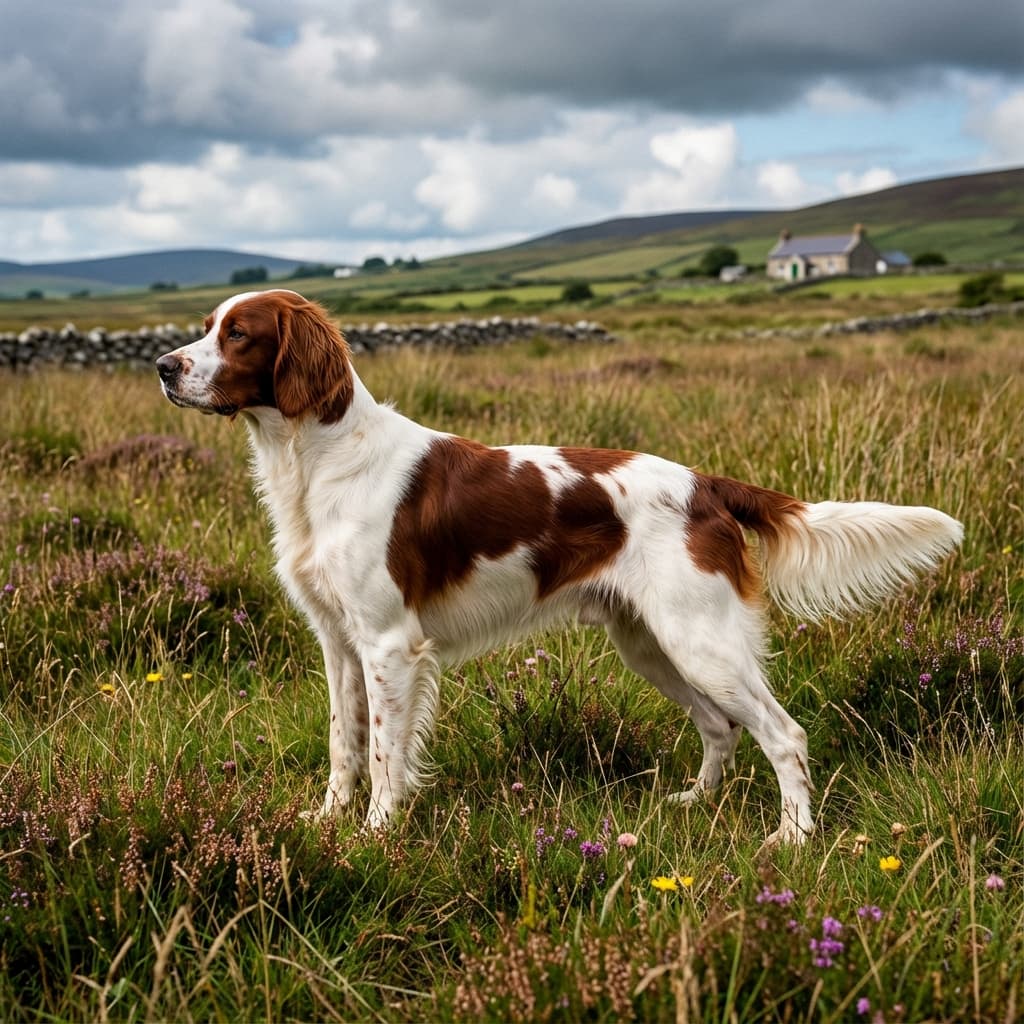
- Irish Red and White Setters - the older type of Irish Setter
- An unknown dog with a solid, intensely red coat - which introduced the characteristic chestnut-red color
- Possible also admixtures of blood: spaniel, pointer, Gordon setters
The first Irish Setters were known as Red Spaniels or Irish Setters, and their unique, intensely chestnut-red coat (mahogany red) quickly caught the attention of hunters and breeders. By the 18th century, the breed was already a distinctly recognizable type, although it had not yet been standardized.
In 1882, the Irish Red Setter Club was established, which began systematic work on establishing breed standards and organizing shows and field trials. This was a milestone in the breed's history - from that moment on, breeding became intentional and focused on preserving desired traits.
In 1886, the club published the first official breed standard, which defined the physical appearance and working abilities of the Irish Setter. This standard laid the foundation for today’s pure breeding and ensured that the breed would retain its characteristic features: athletic build, spectacular color, friendly temperament, and excellent hunting abilities.
Since then, the club has organized field trials and shows to set the standard for the breed and promote the best individuals for breeding. In 1998, the club published a document on the working style for the breed, which detailed how the Irish Setter should work in the field. The standard and working style together describe the physical form and working abilities of the breed.
Thanks to these efforts, the Irish Setter has evolved over the years into a hardy, healthy, intelligent dog, endowed with excellent working abilities and great stamina. The FCI standard emphasizes: The Irish Red Setter has evolved down the years into a hardy, healthy, intelligent dog, possessed of excellent working ability and great stamina.
In the 19th and early 20th centuries, the breed gained immense popularity not only in Ireland but also in Great Britain, the United States, and other countries. Irish Setters were particularly valued by hunters pursuing birds - snipe, partridges, pheasants - where their spectacular point and natural passion for work made a huge impression.
However, with the growing popularity, a division in breeding began:
- Field/working line - bred mainly for hunting abilities, endurance, instinct, intelligence. Dogs are often lighter, more athletic, with a stronger instinct
- Show/bench line - bred mainly for appearance, spectacular coat, elegant silhouette in accordance with the standard. Dogs are often heavier, with longer coats, more visually striking
Although both lines come from the same breed, they differ slightly in temperament and appearance. The working line is usually more energetic, intense in work, with a stronger hunting instinct. The show line may be somewhat calmer (though still very energetic!), more visually impressive.
In the 1960s and 1970s, the breed gained even more popularity thanks to films:
- Big Red (1962) - a Disney film about the friendship between a boy and an Irish Setter. This film made the breed incredibly popular in the United States and around the world. Many families wanted to have a beautiful, red dog like in the movie
- Sequel: Big Red (1973, 1985) - further films continuing the story
This sudden popularity had, however, negative consequences - many puppies were bred by irresponsible breeders (puppy mills), who focused on quantity rather than quality, leading to health problems, temperament issues, and deviation from the breed standard. Fortunately, responsible breeders continued proper breeding, preserving the best traits of the breed.
Today, the Irish Setter remains one of the most recognizable hunting dog breeds in the world, valued not only for its spectacular coat and elegant appearance but also for:
- Excellent hunting abilities - still used in hunting in many countries
- Participation in field trials and working tests - competitions for hunting dogs, where Setters regularly prove their skills
- Companion dogs for active families - more and more Setters live as beloved family members
- Sporting dogs - agility, rally obedience, flyball, canicross
- Therapy dogs - some Setters work as therapy dogs in hospitals, schools, nursing homes
The breed has retained its original working traits - intelligence, hunting instinct, endurance, passion for work - and is still primarily bred with the aim of preserving these abilities, although more and more Irish Setters live as family dogs.
In Poland, the Irish Setter is a relatively popular breed, valued by both hunters and families looking for a beautiful, active companion. The breed has its group of dedicated fans who appreciate its spectacular appearance, friendly character, and boundless enthusiasm for life.
The Irish Setter remains one of the most beautiful and recognizable dog breeds in the world - its chestnut-red color, flowing coat, and elegant silhouette make it eye-catching and awe-inspiring everywhere. For the right owner - active, patient, loving long walks, and willing to spend time on grooming - the Irish Setter becomes a wonderful, loyal partner for long, wonderful years full of adventures and joy.