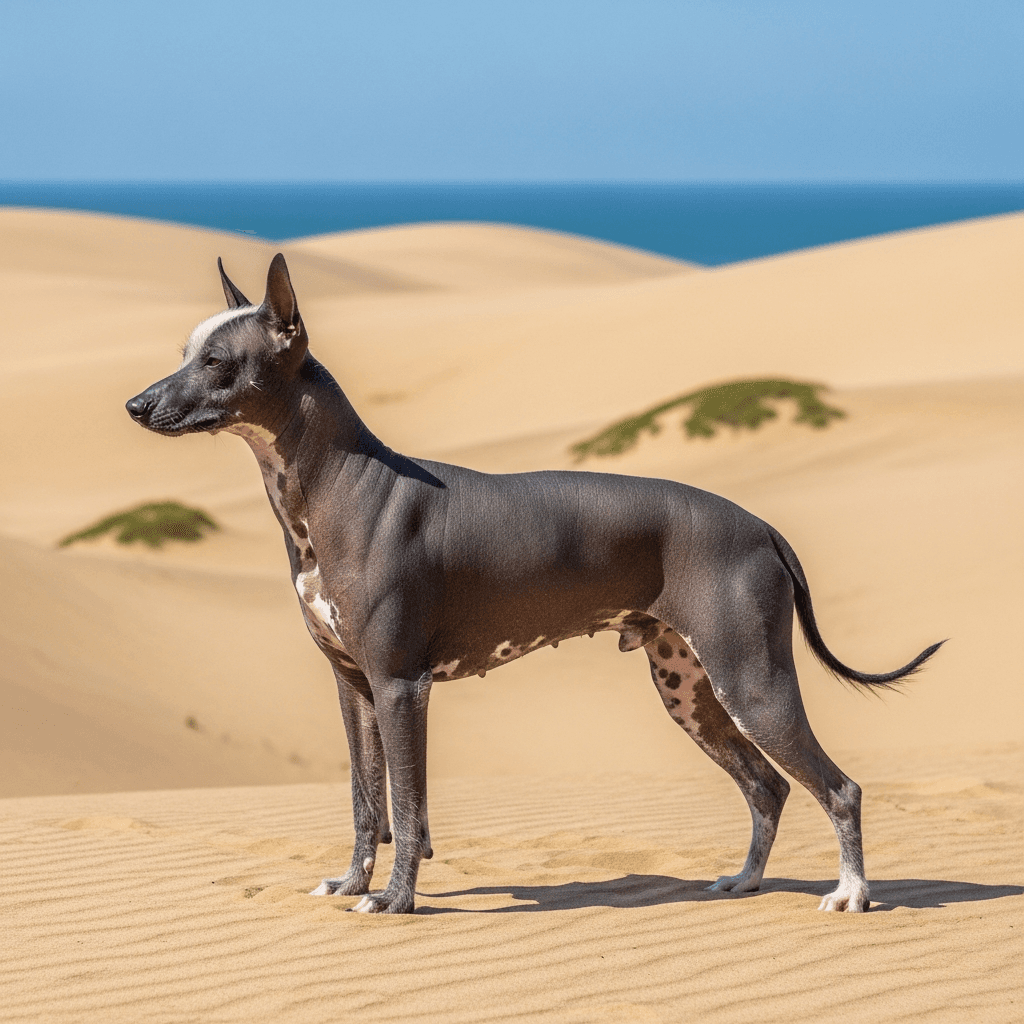
Peruvian hairless dog
FCI Group
5• FCI 310
Size
Medium
Origin Country
XX
Height
25-50 cm
Weight
4-12 kg
Lifespan
10-12 years
Temperament
Overview
The Peruvian Hairless Dog, known as Perro sin pelo del Perú, is a breed surrounded by an aura of mystery and extraordinary charm. Its unusual hairless appearance attracts the attention of every true dog lover and evokes natural curiosity. This remarkable breed originates from Peru and has a fascinating, centuries-old history that dates back to pre-Incan cultures.
In pre-Columbian times, the Peruvian Hairless Dog was not only a loyal companion to humans but also an important element of cultural heritage. Its images often appeared on ceramics of various ancient civilizations, such as Vicus, Mochica, and Chimu. Although some tribes used these dogs as a source of food, this practice was replaced by respect and care after the conquest of the Incas. The Incas attributed mystical and healing properties to these dogs, believing in their ability to alleviate various ailments.
This dog is an excellent life companion, distinguished by its boundless loyalty and strong attachment to its guardians. Its temperament is friendly and affectionate; however, the Peruvian Hairless Dog may show reserve towards strangers. This natural caution makes it a great home guardian that always watches over the safety of its loved ones. The high intelligence of this breed means that dogs quickly learn new skills, but they require their owners to provide a variety of stimulating mental and physical tasks to avoid boredom and maintain excellent mental health.
The breed comes in three size variants: miniature, medium, and large. Body weight ranges widely from just 4 kg in the smallest individuals to as much as 30 kg in the largest representatives of the breed. Although Peruvian Hairless Dogs are hairless, their skin is smooth, elastic, and pleasant to the touch, which also makes them particularly sensitive to sunlight and low temperatures. Therefore, owners must take special care to ensure proper skin hydration and protection against adverse weather conditions to avoid dermatological issues. It is also worth emphasizing that the Peruvian Hairless Dog needs regular physical and mental activity to maintain optimal health and well-being.
We invite you to explore the next sections of our comprehensive guide, where you will find detailed and practical information about the health, grooming, training, nutrition, history, appearance, and behavior of this fascinating and unique breed. The Peruvian Hairless Dog awaits to reveal its secrets and unique character traits that make it such an amazing and one-of-a-kind life companion.
The Peruvian Hairless Dog is an elegant and slender dog, whose appearance radiates strength, endurance, and harmony of proportions. The most important characteristic of this breed is the complete or almost complete lack of hair on most of the body, which makes their skin smooth, elastic, and pleasant to the touch. However, some individuals may have trace amounts of hair on their heads (often in the form of a distinctive crest), on the ends of their paws, and on their tails, which adds to their charm.
Sizes and proportions:
- Miniature: height at the withers 25-40 cm, weight 4-8 kg
- Medium: height at the withers 40-50 cm, weight 8-12 kg
- Large: height at the withers 50-65 cm, weight 12-30 kg
Head and face characteristics: The skull has a lupoid (wolf-like) shape, with a distinct stop. The eyes are medium-sized, with a vigilant and very intelligent expression, usually in a color that harmonizes with the skin's coat. The ears are medium length, erect, and mobile, set in line with the outer corners of the eyes, giving the dog a distinctive, alert appearance. The muzzle is proportional to the skull, gradually narrowing towards the nose.
Body structure: The body is slender and well-muscled, with a straight back line and a slightly sloped rear. The chest is deep, reaching to the elbows, with well-arched ribs. The tail is set low, hanging freely at rest, and is slightly raised when in motion, but it is never curled over the back. The limbs are straight, slender, and strong, ending in oval, hare-like paws.
Skin and coat color: The skin can come in various colors, from black, gray, brown, to shades of pink and cream. All combinations of these colors are also acceptable, including spotted dogs. The skin should be smooth, elastic, and warm to the touch.
Teeth: Due to the genetic link between the hairless gene and dental development, hairless individuals often exhibit incomplete dentition. The absence of some teeth is accepted by the breed standard and does not constitute a disqualifying fault.
The Peruvian hairless dog is a breed with a complex and fascinating temperament, making it a wonderful companion for the right owners. These dogs are extremely friendly, loyal, and devoted to their guardians, often showing deep affection and strong emotional attachment. They form very strong bonds with family members and enjoy participating in all household activities.
Character and temperament:
- Alertness: Peruvian hairless dogs can be suspicious and reserved towards strangers, which makes them excellent home guardians. However, they are not aggressive – they just need time to accept new people.
- Intelligence: Their high intelligence makes them easy to train and they quickly learn new commands, but they require a variety of mental challenges to avoid boredom and frustration.
- Energy: These are lively and energetic dogs that often exhibit spirited behaviors. They need an appropriate amount of physical and mental activity each day.
- Communicativeness: They can be quite vocal, especially when excited or wanting to get their owner's attention.
Social relationships: The Peruvian hairless dog gets along very well with children, provided they are aware of the dog's delicate skin nature. These dogs usually coexist well with other pets, especially if they have been properly socialized from a young age. Their friendly disposition makes them an ideal choice for active families that will provide them with plenty of attention and stimulation.
Emotional needs: It is important to remember that the Peruvian hairless dog does not tolerate prolonged loneliness and may exhibit signs of separation anxiety, leading to destructive behaviors, excessive barking, or depression. These dogs need regular contact with their family and are not suited for living alone in a yard or outdoors. They are typical house dogs that desire to be close to their guardians and participate in the family's daily life.
The Peruvian Hairless Dog is generally a healthy and resilient breed, but due to its unique feature – lack of fur – it has several specific health issues that owners should be aware of and that require special attention.
Life expectancy: The average lifespan of a Peruvian Hairless Dog is between 10 to 12 years, although with proper care and a healthy lifestyle, some individuals may live up to 14-15 years.
Dental issues: Owners should be aware that the gene responsible for the lack of fur is genetically linked to the development of teeth. As a result, Peruvian Hairless Dogs may have incomplete dentition – fewer teeth than other breeds, and some teeth may be poorly shaped or fall out as the dog ages. Dental problems can also lead to gum disease, so regular oral check-ups and dental hygiene are extremely important. It is recommended to use special dental treats and to regularly clean the teeth.
Dermatological issues: Due to the lack of a protective layer of fur, the skin of the Peruvian Hairless Dog is very sensitive to external factors:
- Sunburn: These dogs are particularly susceptible to skin damage from UV radiation. Owners should use appropriate sunscreen creams designed for dogs, especially during summer walks.
- Cold sensitivity: In cooler conditions, these dogs require protective clothing (sweaters, jackets) to avoid hypothermia and frostbite.
- Skin irritations: The skin may be prone to irritations, rashes, acne, or allergic reactions to cosmetics or clothing materials.
Weight and condition: Although the Peruvian Hairless Dog rarely has obesity issues, owners should monitor the dog's weight and adjust the diet according to its activity level. Overweight can lead to joint problems, especially in larger individuals.
Health prevention: Regular veterinary visits, up-to-date vaccinations, deworming, and monitoring of skin and teeth are crucial for maintaining the health of the Peruvian Hairless Dog. Owners should also provide a proper diet rich in omega-3 and omega-6 fatty acids, which support skin health.
The care of the Peruvian hairless dog differs significantly from the care of fur-covered breeds, but it is relatively simple, provided that the owner is systematic and aware of the specific needs of this breed.
Skin care – the most important element: Since the dog does not have fur to protect its skin from external factors, regular skin care is absolutely crucial. The skin requires systematic moisturizing to remain elastic, healthy, and free from irritation.
- Moisturizing: It is recommended to use natural oils such as coconut oil, olive oil, or specialized balms for dogs. Products containing artificial chemicals that may irritate the delicate skin should be avoided.
- Bathing: Baths should be conducted occasionally – once every 2-3 weeks or as needed, to avoid damaging the skin's natural protective layer. Gentle, hypoallergenic shampoos designed for dogs with sensitive skin should be used.
- Sun protection: Before going for a sunny walk, a UV filter cream (special for animals or safe for infants) should be applied to the dog's skin, especially on the most exposed areas such as the ears, back, and nose.
- Protective clothing: On cold days, owners should dress the dog in warm sweaters, hoodies, or jackets to protect the skin from low temperatures and wind. The clothing should be made of natural, soft materials that do not irritate the skin.
Skin condition monitoring: Owners should regularly check the skin for irritations, rashes, sunburns, acne, or other dermatological issues. If any concerning changes are noticed, a veterinarian should be consulted immediately.
Nail and teeth care: Nails should be regularly trimmed (every 3-4 weeks) to avoid discomfort while walking. Teeth should be brushed at least 2-3 times a week using dog toothpaste to prevent gum disease and tartar buildup.
Ear cleaning: Ears should be regularly checked and cleaned with a gentle solution available at pet stores or from a veterinarian.
The Peruvian Hairless Dog is a breed that requires moderate but regular amounts of exercise to maintain healthy physical condition and good mental well-being. Although they are not dogs with extreme exercise requirements, they need daily activity to release energy and satisfy their natural curiosity.
Daily exercise needs: The optimal amount of physical activity for a Peruvian Hairless Dog is 30-60 minutes a day, depending on age, size, and individual energy level. Activity can be divided into several shorter sessions throughout the day, which is especially recommended for younger, more energetic individuals.
Forms of physical activity:
- Walks: Daily leashed walks around the neighborhood are the foundation of physical activity. Owners should provide their dog with the opportunity to explore different terrains and discover new scents.
- Running in a safe area: These dogs love to run freely in a safe, enclosed area where they can move around without a leash.
- Playing with a ball, frisbee: Interactive play with the owner perfectly combines physical activity with mental stimulation.
- Agility and tracking: More advanced forms of activity, such as agility, tracking, or dog dancing, are ideal for intelligent Peruvian Hairless Dogs that need mental challenges.
- Garden games: If you have a garden, you can organize various games like hide-and-seek or searching the area for treats.
Notes on activity:
- Avoid monotony: The Peruvian Hairless Dog is intelligent and gets bored quickly, so it's worth varying the forms of activity and introducing new games.
- Protection from weather conditions: During intense sunlight, it is necessary to provide the dog with protection from sunburn (UV filter cream), and on cool days – warm clothing.
- Mental stimulation: In addition to physical activity, the dog needs mental tasks, such as interactive toys, scent games, or simple training exercises.
Owners should observe their dog and adjust the amount and intensity of exercise to its individual needs, age, and physical condition.
Training a Peruvian Hairless Dog is relatively easy and enjoyable, but it requires commitment, patience, and variety in training methods. These dogs are very intelligent and learn quickly, but they have a low tolerance for monotony and boredom, which means that training sessions must be interesting, short, and full of positive reinforcement.
Basic training principles:
- Positive reinforcement: Owners should use only positive reinforcement methods, such as treats, verbal praise, petting, or favorite toys. These dogs respond very well to positive motivation and are eager to cooperate with their owner.
- Short sessions: Training sessions should be short (10-15 minutes) and conducted several times a day to avoid tiring or boring the dog.
- Variety: Introducing new commands, games, and challenges is crucial for maintaining the dog's interest in training.
- Consistency: All family members should use the same commands and rules to avoid confusing the dog.
Socialization – an absolute priority: Due to the natural distrust of the Peruvian Hairless Dog towards strangers, early and intensive socialization is key. Owners should spend a lot of time on:
- Introducing the puppy to different people (adults, children, people in hats, glasses, etc.)
- Exposing them to various environments (parks, pet stores, visits to friends)
- Contact with other animals (dogs, cats) in controlled conditions
- Acclimating them to different sound stimuli (traffic, household noises, loud sounds)
Basic commands to teach: The Peruvian Hairless Dog should master basic commands such as: Sit, Lie down, Stay, Come, Leave it, Quiet. These commands are the foundation for further learning and ensure the dog's safety in various situations.
What to avoid in training:
- Harsh methods: One should avoid physical punishment, yelling, or aggressive training methods as they can cause fear, reluctance to learn, and behavioral issues.
- Monotony: Constantly repeating the same exercises without variety leads to boredom and frustration.
- Too long sessions: Overloading the dog with long training sessions can cause fatigue and negative associations with learning.
Owners should remember that every dog is different and may need an individual approach. In case of behavioral difficulties, it is advisable to consult a professional dog behaviorist.
The diet of the Peruvian hairless dog should be balanced, nutritious, and tailored to its individual energy needs, age, size, and level of physical activity. Proper nutrition is crucial for maintaining skin health, appropriate body weight, and the overall condition of the dog.
Basic nutrition principles:
- High-quality food: Owners should choose premium or super-premium foods rich in high-quality animal protein (chicken, beef, fish), vitamins, and minerals. The food should contain at least 25-30% protein for adult dogs and 28-32% for puppies.
- Natural ingredients: The best foods contain natural ingredients without artificial additives, preservatives, colorings, or fillers (e.g., corn gluten or meat by-products).
- Healthy fats: The food should be rich in omega-3 and omega-6 fatty acids, which support skin health – particularly important for hairless dogs. Sources of these acids include salmon oil, flaxseed oil, or evening primrose oil.
- Regular meals: Adult dogs should receive 2 meals a day at consistent times to prevent digestive issues. Puppies up to 6 months old require 3-4 meals a day.
Adjusting the diet to conditions: Due to the sensitivity of the Peruvian hairless dog to temperature changes, owners can adjust the diet depending on the season:
- Winter: In cooler months, it is advisable to increase the fat content in the diet to help the dog maintain an appropriate body temperature and provide extra energy.
- Summer: On hot days, it is important to ensure proper hydration and possibly slightly reduce portions if the dog is less active.
Supplementation: In some cases, it may be worth considering supplementation:
- Marine fish oils (omega-3): Support skin and coat health (if present)
- Probiotics: Improve digestion and strengthen the immune system
- Skin vitamins: Biotin, zinc, vitamins A and E support skin regeneration and elasticity
Weight monitoring: It is essential to regularly check the dog's weight to prevent obesity, which can lead to joint problems, cardiovascular issues, or diabetes. Although Peruvian hairless dogs rarely have obesity problems, owners should remain vigilant and adjust portions according to the dog's activity level.
What to avoid:
- Foods containing artificial additives, preservatives, and colorings
- Table scraps that may cause digestive or allergic issues
- Toxic products for dogs: chocolate, onions, garlic, avocado, grapes, raisins, xylitol
Regular consultations with a veterinarian will help tailor the diet to the dog's individual needs and monitor its health and physical condition.
Characteristic Traits
Pros
- Loyalty and strong attachment to the owner
- Lack of fur eliminates the shedding problem
- High intelligence and ease of learning
- Excellent home guard.
Cons
- Requires protection from the sun and cold
- Needs regular mental and physical tasks
- May be distrustful of strangers.
Behavioral Ratings
Breed History
The Peruvian hairless dog is a breed with a remarkably long and fascinating history, whose roots date back over 3000 years, to the times of pre-Inca cultures inhabiting the coast and highlands of present-day Peru. This unique hairless dog breed was not only a companion to humans but also an important element of the cultural, religious, and daily life of ancient Andean civilizations.
Origins and cultural significance: The oldest evidence of the existence of the Peruvian hairless dog comes from ceramics of pre-Inca cultures, such as Vicus (400 BC - 100 AD), Mochica (100-700 AD), Chimú (900-1470 AD), and Chancay (1000-1470 AD). Realistic representations of these dogs have been found on numerous ceramic vessels, indicating their significant role in those communities. These dogs were considered magical and spiritual animals, often associated with the cult of the dead and religious beliefs.
In some pre-Inca cultures, Peruvian hairless dogs were used as a source of food, especially during periods of food shortages. However, this practice significantly declined after the conquest of these lands by the Inca Empire (15th-16th century).
The Inca era and healing beliefs: After being conquered by the Incas, Peruvian hairless dogs gained a new status. The Incas attributed mystical and healing properties to these dogs, believing that the warmth of their skin (devoid of hair) could alleviate various ailments such as joint pain, rheumatism, or digestive issues. These dogs became valued companions in noble households and temples. It was believed that they had the ability to absorb diseases and negative energy from their owners.
The colonial era and the threat of extinction: After the Spanish conquest in the 16th century, this breed found itself in serious danger. European conquistadors brought with them dogs of European breeds, which began to dominate and crossbreed with local dogs. Peruvian hairless dogs, often seen as strange or unattractive by colonists, became endangered. They survived mainly in remote, isolated Andean regions and on the coast, where the local population still valued their unique traits.
Protection and renaissance of the breed: It was not until the 20th century, thanks to the efforts of Peruvian cynologists and enthusiasts of this breed, that the Peruvian hairless dog began to be systematically protected and promoted. In 1985, during the FCI General Assembly in Amsterdam, thanks to the initiative of cynologist Ermanno Maniero, who developed the first breed standard, the Peruvian hairless dog was officially recognized by the International Cynological Federation as a native breed of Peru. It was registered under number 310 in the FCI nomenclature.
Modern times: Today, the Peruvian hairless dog is a national symbol of Peru and is gaining increasing recognition worldwide as a companion dog. In 2001, it was officially declared the national cultural heritage of Peru (Patrimonio Cultural de la Nación). This breed is currently promoted by Peruvian cynological clubs and enthusiasts who care for its genetic purity and international popularity.
It is also worth mentioning that besides the hairless variety, there is also a coated variety, which is genetically part of the same breed. Initially rejected from breeding programs, the coated variety has been officially recognized, as its presence in breeding is essential for maintaining genetic diversity and the health of the breed.