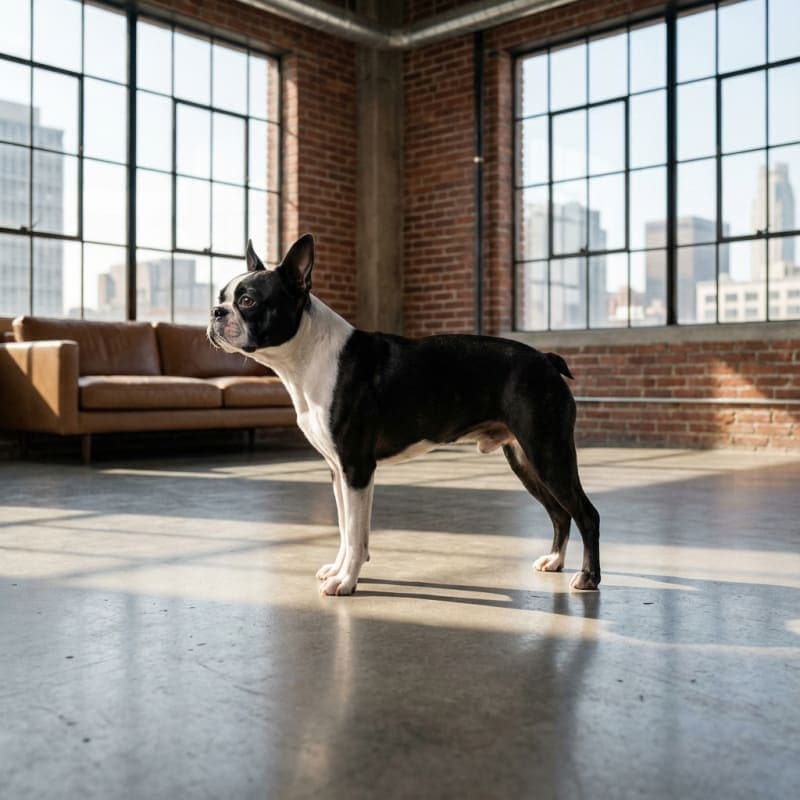
Boston Terrier
FCI Group
9• FCI 140
Size
Small
Origin Country
XX
Height
25-40 cm
Weight
6.8-10.9 kg
Lifespan
13-15 years
Temperament
Overview
Boston Terrier is an incredibly charming breed of dog originating from the United States, specifically from Boston. These small molossers have gained immense popularity not only due to their friendly disposition but also because of their unique appearance resembling an elegant tuxedo. The Boston Terrier is a classic companion dog that thrives in family life, loving to play with children and other pets.
Their temperament is cheerful, and their character is extremely friendly. They are dogs that desire to be close to their owners and do not cope well with prolonged loneliness, making them ideal companions for people of all ages. The average lifespan is between 13 to 15 years, which is an impressive result for dogs of this size.
The compact body structure, short neck, and strong, square torso make them incredibly agile and energetic. Their distinctive head and large, expressive eyes full of intelligence and friendliness give them a unique charm. The Boston Terrier's nose is black and wide, and its muzzle is short and square, adding to their character.
The breed comes in three colorations: brindle, black, and seal, always with characteristic white markings. A white stripe on the forehead, a white chest, white limbs, and sometimes a white collar create a pattern reminiscent of a tuxedo, which is why the breed has earned the nickname the gentleman of the dog world. Their short, smooth coat is easy to maintain.
The boldness typical of terriers combines in the Boston Terrier with intelligence and the ability to learn quickly, allowing them to adapt well to the rules of the household. Despite their small size, they are dogs with a strong character and great self-confidence.
Their energy and eagerness to play make them excellent companions for both active and more laid-back families. The Boston Terrier combines elegance, intelligence, and devotion, making it one of the most popular companion breeds in the world.
The Boston Terrier is a dog with a distinctive and elegant appearance that attracts attention with its harmonious build. Their silhouette is compact and square, giving the impression of strength in a small body.
Dimensions and proportions:
- Height at the withers: 38-43 cm
- Weight: according to category - light (under 6.8 kg), medium (6.8-9 kg), heavy (9-11.35 kg)
- Square build - body length equal to height at the withers
Head and expression:
The head is proportional to the body, with a flat top skull and a clearly defined stop. The characteristic square muzzle is wide and deep, with a well-developed jaw. The eyes are large, round, dark, and widely spaced, giving an intelligent and friendly expression. The nose is black, wide with well-opened nostrils.
Ears: small, thin, erect, set high on the skull - perfectly at the corners of the skull.
Coat and coloration:
The coat is short, smooth, shiny, and soft to the touch. There are three basic colors:
- Brindle - black with brindle stripes
- Seal - black with a reddish hue visible in sunlight
- Black - deep black
White markings are key to the breed standard:
- White band around the muzzle (muzzle band)
- White blaze between the eyes (blaze)
- White chest (forechest)
- White front limbs partially or completely
- White hind limbs to the hocks
Movement: confident, straight, fluid - the front and hind limbs move straight forward, in perfect rhythm, demonstrating grace and strength.
The Boston Terrier is a dog with a friendly, lively, and intelligent character. The FCI standard describes it as an excellent companion - determined, strong, and active, with flawless style and an easy, graceful way of moving.
Temperament and personality:
- Very sociable - loves to be with family and does not cope well with loneliness
- Friendly towards children - patient and gentle during play
- Gets along well with other animals - both dogs and cats
- Intelligent and sharp - quickly learns new commands
- Trusting but alert - may bark at strangers, but without aggression
Characteristic features:
The Boston Terrier carries the nickname American gentleman not only because of its tuxedo-like coloring but also due to its polite and elegant behavior. Despite its terrier origins, it does not show excessive aggression or a tendency for conflict.
The breed is characterized by a high degree of intelligence, which is evident in the expression of its eyes and its ability to quickly understand situations. These dogs have a balanced temperament - they can be energetic during play but are equally happy to rest quietly in the company of their owners.
Activity and energy:
The Boston Terrier has a moderate need for exercise. It does not require intense, prolonged workouts, but needs daily walks and mental stimulation. It adapts well to the family's lifestyle - it can be a companion for active people, but also feels comfortable in a calmer environment.
Relationships with family:
These dogs are extremely attached to their owners and wish to participate in all family activities. They do not tolerate prolonged loneliness and may develop separation anxiety if regularly left alone for many hours. The Boston Terrier is an ideal companion for those who can dedicate a lot of time and attention to it.
The Boston Terrier is a relatively healthy and resilient breed; however, like all purebred dogs, it can be prone to specific health issues. The average lifespan is 11-15 years, often reaching the upper limit of this range with proper care.
Problems related to brachycephalic structure:
Due to its short muzzle and flat face, the Boston Terrier belongs to the brachycephalic breeds, which comes with certain health challenges:
- Brachycephalic obstructive airway syndrome - difficulty breathing, especially during exertion and in high temperatures
- Heat intolerance - risk of overheating and heatstroke
- Snoring and loud breathing - often natural for the breed
- Reverse sneezing - a characteristic sound resembling choking
Eye problems:
Large, bulging eyes are prone to:
- Corneal inflammation
- Cataracts (especially in older dogs)
- Dry eye syndrome (keratoconjunctivitis sicca)
- Mechanical injuries - require protection during play
Skin diseases:
- Allergic dermatitis
- Atopy
- Melanoma (especially in dogs with darker coats)
Orthopedic problems:
- Patellar luxation
- Legg-Calvé-Perthes disease (necrosis of the femoral head)
- Intervertebral disc disease
Other conditions:
- Deafness (especially in dogs with a lot of white color)
- Heart problems - aortic stenosis
- Skin tumors - mastocytoma
Prevention and care:
Regular veterinary visits (every 6-12 months) allow for early detection of health problems. It is important to avoid overheating - on hot days, walks should take place early in the morning or in the evening, with access to shade and water.
The Boston Terrier does not tolerate extreme temperatures. In winter, due to its short coat, it may require protective clothing. In summer, special caution is necessary - the breed is very sensitive to heat.
Weight control is crucial - obesity worsens breathing problems and puts stress on the joints. Regular eye care (daily cleaning) and ear maintenance help prevent infections.
Boston Terrier is a breed that is easy to care for, ideal for owners who do not want to spend excessive amounts of time on grooming. The short, smooth coat does not require complicated procedures, but regular basic grooming is essential.
Brushing the coat:
- Frequency: 1-2 times a week during normal periods, 3-4 times a week during shedding
- Tools: soft-bristle brush or rubber grooming glove
- Goals: to remove dead hair, stimulate the skin, distribute natural oils
- Shedding: moderate, more intense in spring and autumn
Bathing:
Boston Terriers do not require frequent baths - it is recommended to bathe every 6-8 weeks or as needed (when the dog gets dirty). Excessive bathing can lead to dry skin and the removal of the natural protective layer.
- Use mild shampoos designed for dogs
- Rinse the shampoo thoroughly to avoid irritation
- Gently dry with a towel - the coat dries quickly
Eye care:
The most important aspect of grooming due to the large, protruding eyes that are prone to irritation:
- Daily: gently wipe around the eyes with a damp, clean cloth
- Remove discharge that accumulates in the corners of the eyes
- Watch for signs of redness, tearing, or cloudiness
- If there is discharge or redness, consult a veterinarian
Ear care:
- Frequency: weekly check, cleaning as needed
- Use dog ear cleaning solutions
- Gently wipe the visible part of the ear - do not insert cotton swabs deeply
- Pay attention to any unpleasant odor, redness, or excessive discharge
Dental care:
- Ideal: brushing teeth 2-3 times a week
- Use dog toothpaste (never human toothpaste!)
- Alternatively: dental treats, teeth cleaning toys
- Regular dental check-ups with a veterinarian
Nail trimming:
- Frequency: every 2-4 weeks, depending on wear rate
- Nails should not click on the floor while walking
- Use clippers or a nail grinder
- Be careful not to cut too close to the quick
Care of skin folds (if present):
Some Boston Terriers have delicate folds on their muzzle:
- Regularly wipe with a damp cloth
- Thoroughly dry to prevent moisture buildup
- Watch for signs of irritation or infection
Skin check:
While brushing, check the skin for:
- Rashes, redness, flaking
- Ticks (especially after walks in the woods)
- Growths, skin changes, warts
The Boston Terrier is a breed with moderate exercise needs, which adapts well to the lifestyle of its owners. It does not require extreme activity but needs regular walks and mental stimulation to maintain physical and mental health.
Daily walks:
- Frequency: 2-3 walks per day
- Duration: 20-30 minutes per walk
- Pace: moderate - the Boston Terrier is not a breed built for endurance
- Purpose: to meet physiological needs, explore the environment, socialize
Important limitations due to brachycephalic structure:
NOTE: Due to its short snout and breathing difficulties, the Boston Terrier does not tolerate intense exertion, especially in high temperatures:
- In summer: walks early in the morning and late in the evening, avoid the sun
- In winter: consider protective clothing due to its short coat
- During activity: watch for signs of fatigue - heavy breathing, tongue turning blue, unsteady gait
- Always: provide access to fresh water
Appropriate forms of activity:
- Park walks - an ideal form of exercise
- Fetching - short sessions with a ball or toy
- Scent games - searching for treats hidden in the house or garden
- Socialization with other dogs - controlled meetings in dog parks
- Walking on different surfaces - grass, sidewalk, gravel (sensory stimulation)
Inappropriate forms of activity:
- ❌ Long-distance running - the breed is not built for endurance efforts
- ❌ Intense agility - risk of overheating and breathing problems
- ❌ Swimming without supervision - due to their body structure, they may have trouble staying afloat
- ❌ Activity on hot days - high risk of heatstroke
Mental stimulation:
The Boston Terrier is a smart breed that needs intellectual challenges as much as physical ones:
- Interactive toys - Kong, puzzles, toys with hidden treats
- Learning new commands - short training sessions (5-10 minutes)
- Scent games - searching, scent trails
- Changing walking routes - new stimuli and scents
Adaptation to the owners' lifestyle:
The Boston Terrier can be just as happy as a companion:
- Active owners - eager to participate in moderate activities
- Calmer individuals - feels great as a house dog
- City dwellers - small size and moderate exercise needs fit perfectly into apartment living
Consequences of lack of exercise:
Insufficient activity can lead to:
- Obesity - particularly problematic for this breed
- Hyperactivity and destructive behavior
- Behavioral problems - barking, chewing on objects
- Deterioration of mental health - anxiety, depression
The Boston Terrier is a smart and eager to learn breed, making training an enjoyable experience for both the dog and the owner. The FCI standard emphasizes their high level of intelligence, evident in their expression and speed of acquiring new skills.
Training Characteristics:
- High intelligence - they quickly understand commands and rules
- Willingness to cooperate - they want to please their owner
- Temporary stubbornness - terrier genes can cause stubbornness
- Sensitivity - they react poorly to harsh training methods
Basic Training Principles:
1. Positive reinforcement
The Boston Terrier responds best to positive training methods:
- Reward with treats, praise, play
- Ignore undesirable behaviors (do not reward with attention)
- Never use violence or yelling
- Be consistent - always reward desired behavior
2. Short, engaging sessions
- Duration: 5-10 minutes per session
- Frequency: 2-3 sessions daily
- End training while the dog is still interested
- Vary exercises to avoid boredom
3. Early start
Introduce rules from the first day in the new home:
- Basic commands: Sit, Stay, Come, Lie down, No
- House training - consistent schedule for outings
- Socialization - exposure to various stimuli, people, animals
- House rules - what is allowed and what is not
Key Training Areas:
Basic obedience:
- Sit - the first command, the foundation for further training
- Stay - important for safety
- Come - a key recall command
- Lie down - calming in various situations
- No or Leave it - interrupting undesirable behavior
Socialization:
Critical for developing a balanced personality, especially during the puppy stage (8-16 weeks):
- Contact with different people - adults, children, people in hats, glasses
- Exposure to other animals - dogs, cats, birds
- Different environments - street, park, pet store, car
- Various stimuli - sounds, surfaces, objects
House training:
- Take the puppy out every 2-3 hours
- Always after meals, playtime, naps
- Choose one spot for bathroom needs
- Reward immediately after going in the right place
- Do not punish for accidents - clean up without emotional reaction
Common challenges and solutions:
Problem: Stubbornness and selective listening
- Solution: Increase motivation - use more valuable rewards
- Be more interesting than the environment
- Do not repeat commands multiple times - wait for execution
Problem: Barking at strangers or other dogs
- Solution: Socialization and desensitization
- Reward calm behavior in the presence of the stimulus
- Gradually decrease the distance to the source of excitement
Problem: Hyperactivity
- Solution: Teach a relaxation command, e.g., Go to your place
- Provide sufficient exercise and mental stimulation
- Ignore overly excited behavior
Advanced training:
Once the basics are mastered, the Boston Terrier can participate in:
- Obedience training - more complex commands and sequences
- Tricks - fun tricks that utilize the breed's intelligence
- Nosework - scent work, ideal for this breed
- Rally - a gentler form of dog sports
Key tips:
- ✅ Be patient and consistent
- ✅ Always use the same command for the same behavior
- ✅ All household members should follow the same rules
- ✅ Reward immediately - the dog must understand the cause-and-effect relationship
- ✅ End the session on a success - even a small one
- ❌ Do not yell or use violence
- ❌ Do not prolong sessions - a tired dog stops learning
- ❌ Do not expect perfection - build skills gradually
Proper nutrition for a Boston Terrier is a key element in maintaining its health, condition, and appropriate body weight. The breed is prone to weight gain, so portion control and food quality are extremely important.
Basic nutrition guidelines:
1. High-quality food
- Choose premium or super-premium foods with meat as the first ingredient
- Avoid foods with excessive grains, artificial colors, and preservatives
- Adjust the food to the dog's age: puppy, adult, senior
- Consider foods for small breeds - tailored to kibble sizes
2. Portion control
Boston Terriers easily gain weight, which is particularly dangerous due to respiratory issues:
- Follow the manufacturer's feeding guidelines (adjusted to the dog's weight)
- Consider the activity level - less active dogs need smaller portions
- Regularly check body condition - ribs should be palpable but not visible
- Use a measuring cup for food, do not estimate portions by eye
3. Feeding schedule
- Puppies (2-6 months): 3-4 meals a day
- Young dogs (6-12 months): 2-3 meals a day
- Adults (12+ months): 2 meals a day
- Consistent rhythm: feed at the same times every day
Dietary needs by age:
Puppies (0-12 months):
- Food for small breed puppies
- Higher protein content (minimum 28%) and fat (minimum 17%)
- Calcium and phosphorus for proper bone development
- DHA for brain and eye development
Adults (1-7 years):
- Food for adult small breed dogs
- Protein: 18-25%, fat: 10-15%
- Calorie control for maintaining proper weight
- Omega-3 and Omega-6 for healthy skin and coat
Seniors (7+ years):
- Senior food for small breeds
- Lower calorie content (reduced activity)
- Glucosamine and chondroitin for joints
- Antioxidants for immune system support
Nutrients:
Protein:
- Essential component of the diet - builds and repairs muscles
- Sources: chicken, turkey, beef, lamb, fish
- Avoid foods with excessive by-products
Fats:
- Source of energy, healthy skin, and shiny coat
- Omega-3 and Omega-6 fatty acids
- Moderate amount - excess leads to obesity
Carbohydrates:
- Source of energy, fiber for digestion
- Choose whole grains: brown rice, oats
- Avoid excessive grains - can cause allergies
Vitamins and minerals:
- Complete food should contain a full range
- Do not supplement without consulting a veterinarian
Snacks and treats:
Snacks should not exceed 10% of daily calorie intake:
- Use healthy options: carrot pieces, apples (without seeds), cooked chicken
- Avoid: chocolate, grapes, raisins, onions, garlic, xylitol
- Training treats: small, low-calorie bites
- Subtract calories from treats from main meals
Water:
- Constant access to fresh water - absolutely crucial
- Especially important due to the breed's respiratory issues
- Change water daily, clean the bowl regularly
- Monitor intake - a sudden increase may indicate health problems
Special diets:
Food allergies:
Boston Terriers may be prone to allergies - symptoms: itching, rashes, digestive issues:
- Elimination diet under veterinary supervision
- Hypoallergenic foods with novel proteins (duck, rabbit, salmon)
- Avoid common allergens: beef, chicken, wheat, soy, corn
Weight control:
For overweight dogs:
- Light or weight management food
- Increase physical activity (within safe limits)
- More vegetables, fewer treats
- Consult with a veterinarian - weight reduction plan
Digestive issues:
Some Boston Terriers have sensitive digestive systems:
- Food for dogs with sensitive stomachs
- Smaller, more frequent meals
- Probiotics for gut flora support
- Avoid sudden food changes - transition gradually (7-10 days)
Prohibited products:
NEVER give a Boston Terrier:
- ❌ Chocolate - toxic to dogs
- ❌ Grapes and raisins - kidney damage
- ❌ Onions and garlic - destroy red blood cells
- ❌ Xylitol (sweetener) - deadly dangerous
- ❌ Avocado - contains persin (toxin)
- ❌ Cooked bones - risk of choking and intestinal perforation
- ❌ Alcohol - extremely toxic
Condition monitoring:
Regular weight and body condition assessment:
- Weigh once a month
- Visual assessment: visible waist, palpable ribs
- Adjust portions based on condition
- Consult changes with a veterinarian
Characteristic Traits
Pros
- Friendly and gentle nature
- High intelligence and ease of training
- Easy to care for
- Ideal for families with children
- Adapts well to apartment living
- Small size.
Cons
- Does not tolerate loneliness
- Sensitive to extreme temperatures
- Respiratory issues (brachycephaly)
- Can be stubborn
- Prone to obesity
- Eye problems.
Behavioral Ratings
Breed History
The history of the Boston Terrier is a fascinating tale of the only dog breed developed for non-sporting purposes that originated in the United States. This breed earned the nickname American Gentleman not only for its tuxedo-like coloring but also for its elegant manners.
The origins of the breed (1860-1870):
The history of the Boston Terrier begins in Boston, Massachusetts, around 1870. The breed was created from the crossing of:
- English Bulldog - strength, body structure
- White English Terrier (now extinct) - agility, intelligence, white markings
- Probably also Bull Terriers and other terrier breeds
Judge - the founding father:
All modern Boston Terriers descend from a single dog named Judge (full name: Hooper's Judge or Judge), purchased by Robert C. Hooper from Boston around 1870.
- Judge weighed about 32 pounds (14.5 kg)
- He was dark brindle with white markings
- He had a square, sturdy build with a short tail
Judge was crossed with a female dog named Gyp (or Kate), who belonged to Edward Burnett. Gyp was small, white, with a bulldog build. This union produced puppies that became the foundation of the breed.
Development of the breed (1878-1889):
Initially, these dogs were known by various names:
- Round Heads
- Bull Terriers
- American Bull Terriers
- Boston Bull Terriers
Breeders in Boston worked to standardize the type, aiming for smaller, more elegant dogs than their bulldog ancestors. They focused on:
- Reducing size
- Shortening the muzzle (but not as extremely as in bulldogs)
- Refining the characteristic tuxedo coloring
- Maintaining a friendly, non-aggressive temperament
Official recognition (1889-1893):
In 1889, a group of about 30 Boston Terrier owners founded the American Bull Terrier Club. However, the name met with strong opposition from Bull Terrier and Bulldog breeders.
In 1891, the name was changed to Boston Terrier Club of America, and the breed was officially named Boston Terrier in honor of the city where it was developed.
Finally, in 1893, the American Kennel Club (AKC) officially recognized the Boston Terrier as a distinct breed - it was one of the first American breeds recognized by the AKC.
Rise in popularity (early 20th century):
The Boston Terrier quickly gained immense popularity across the United States:
- 1915: The Boston Terrier was the most popular breed in the USA
- It remained in the top 10 most popular breeds for decades
- It became the official dog of the state of Massachusetts in 1979
- It is the mascot of Boston University
International expansion (20th century):
- 1901: The first Boston Terriers arrived in Great Britain
- 1914: Recognition by The Kennel Club in the UK
- 1955: Recognition by FCI (Fédération Cynologique Internationale)
- They spread worldwide - Europe, Australia, Asia
Evolution of the breed standard:
Over the years, the Boston Terrier standard has been modified multiple times:
- Size: Early Boston Terriers weighed 44 pounds (20 kg) or more. Gradually, the size was reduced to current weight categories
- Head: A more square, proportionate head was sought
- Coloring: Required white markings were standardized
- Tail: Naturally short tails were preferred
Boston Terrier in culture:
This breed holds a special place in American culture:
- Symbol of Boston: Represents the city and its residents
- In advertisements: Symbol of the middle class, family dog
- In literature and film: Appears as companions to heroes
- Famous owners: U.S. Presidents (Warren G. Harding, Gerald Ford), Hollywood stars
Contemporary times (21st century):
Today, the Boston Terrier is:
- One of the most popular companion breeds in the world
- A symbol of American dog breeding
- An ideal city dog - small, intelligent, friendly
- Still in the top 25 most popular breeds according to the AKC
The FCI standard was recently updated in 2014 (publication date: 06.24.2014), confirming the breed's key characteristics: compact build, distinctive coloring, friendly temperament, and high intelligence.
Legacy:
The Boston Terrier remains a living testament to American breeding, combining the strength of the bulldog, the agility of the terrier, and an extraordinary charm. It is a breed that has come a long way from fighting dogs to beloved family companions, symbolizing the transformation of human relationships with dogs in the 19th and 20th centuries.