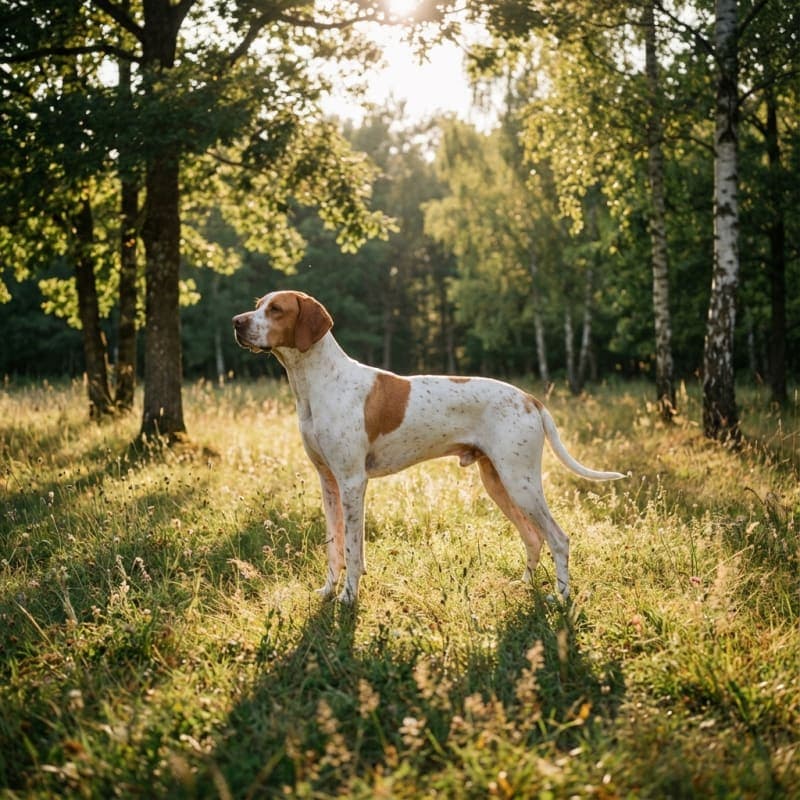
Braque Saint-Germain
FCI Group
7• FCI 115
Size
Medium
Origin Country
FR
Height
54-62 cm
Weight
20-25 kg
Lifespan
12-14 years
Temperament
Overview
Braque Saint-Germain, also known as the Saint-Germain Pointer, is a unique French hunting dog breed that combines elegance, versatility, and a gentle temperament. This extraordinary breed was developed in the 1830s in the royal kennels of Compiègne and later in Saint-Germain-en-Laye, becoming one of the most valued continental pointer breeds.
The history of this breed is closely tied to the royal heritage of France. Braque Saint-Germain was created around 1830 through careful crossbreeding of English Pointers with continental (French) pointers. King Charles X played a key role in the development of this breed, which was originally bred in his kennels in Compiègne, giving rise to the breed's original name.
This meticulous selection resulted in the creation of a dog with excellent working traits:
- Versatility - work on game birds (pheasants, partridges, woodcocks) as well as fur-bearing animals
- Elegance of movement - smooth, regular, and flexible gallop
- Excellent sense of smell - precise pointing of game
- Soft retrieve - gentle bringing back of shot birds
- Gentle character - sociable, attached to humans, easy to train
Braque Saint-Germain experienced its peak popularity until the early 20th century, being the most frequently exhibited pointer breed at the first dog shows, including the first French dog show in 1863. This exclusive breed was a symbol of aristocratic elegance and functionality.
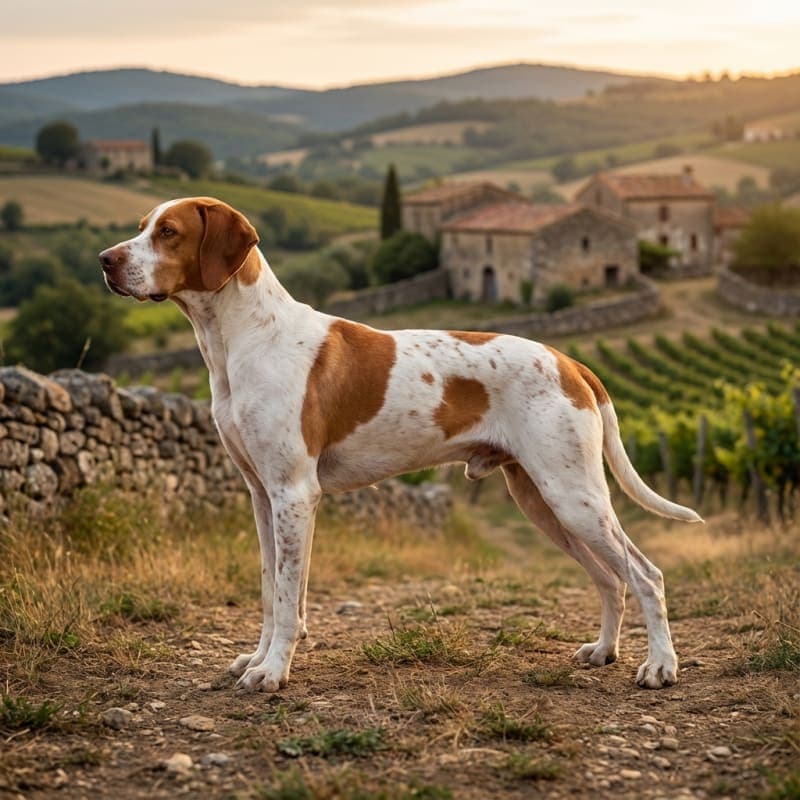
The appearance of Braque Saint-Germain is as impressive as its working traits. It is a medium-sized dog with a proportional build, characterized by a white coat with orange spots - without any traces of black. Its coat is short and smooth, and its movement is harmonious and graceful.
The most recognizable features of its appearance are:
- A head with parallel or very slightly divergent lines of the skull and muzzle
- Gold-green eyes with a gentle, intelligent expression
- Medium-length ears, rounded and slightly drooping
- Strong but not heavy bone structure
- Musculature adapted for work requiring endurance
The temperament of Braque Saint-Germain is its true hallmark. It is primarily a hunting dog, but at the same time, it is incredibly:
- Sociable - loves the presence of people and family life
- Balanced and affectionate - gentle, patient, excellent for families with children
- Sensitive - does not tolerate rough treatment during training
- Easy to train - intelligent, eager to cooperate
- Passionate about hunting - enthusiastically tracks pheasants, partridges, and woodcocks in any terrain
This breed requires an active lifestyle. As a hunting dog, Braque Saint-Germain needs regular, intense physical activity - long walks, running, and retrieving games. Its hunting instincts need to be channeled through appropriate forms of activity - field training, scent games, canine sports.
Despite its working roots, Braque Saint-Germain thrives as a family dog. Its gentle disposition, attachment to people, and patience with children make it a wonderful companion. It is a dog that desires to be close to its family and participate in its daily life.
In the further sections of this comprehensive guide, you will discover detailed information about the health, grooming, physical activity, training, nutrition, history, appearance, and behavior of Braque Saint-Germain. Each section contains practical advice based on deep knowledge of this breed, which will help you better understand and provide optimal living conditions for this unique, royal hunting dog.
If you are looking for an elegant, versatile companion with a gentle heart and a hunting soul, who will be just as eager to work in the field as to spend evenings with the family - Braque Saint-Germain may be the perfect choice. This is a dog for those who value aristocratic elegance combined with functionality and boundless loyalty.
Braque Saint-Germain is a dog with a characteristic, elegant silhouette that combines proportionality, functionality, and a noble appearance typical of continental pointers. Its build is perfectly adapted for prolonged work in the field while maintaining aesthetics and harmony of form.
Basic physical parameters according to the FCI standard:
- Height at the withers (males): 56-62 cm
- Height at the withers (females): 54-59 cm
- Weight: about 20-25 kg (depending on sex and build)
- Proportions: Average overall proportions
- Bone structure: Relatively heavy, but not massive
- Musculature: Adapted for work requiring endurance
The head of the Braque Saint-Germain is one of its most characteristic features. The lines of the skull and muzzle are parallel or very slightly divergent, with a moderately pronounced stop. This proportion gives the head a noble, elegant appearance.
The skull is slightly rounded with a clearly curved back (the occipital protuberance is well defined). It is quite wide, proportional to the overall build. The muzzle is long, strong, and square in profile.
The nose is pink - a characteristic feature of this breed, reflecting the lack of black pigmentation. The nostrils are well open, indicating excellent olfactory abilities.
The eyes are deep-set, relatively large, in the color of golden-green or gold-greenish (dark amber with green reflections). They express gentleness, intelligence, and sincerity - characteristic of this breed. The gaze of the Braque Saint-Germain is full of expression, warmth, and devotion.
The ears are of medium length and thickness, set at the level of the eye line, slightly rounded at the tips, and gently protruding from the head. They do not lie flat against the cheeks, giving the head a characteristic, open appearance.
The neck is of medium length, strong, and muscular, without a dewlap. It harmoniously connects with the head and shoulders, creating an elegant line.
The body is strong, proportional, and functional:
- Back: Straight, strong, well-muscled
- Loin: Short, wide, strong
- Croup: Slightly sloping, well-muscled
- Chest: Deep, well-developed, descending to the level of the elbows
- Ribs: Well-arched, providing space for the lungs
- Abdomen line: Slightly tucked up
The coat of the Braque Saint-Germain is absolutely characteristic and serves as the breed's hallmark:
- White-orange - the basic and most typical variant
- White with orange spots - spots can vary in size
- White with orange ticking (rouan)
- CRITICALLY IMPORTANT: Absence of any black pigmentation - the nose, eye rims, and lips are pink, never black
This coat feature distinguishes the Braque Saint-Germain from other pointer breeds and is one of the most important breed characteristics.
The coat is short, smooth, and close-lying to the body:
- Length: Short all over the body
- Structure: Smooth, not rough
- Density: Moderate, without a dense undercoat
- Shine: Natural, healthy coat has a subtle shine
- Properties: Easy to care for, minimal shedding
The front limbs are straight, strong, well-muscled, set parallel. The shoulders are long and sloping, with elbows close to the body. The paws are round, compact, with thick pads.
The hind limbs are strong, well-muscled, with well-defined angles at the knee and hock joints. The thighs are long and muscular, with well-developed shins.
The tail is set rather low, thick at the base, tapering towards the end. Traditionally, it was not docked (currently docking is prohibited in many countries). At rest, it is carried below the line of the back, while working it is raised horizontally. It does not reach below the hock joint.
The movement of the Braque Saint-Germain is smooth, harmonious, and flexible. The gallop is regular and supple, moving with ease and grace. When working in the field, the movement is energetic yet controlled, with good ground coverage. It is the quality of movement that indicates the correct construction and functionality of this breed.
The overall expression of the Braque Saint-Germain is a combination of nobility, elegance, and power with a gentle, friendly character. It is a dog that immediately attracts attention with its harmonious build, characteristic white-orange coat, and expressive, intelligent gaze. It is one of the most recognizable and elegant breeds of continental pointers.
Braque Saint-Germain is a dog with a remarkably balanced, gentle, and sociable temperament, making him equally excellent in hunting work and as a family dog. His nature combines the passion of a hunter with the tenderness and devotion of a companion, creating an ideal harmony of temperament.
Key character traits of the Braque Saint-Germain:
- Primarily a hunter - a passion for fieldwork, strong hunting instinct
- Extremely sociable - loves the presence of people, desires to participate in family life
- Balanced and affectionate - gentle, patient, empathetic
- Sensitive to treatment - does not tolerate roughness and harsh training methods
- Easy to train - intelligent, eager to learn, responsive to positive reinforcement
- Very attached to humans - values life with family above all
- Patient and caring - excellent with children
The Braque Saint-Germain is primarily a hunting dog that hunts passionately for:
- Partridges - his favorite game
- Quails - precise pointing and retrieving
- Snipe - working in difficult terrain
- Fur game - although he specializes in birds, he can also work for fur
During hunting, he displays:
- Excellent sense of smell and precise pointing
- Medium-range gallop - effective coverage of terrain
- Soft retrieve - gently bringing back shot birds
- Versatility - works in any terrain
- Endurance and perseverance
However, despite his hunting roots, the Braque Saint-Germain greatly values family life. He is a dog that:
- Wants to be close to his people
- Participates in the family's daily activities
- Is happy when he can spend time at home with family
- Is not a garden dog - needs contact with people
- Perfectly combines the role of a working dog and a companion
In contact with children, the Braque Saint-Germain is:
- Extremely patient - tolerates the noise and energy of children
- Gentle and kind - never shows aggression
- Caring - naturally looks after younger family members
- Playful - eagerly participates in games and activities
- Tolerant - rarely loses patience
Thanks to these traits, he is an excellent choice for families with children, provided that children are taught to respect the dog and its boundaries.
A key character trait of the Braque Saint-Germain is his sensitivity to treatment. The breed standard clearly emphasizes: he cannot tolerate rough treatment during training. This means that:
- He requires a gentle, positive approach
- He reacts poorly to shouting, brutality, physical punishment
- He may become insecure or fearful with harsh treatment
- He learns best through positive reinforcement and rewards
- He needs patience and consistency, not harshness
This sensitivity is not a weakness - it is a trait that makes the Braque Saint-Germain so close to people and so eager to cooperate.
In contact with strangers, the Braque Saint-Germain is usually:
- Friendly and open - not overly suspicious
- Polite and well-mannered
- Not aggressive or fearful
- May be slightly reserved upon first meeting
- Quickly opens up to new people
This is not a good guard dog - he is more likely to greet a guest with a wagging tail than to scare them away.
Coexistence with other dogs is usually trouble-free:
- Sociable towards other dogs
- Does not show interspecies aggression
- Functions well in a group of dogs (e.g., hunting kennel)
- Socialization from puppyhood facilitates relationships
However, coexistence with cats and small animals can be challenging due to his strong hunting instinct. The Braque Saint-Germain:
- May get excited by the sight of small, quickly moving animals
- Has a natural instinct to chase and point at birds
- May have difficulty controlling his hunting drive
Early socialization with cats from puppyhood can help, but it requires time and consistency.
The Braque Saint-Germain cannot stand long periods of solitude. He is a deeply social dog who:
- Needs the presence of people
- May develop separation anxiety if left alone for long periods
- May exhibit destructive behaviors out of frustration
- May bark or howl out of loneliness
- Is happiest when accompanying people
Barking is moderate. The Braque Saint-Germain is not an overly vocal breed, but he may raise his voice:
- When he sees a bird or game (out of excitement)
- To get the owner's attention
- During play
- Rarely without reason
At home, after an appropriate dose of activity, the Braque Saint-Germain is:
- Calm and relaxed
- Eager to rest in the company of family
- Unassuming - not intrusive
- Content with the close presence of people
However, a dog that has not received enough activity may become restless and frustrated.
The energy level of the Braque Saint-Germain is high but controlled:
- In the field - full of energy, passionate about work
- At home - calm, balanced
- Not hyperactive
- Can adapt to the situation
In summary, the Braque Saint-Germain is a wonderful companion for those who value elegance, gentleness, and versatility. He is a dog for people who want an active partner for fieldwork or canine sports, but at the same time desire a tender, devoted family companion. He requires gentleness, patience, and respect, in return offering unconditional loyalty, intelligence, and joy for life.
Braque Saint-Germain is a generally healthy breed with good health condition, especially considering its average size and functional build. As a working breed, it has maintained good resilience and vitality. The average lifespan is 12 to 14 years, which is typical for medium-sized dogs. With proper care, a healthy diet, and regular activity, many individuals reach the age of 14-15 years in good condition.
This breed is not burdened by extreme anatomical features that could negatively affect health. Its functional build, developed over years of work in the field, contributes to its overall good health.
However, like any breed, Braque Saint-Germain may be prone to certain health issues. The most common health problems include:
- Hip Dysplasia (HD):
- Abnormal development of the hip joint
- Leads to pain, limping, arthritis
- Can be inherited
- Important: X-ray tests of parents before purchasing a puppy
- Elbow Dysplasia (ED):
- Abnormal development of the elbow joint
- Causes limping on the front limb
- May require surgical intervention
- Ophthalmic Issues:
- Cataracts
- Progressive Retinal Atrophy (PRA)
- Entropion (inward rolling of the eyelids)
- Regular ophthalmic examinations recommended
- Ear Infections:
- Common in dogs with floppy ears
- Requires regular cleaning and monitoring
- Especially after swimming or in humid weather
- Aortic Stenosis:
- Heart defect
- Can be inherited
- Cardiac examination recommended for breeding dogs
- Overweight and Obesity:
- A problem in inactive dogs
- Especially in neutered dogs
- Leads to joint strain and metabolic diseases
An important aspect of Braque Saint-Germain's health is its sensitivity to low temperatures. Due to:
- Short coat without dense undercoat
- Lack of natural thermal insulation
- Slender body structure
This breed does not tolerate cold, especially in humid conditions. On cold days, it is necessary to:
- Provide the dog with warm shelter
- Consider using a dog sweater/jacket during walks
- Avoid prolonged exposure outdoors in freezing temperatures
- Provide a warm, dry place to rest
- Quickly dry the dog after rain or snow
Due to its active lifestyle, Braque Saint-Germain may be prone to injuries while working in the field:
- Cut pads
- Muscle and tendon strains
- Thorns and brambles in the coat
- Injuries while running in dense vegetation
Regular checks after walks/hunts are crucial.
Key preventive measures for maintaining the health of Braque Saint-Germain:
- Regular veterinary visits:
- At least once every 6-12 months
- More frequently for puppies (every 3-4 months)
- More frequently for seniors over 9 years (every 6 months)
- Complete vaccination program:
- Protection against infectious diseases
- Rabies, parvovirus, distemper, parainfluenza, leptospirosis
- Regular reminders according to veterinarian recommendations
- Regular deworming:
- Every 3 months
- Especially for dogs working in the field
- Stool checks for parasites
- Parasite prevention:
- Protection against ticks and fleas
- Spot-on treatments or collars
- Especially in season (spring-autumn)
- Check-ups:
- Blood count, biochemical tests (especially after 7 years of age)
- X-ray examination of hip joints (18-24 months)
- Ophthalmic examinations (annually)
- Cardiac examination (for breeding dogs)
- Dental care:
- Brushing 3-4 times a week
- Preventing tartar buildup
- Professional cleaning by a veterinarian if necessary
- Weight management:
- Regular weighing (monthly)
- Monitoring body condition
- Adjusting diet to activity level
Responsible breeding plays a key role in the health of the breed. Responsible breeders:
- Conduct health tests on breeding dogs (X-ray HD/ED, ophthalmic, cardiac examinations)
- Avoid breeding related dogs
- Monitor the health of offspring
- Are members of breed clubs adhering to ethical practices
- Inform buyers about potential health issues in the line
Before purchasing a Braque Saint-Germain puppy, it is advisable to:
- Check the health test results of the parents (X-ray HD/ED, eye tests)
- Learn the health history of the breeding line
- Ensure the breeder is reputable
- Request health documentation for the puppy
- Meet the parents and assess their health and temperament
- Ask about post-purchase support
With proper veterinary care, a healthy diet, regular activity, and attention to hygiene as well as avoiding cold, Braque Saint-Germain can enjoy a long, healthy, and active life, being a devoted companion and tireless worker for many happy years.
The grooming of the Braque Saint-Germain is relatively simple and uncomplicated due to its short, smooth coat. This is one of the advantages of this breed - it requires minimal effort compared to long-haired or rough-haired breeds, making it ideal for people who do not have much time for intensive grooming.
Basic grooming tasks include:
- Brushing the coat - at least once a week, more often during shedding periods
- Bathing - as needed, usually every 6-12 weeks
- Cleaning and checking ears - at least once a week
- Brushing teeth - 3-4 times a week, ideally daily
- Trimming nails - every 3-4 weeks (if they do not wear down naturally)
- Checking paws - after every walk in the field or hunting
- Checking skin - for parasites, wounds, irritations
The coat of the Braque Saint-Germain is short, smooth, and close-fitting to the body:
- No dense undercoat
- Minimal shedding (moderate, even throughout the year)
- Easy to keep clean
- Natural, subtle shine in a healthy dog
Regular brushing once a week is sufficient. Recommended tools:
- Natural bristle brush - for daily brushing
- Rubber grooming glove - for removing loose hair
- Comb with short teeth - for delicate areas
Brushing helps:
- Remove dead hair
- Distribute natural skin oils
- Check the condition of the skin
- Minimize the amount of hair in the home
- Strengthen the bond with the dog
During intense shedding periods (spring, autumn), it is advisable to increase the brushing frequency to 2-3 times a week.
Bathing the Braque Saint-Germain should be done as needed, usually every 6-12 weeks, or when the dog is dirty or smells. Bathing too frequently can:
- Weaken the natural protective layer of the skin
- Lead to dry skin
- Reduce the natural self-cleaning ability of the coat
During bathing, it is important to:
- Use a gentle dog shampoo (preferably for short-haired breeds)
- Thoroughly rinse out the shampoo - residues can irritate the skin
- Dry with a towel
- IMPORTANT: On cold days, thoroughly dry the dog before going outside (the breed is sensitive to cold)
- Check the ears after bathing - dry them
After hunting or walks in the mud, it may be necessary to rinse the paws and belly with clean water without a full bath.
The ears of the Braque Saint-Germain require regular checking and cleaning. Due to:
- Medium length and drooping shape
- Limited ventilation of the ear canals
- Susceptibility to infections
Ear care:
- Check at least once a week
- Clean with ear cleaning solution as needed
- Watch for signs of problems: redness, unpleasant odor, excess wax, scratching, shaking head
- Gently dry ears after bathing or rain
- Respond immediately to the first signs of infection
Checking and brushing teeth is crucial:
- Brushing 3-4 times a week, ideally daily
- Using dog toothpaste (never human)
- Special toothbrush or finger brush
- Providing dental chews
- Regular veterinary check-ups
- Professional cleaning as needed (tartar)
Paws require attention due to an active lifestyle:
- Check after every walk in the field - especially after hunting
- Check pads for wounds, cracks, foreign bodies
- Check between toes - thorns, grass seeds
- In winter, use protective balms on pads
- Remove stones or snow from between toes
Nails should be trimmed every 3-4 weeks, if they do not wear down naturally. In active dogs, nails often wear down on their own. Overgrown nails:
- Cause discomfort
- Can lead to joint problems
- Risk of breaking
Use special clippers and be careful of the quick (nerve and blood vessels in the nail).
Due to the distinctive pink coloration of the nose, it is important to:
- Monitor the nose for excessive dryness
- Use dog balms as needed
- Avoid excessive sun exposure (the nose can get sunburned)
- Watch for cracks or irritations
Special grooming recommendations:
- After hunting/walks in the field:
- Thoroughly check the entire body for ticks
- Remove thorns, grass seeds, clumps
- Check paws, ears, belly
- Rinse off mud and dirt
- On cold days:
- Consider protective clothing for the dog
- Thoroughly dry after rain/snow
- Provide a warm place to rest
- Skin check:
- Regularly check for parasites (ticks, fleas)
- Watch for rashes, irritations
- Check for lumps, skin changes
The Braque Saint-Germain has minimal grooming requirements, making it ideal for people who:
- Do not have much time for intensive grooming
- Prefer dogs with low grooming needs
- Value a natural, functional appearance
- Do not want to regularly use grooming services
Proper, systematic (though minimal) grooming not only keeps the Braque Saint-Germain clean but also contributes to its health and comfort. Regular grooming allows for early detection of health issues and is an excellent opportunity to strengthen the bond with your pet through positive contact.
Braque Saint-Germain is a breed with high physical activity requirements, which is natural for a hunting dog bred for long-term work in the field. This breed needs regular, intense activity to remain happy, healthy, and mentally balanced. This is not a dog for people who prefer a calm, sedentary lifestyle.
Minimum exercise requirements for Braque Saint-Germain:
- At least 90-120 minutes of intense activity daily
- Two or more walks per day - 45-60 minutes each
- Activity in varied terrain - meadows, fields, forests (not just sidewalk routes)
- Opportunity to run - galloping is a natural movement for this breed
- Mental stimulation - scent games, training, new challenges
- Opportunity to explore - sniffing, tracking
These are absolute minimums. Most Braque Saint-Germain will gladly accept more activity, especially if it involves fieldwork or hunting.
Braque Saint-Germain needs movement to:
- Satisfy its natural hunting instincts
- Maintain a healthy weight and physical condition
- Prevent behavioral problems resulting from boredom
- Maintain joint, muscle, and cardiovascular health
- Release energy and maintain calm behavior at home
- Preserve mental balance and well-being
Ideal forms of activity for Braque Saint-Germain:
- Hunting and hunting training - ABSOLUTE FAVORITE:
- Hunting for pheasants, partridges, and quails
- Training for game pointing
- Fieldwork with birds
- Retrieving shot birds
- This is the natural purpose of this breed
- Long walks and hikes:
- In varied terrain - fields, meadows, forests
- With the opportunity to run freely (in safe places)
- Exploring new trails
- Avoiding monotonous asphalt routes
- Running alongside a bicycle:
- For well-trained, adult dogs
- Gradually introducing this activity
- Avoiding heat
- Pace adjusted to the dog
- Retrieving:
- A natural trait of this breed
- Retrieving balls, dummies, toys
- Various distances and terrains
- Excellent mental and physical stimulation
- Scent games and tracking:
- Hiding treats or toys
- Scent trails to follow
- Searching for hidden objects
- Nosework training
- Cynological sports:
- Agility - obstacle courses
- Rally obedience
- Field trials - competitions for hunting dogs
- Canicross - running with a dog
Movement characteristics of Braque Saint-Germain:
- Medium-range gallop - not as wide a coverage as some English pointers
- Regular and flexible - smooth, harmonious movement
- Enduring - can work for many hours
- Efficient - good balance between speed and endurance
Due to its strong hunting instinct, during walks, Braque Saint-Germain:
- Intensely reacts to birds, especially pheasants
- Loves to sniff and track scents
- May point game (freezing in a pointing position)
- Can be fascinated by tracks and ignore commands
- Needs strong control and recall training
Therefore, leash walking is recommended in areas where birds, animals, or traffic may be present. Off-leash time should only be allowed in:
- Safe, enclosed areas
- Places away from roads
- After solid training of the recall command
- Under constant supervision
Lack of adequate exercise leads to serious problems:
- Destructive behaviors - destroying furniture
- Excessive barking, howling
- Hyperactivity at home
- Separation anxiety (worse tolerance of solitude)
- Overweight and obesity
- Behavioral problems - disobedience, frustration
- Depression - apathy, lack of joy
It is important to adjust the intensity of exercise to the dog's age:
- Puppies (up to 12 months):
- Shorter, more frequent walks (5-10 minutes per month of life, 2-3 times a day)
- Avoid intense effort that strains joints
- Play on grass
- Gradually introducing activity
- Avoid jumping and long running
- Young adults (1-2 years):
- Gradually increasing intensity
- Introducing more demanding activities
- Full range of activities after 18 months
- Adult dogs (2-9 years):
- Standard, full amount of exercise (90-120+ minutes daily)
- All forms of activity
- Peak condition and endurance
- Seniors (over 9 years):
- Adjust to individual condition
- Shorter but regular walks
- Lower intensity, but continuous activity
- Watch for signs of pain or fatigue
Important recommendations:
- Avoid activities in extreme temperatures:
- Breed sensitive to cold - limit outdoor time in freezing conditions
- On hot days, engage in activity during cooler hours
- Mental stimulation is as important as physical:
- Obedience training
- Scent games
- New commands and tricks
- Exploring new places
- Diversity of activity forms:
- Prevents boredom
- Develops various skills
- Maintains interest
Regularly engaging Braque Saint-Germain in an adequate amount of physical activity and mental stimulation is key to its happiness and health. A dog that receives sufficient exercise is calm, relaxed, and obedient at home, ready for quiet moments of relaxation with the family. This is a dog made for work - let it fulfill its natural instincts, and you will have the most wonderful companion.
The Braque Saint-Germain training is relatively easy and enjoyable, as long as appropriate methods are applied. The breed standard clearly emphasizes: this is a dog that is easy to train, considering everything, but absolutely cannot tolerate rough treatment during training. This trait defines the entire approach to training this breed.
Key features that facilitate training:
- Intelligence - quickly understands new concepts
- Willingness to cooperate - wants to please the owner
- Sensitivity - reactive to subtle signals
- Motivation - eager to learn, especially when associated with rewards
- Attachment to humans - a strong bond facilitates communication
- Natural abilities - easily learns tasks related to hunting
Absolutely CRITICAL rule in Braque Saint-Germain training:
NEVER USE ROUGH TREATMENT
The breed standard clearly states that this dog cannot tolerate a brutal approach. This means:
- PROHIBITION of physical punishment - hitting, yanking, kicking
- PROHIBITION of shouting and aggressive tone
- PROHIBITION of harsh corrections
- PROHIBITION of forcing by strength
- PROHIBITION of intimidating the dog
A dog treated brutally:
- Will become fearful and insecure
- Will lose trust in the owner
- May develop behavioral problems
- Will not want to cooperate
- Its natural enthusiasm will be destroyed
Key training principles for Braque Saint-Germain:
- Only positive reinforcement:
- Food rewards (high-value treats)
- Enthusiastic verbal praise
- Play as a reward
- Petting and affection
- Immediate reward for desired behaviors
- Gentleness and patience:
- Calm, warm tone of voice
- Patience during learning
- Acceptance of mistakes as part of the process
- No frustration
- Consistency without harshness:
- Clear, unchanging rules
- All family members use the same commands
- Regular training sessions
- Firmness expressed through consistency, not strength
- Early start:
- Training from 8-10 weeks of age
- Early socialization is absolutely crucial
- Building positive experiences
- Short, frequent sessions:
- 5-15 minutes, 2-3 times a day
- Ending on a positive note
- Diverse exercises
Basic commands to teach (in order of importance):
- Name - the most important, the dog must respond immediately
- Come - absolutely crucial for a hunting dog
- Stop/Stay - key for fieldwork (pointing game)
- Sit - the foundation of obedience
- Lie down - calming and control
- Leave it - safety
- Fetch - natural for this breed, crucial in work
- Drop it - returning the retrieved item
- Search - for hunting work
- Place - resting in a designated bed
Early socialization is absolutely crucial. Puppies aged 8-16 weeks should be exposed to:
- Different people - all types, ages, appearances
- Other dogs - different breeds, sizes, temperaments
- Different animals - cats (if they will live with them), farm animals
- Different environments - city, countryside, forest, fields
- Different sounds - vacuum cleaner, firecrackers (recordings), street noise, gunshots (gradually for hunting dogs)
- Different surfaces - grass, asphalt, water, stairs
- Handling - touching paws, ears, muzzle, veterinary checks
- Birds - exposure to the sight and smell of birds (for hunting dogs)
Specific training for Braque Saint-Germain as a hunting dog:
- Pointing:
- Natural trait, but requires training
- Training with birds (pigeons, quails)
- Learning to maintain the pointing position
- Control of excitement
- Retrieving:
- Gradual introduction - from toys to dummies
- Learning a soft grip (not damaging the bird)
- Fetching on command
- Returning to hand
- Getting used to gunshots:
- GRADUALLY - very important!
- Start with quiet sounds (clapping)
- Gradually increase the volume
- Always associate with treats or play
- Never shoot close to an unprepared dog
- Working in different terrain:
- Exposure to fields, meadows, brush
- Learning to navigate obstacles
- Water work (some lines)
Braque Saint-Germain can succeed in various forms of activity:
- Hunting - their primary purpose
- Field trials - competitions for hunting dogs
- Obedience - precise obedience
- Rally obedience - dynamic form of obedience
- Nosework - utilizing the sense of smell
- Agility - obstacle courses
- Dog shows - presentation in the ring
Potential training challenges:
- Excessive excitement - towards birds; requires calm training
- Selective deafness - when tracking; consistent recall training
- Sensitivity - may be too sensitive to corrections; requires a very gentle approach
It is important that training is a regular part of the dog's life, not just in young age. Regular, short sessions:
- Maintain skills
- Provide mental stimulation
- Strengthen the bond
- Prevent behavioral problems
If you encounter difficulties in training, consult a professional trainer specializing in pointing breeds or hunting dogs who uses only positive methods.
Positive experiences in training contribute to building a strong, lasting bond based on mutual respect and trust. A Braque Saint-Germain, trained gently and consistently, becomes an ideal partner - obedient, confident, and joyful.
Proper nutrition for the Braque Saint-Germain is key to its health, physical condition, and work performance. As an active medium-sized hunting dog, it has specific nutritional needs that must be considered when planning its diet.
It is advisable to choose high-quality premium or super-premium dog food dedicated to medium, active, or sporting breeds:
- High protein content - 24-28%:
- Essential for muscle recovery
- Support for physical activity
- Sources: chicken, turkey, lamb, salmon, game meat
- Moderate to high fat content - 12-16%:
- Main source of energy
- Omega-3 and omega-6 fatty acids for healthy skin and coat
- Support for the nervous system
- Complex carbohydrates:
- Brown rice, oats, sweet potatoes
- Long-lasting energy
- Stable blood sugar levels
- Fiber - for proper digestion
- Glucosamine and chondroitin - support for joints
- Vitamins and minerals - comprehensive composition
- Antioxidants - support for the immune system
Typically, an adult Braque Saint-Germain weighing 20-25 kg should receive:
- Moderately active dogs: about 280-350 grams of dry food per day
- Very active/working dogs: about 350-450 grams per day
- Exact amount: depends on the caloric content of the food, metabolism, age, and activity level
The portion should be divided into two meals per day (morning and evening):
- Maintaining stable energy levels
- Preventing digestive issues
- Reducing the risk of gastric torsion (though rare in this breed)
Adjusting the amount of food according to needs:
- Very active/working dogs in the field:
- Increase portions by 20-30%
- High-energy foods for sporting dogs
- Possible additional feeding before/after hunting
- Less active dogs:
- Reduce portions by 10-15%
- Lower-calorie foods
- Strict weight control
- Older dogs (over 9 years):
- Senior foods with lower calories
- Reduce portions by 10-20%
- Higher glucosamine content for joints
- Easier to digest ingredients
- Overweight dogs:
- Light weight-loss foods
- Portion and treat control
- Increase activity
- Puppies (up to 12 months):
- Puppy foods with higher protein content
- 3-4 meals per day (up to 6 months)
- 2-3 meals per day (6-12 months)
- Transition to adult food around 12 months
- Dogs after neutering/spaying:
- Reduce portions by 15-25%
- Foods for post-surgery dogs
- Strict weight control
The Braque Saint-Germain has a tendency to gain weight if not properly exercised. Weight control is crucial:
- Weigh the dog regularly (monthly)
- Monitor body condition (visible waist, palpable ribs)
- Adjust portions as needed
Treats:
- Should not exceed 10% of daily caloric intake
- Choose healthy, low-calorie treats
- Account for treat calories from main meals
- Use small training treats
- Avoid table scraps
Natural, healthy additions:
- Lean meat - chicken, turkey, beef (cooked, boneless, unseasoned)
- Fish - salmon, cod (cooked, boneless, rich in omega-3)
- Vegetables - carrots, broccoli, pumpkin, spinach (cooked or raw)
- Fruits - apples (without seeds), berries, raspberries (in small amounts)
- Eggs - cooked (excellent source of protein)
- Plain yogurt - unsweetened, with probiotics (in small amounts)
Products TOXIC to dogs:
- Chocolate and cocoa
- Onions and garlic
- Grapes and raisins
- Avocado
- Xylitol (sweetener)
- Alcohol
- Chicken and fish bones
- Macadamia nuts
- Coffee and tea
Always provide access to fresh water:
- Bowl available 24/7
- Water changed daily
- Bowl regularly cleaned
- In hot weather or after activity - frequent refills
- During hunting - bring water for the dog
Special dietary recommendations:
- Do not feed directly before intense activity (wait 1-2 hours)
- A light meal can be given after intense work (recovery)
- For working dogs - higher calorie content
It is advisable to consult with a veterinarian or nutritionist who can create an optimal plan considering:
- Dog's age
- Weight and condition
- Activity level (household companion vs working dog)
- Individual health needs
- Reproductive status
A well-balanced diet, combined with appropriate activity, is the foundation of the Braque Saint-Germain's health, allowing it to enjoy a long, active life.
Characteristic Traits
Pros
- Versatility in bird and fur hunting
- Friendly and balanced temperament ideal for families
- Ease of training with a positive approach
- Excellent for families with children
- Minimal grooming requirements
- Elegant and harmonious silhouette
- Good with other dogs
- Royal heritage and rarity.
Cons
- Requires a lot of movement and physical activity
- Strong hunting instinct can be problematic
- Does not tolerate rough treatment during training
- Sensitive to low temperatures
- Cannot stand long periods of solitude
- Rarity of the breed makes it difficult to find a breeder
- May chase small animals
- Not suitable for those who prefer a calm lifestyle.
Behavioral Ratings
Breed History
The history of Braque Saint-Germain is a fascinating tale connected to the royal heritage of France, aristocratic hunting, and the evolution of French pointer breeds. It is a breed that combines the elegance of the royal court with the functionality of a working dog, creating a unique combination of traits.
The origins of the breed date back to around 1830, when deliberate crossbreeding of breeds began in the royal kennels in Compiègne, and later in Saint-Germain-en-Laye, aimed at creating the ideal hunting dog. A key figure in the breed's history was King Charles X (Charles X, reigned 1824-1830), who was an avid hunter and a patron of dog breeding.
The genesis of the Braque Saint-Germain breed:
- English Pointers:
- For elegance of movement and speed
- For excellent scenting ability and pointing skills
- For the characteristic galloping style of work
- French Continental Pointers:
- For endurance and adaptation to local conditions
- For versatility (working on both feathered and fur game)
- For gentle temperament and ease of training
This careful selection resulted in the creation of a dog that combined the best traits of both lines - the elegance and speed of the English Pointer with the versatility and endurance of the Continental Pointer.
Originally, the breed was known as Braque de Compiègne, named after the place of its origin - the royal castle and hunting grounds in Compiègne. When breeding moved to Saint-Germain-en-Laye (also a royal residence with extensive forests and hunting grounds), the breed's name changed to Braque Saint-Germain, under which it is known today.
In the 19th century, Braque Saint-Germain experienced a golden age of popularity:
- It was a favorite among the French aristocracy and bourgeoisie
- Valued for its versatility in hunting
- A symbol of elegant, aristocratic hunting style
- The most frequently exhibited breed of pointers at the first dog shows
Important events in the breed's history:
- 1863 - The first French dog show:
- Braque Saint-Germain was the most represented breed of pointers
- Gained immense recognition and popularity
- It became a symbol of the French Continental Pointer
- Second half of the 19th century:
- Peak popularity of the breed
- Numerous registrations in breeding books
- Export to other European countries
- March 1913 - Establishment of the French Club of Braque Saint-Germain:
- Formalization of the breed standard
- Organization of breeding
- Promotion of the breed in France and abroad
However, in the early 20th century, the popularity of Braque Saint-Germain began to decline. Reasons:
- Competition from other pointer breeds (especially the German Shorthaired Pointer)
- World War I (1914-1918) - losses in population
- World War II (1939-1945) - further decrease in numbers
- Changes in hunting styles and preferences of hunters
- Development of other, more versatile breeds
After World War II, the breed was in serious danger. The number of individuals dramatically decreased, and many feared for the breed's survival.
Thanks to the determination of a small group of enthusiasts, the breed was saved and gradually rebuilt. In the second half of the 20th century:
- Breed clubs were reactivated
- Systematic breeding began
- The breed was promoted at shows and hunting competitions
- The history and standard of the breed were documented
Important milestones in contemporary history:
- 2006 - Full recognition of the breed in the United Kingdom (UK Kennel Club):
- Group of hunting dogs (Gundog Group)
- Increased international visibility
- Opportunity to participate in British shows and competitions
- 2023 - Update of the FCI standard:
- Latest standard (no. 115)
- Confirmation of contemporary breed traits
- Further formalization of breeding
Today, Braque Saint-Germain remains a relatively rare breed, especially outside France. It is valued mainly by:
- French bird hunters
- Enthusiasts of rare pointer breeds
- Fans of historical, aristocratic breeds
- Active families looking for a versatile companion
The values of the breed appreciated by contemporary owners:
- Versatility - working on both feathered and fur game
- Gentle temperament - an excellent family companion
- Elegance - beautiful, harmonious silhouette
- Historical heritage - connection to royal France
- Rarity - a unique, uncommon breed
- Functionality - preserved working abilities
Today, Braque Saint-Germain is a living monument of history - a breed that has survived thanks to the passion of a few, preserving its unique traits and royal heritage. Every owner of this breed is part of a history that spans nearly 200 years, continuing the tradition of aristocratic hunting of the French court.
It is not just a dog - it is a piece of living history of France, a symbol of elegant hunting style and a testament to the determination of people who would not let this exceptional breed fade into the mists of time.