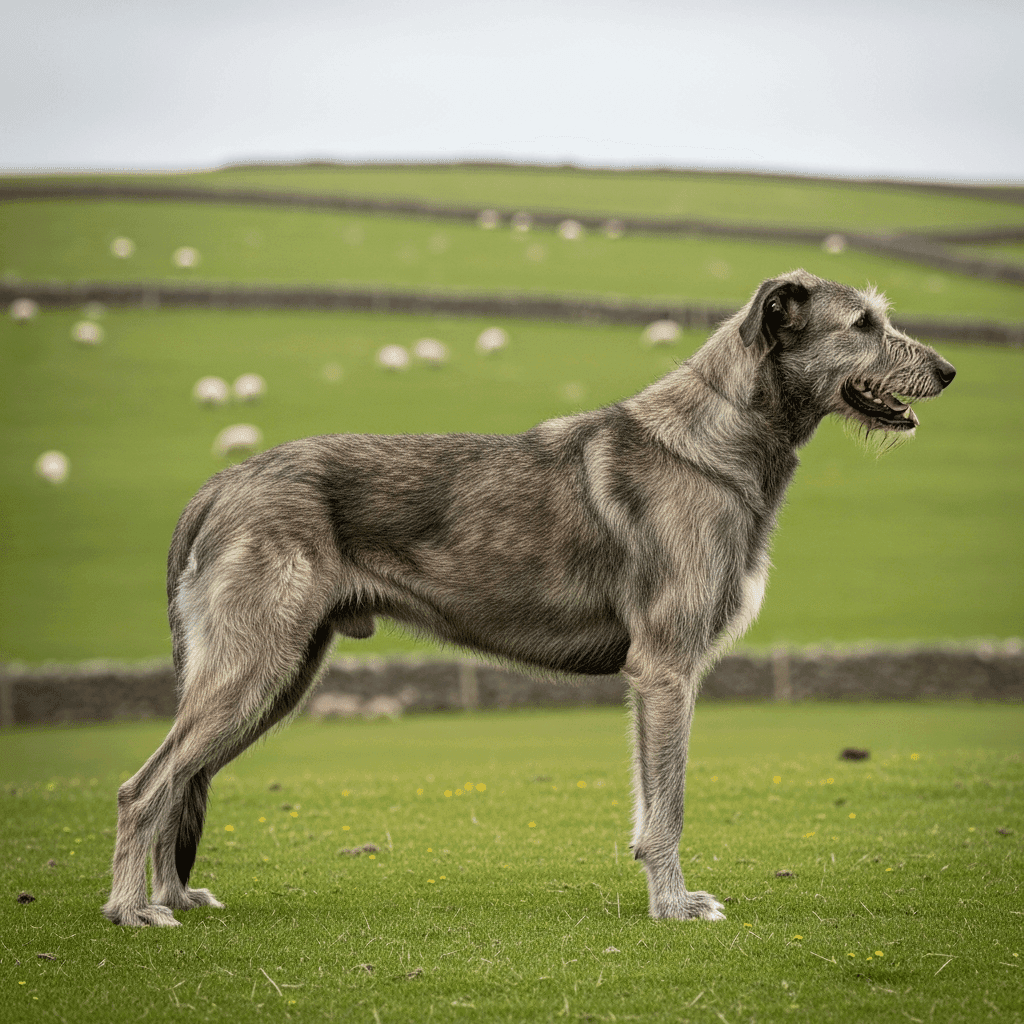
Irish Wolfhound
FCI Group
10• FCI 160
Size
Large
Origin Country
IE
Height
71-86 cm
Weight
40.5-59 kg
Lifespan
6-10 years
Temperament
Overview
The Irish Wolfhound, often referred to as the Irish Wolfhound, is one of the largest and most majestic dog breeds in the world. This proud breed originates from Ireland, where for centuries it served as a relentless hunter of wolves and deer. Its impressive silhouette – long, muscular body, powerful limbs, and characteristically long neck – commands respect and admiration.
The coat of the wolfhound is rough and tough, creating a natural protective barrier against the harsh Irish climate. Despite their impressive size and hunting background, these gentle giants stand out for their exceptionally calm and affectionate temperament. They are extremely loyal to their family and form deep emotional bonds with their caregivers, making them excellent companion dogs as well as vigilant, though non-aggressive, guardians of the home.
Irish Wolfhounds reach truly spectacular heights – from 79 to even 86 cm at the withers, placing them among the tallest dogs in the world. There is a saying that perfectly captures their nature: at home like a sheep, on a hunt like a lion. This duality of character means that within four walls they behave like gentle, calm animals, while in the field they reveal their primal hunting instinct and remarkable determination.
The history of the breed dates back to antiquity – the first written mentions come from 391 AD, when a Roman consul described these magnificent dogs. For centuries, Irish Wolfhounds were valued gifts for European royal households. Unfortunately, in the 17th century, the breed was on the brink of extinction when wolves in Ireland were completely eradicated. Thanks to the passion and determination of breeders, particularly Captain G.A. Graham in the 19th century, this unique breed was saved. Modern wolfhounds are the result of careful reconstruction using Scottish deerhounds and other breeds.
In interactions with children, Irish Wolfhounds display angelic patience and gentleness, making them ideal family dogs. However, it is important to remember that their exercise needs are significant – they require space and regular, intense physical activity. Training requires patience and consistency, as the breed matures very slowly – achieving full mental maturity only at the age of 3-4 years.
Wolfhounds love the company of people and do not tolerate loneliness well. They are not dogs for people who are often away from home. Their diet must be carefully balanced to support the proper development and health of such a large body. Unfortunately, like most giant breeds, Irish Wolfhounds have a relatively short average lifespan – usually 6-10 years, which is biologically related to their size.
Although they can adapt to various conditions, they feel best in homes with large gardens, where they have space to run and expend energy. Their rich history, noble character, and extraordinary beauty make them exceptional life companions who bring not only joy and love into the home but also a piece of Irish tradition and cultural heritage.
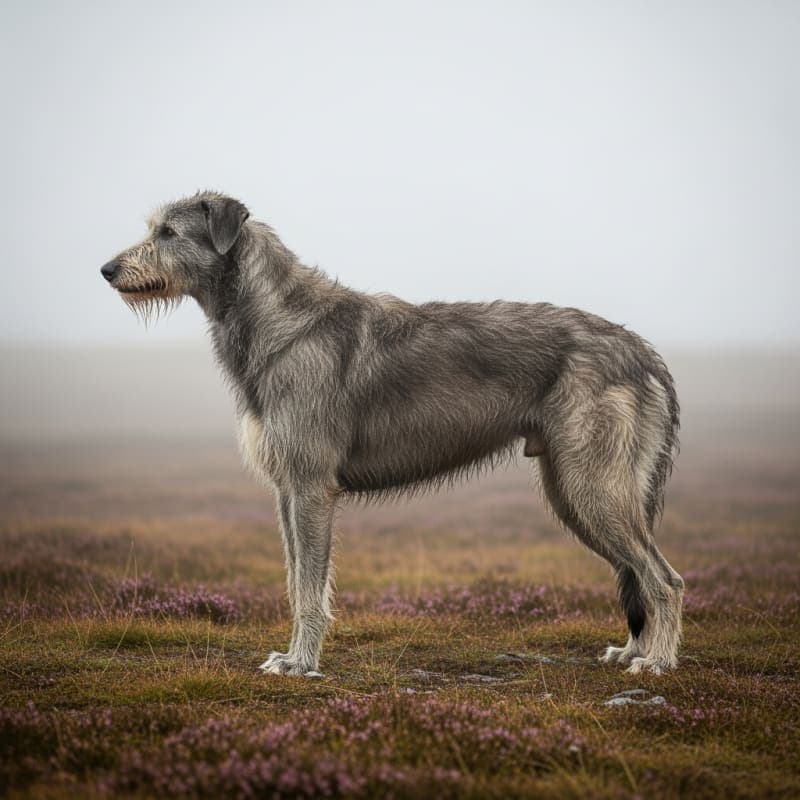
The Irish Wolfhound embodies dignity and strength in the world of dogs. Its appearance makes an immediate impression – it is a dog that leaves no one indifferent. With a height at the withers ranging from 79 to 86 cm (some individuals even exceed these dimensions), the wolfhound can easily look an adult person straight in the eye while standing on its hind legs.
The body of the wolfhound is long and harmoniously built, with strongly muscled, powerful limbs that provide it with both immense strength and surprising agility. The proportions of its silhouette somewhat resemble those of greyhounds, but on a much larger, more powerful scale. The neck is long, strong, and beautifully arched, proudly raising the head, which further emphasizes the noble appearance of this breed.
The head of the Irish Wolfhound is characteristically long, with a slightly convex forehead and an elongated, narrow muzzle. The eyes are dark, expressive, and intelligent – in their gaze, one can see both gentleness and determination. The ears are relatively small, delicate, and drooping, resembling the ears of sighthounds, which highlights their hunting heritage.
The coat is one of the most recognizable elements of this breed's appearance. It is rough, tough, and weather-resistant, with longer hairs forming distinctive brows and a beard, giving the wolfhounds a unique, somewhat fierce expression. Acceptable coat colors are diverse:
- Gray in various shades (from light to dark)
- Brindle
- Red
- Black
- Pure white
- Fawn
- Other colors typical of Scottish deerhounds
The tail is long, slightly curved, and evenly covered with fur, carried low with a gentle bend at the tip. In motion, the wolfhound exudes power and elegance at the same time – its gait is smooth, light, and full of grace, despite its enormous size. It is a dog that combines raw strength with aristocratic beauty, creating a truly majestic and unforgettable silhouette.
The Irish Wolfhound is a breed with a surprisingly gentle, calm, and affectionate temperament, which may seem counterintuitive for such a powerful hunting dog. Their temperament can best be described as a combination of the gentleness of a domestic companion and the primal strength of a hunter – a balance that makes them unique.
In relationships with family, wolfhounds show deep emotional attachment and boundless loyalty. They are incredibly patient and gentle with children, even the youngest, making them excellent family dogs. However, their calm nature does not mean a lack of vigilance – wolfhounds are excellent guard dogs that will firmly defend their territory and loved ones when necessary, though they do not exhibit excessive aggression or territoriality.
Irish wolfhounds do not cope well with loneliness and isolation from their family. They are dogs that need close contact with people and are not suited to living in a kennel or outdoors – they must be full-fledged members of the household. Prolonged loneliness can lead to separation anxiety and behavioral problems.
In relation to strangers, wolfhounds typically behave with reserve and dignity, not showing excessive cheerfulness but also without aggression. After proper introduction and socialization, they accept new guests in the home. It is worth remembering that strong hunting instincts can cause wolfhounds to react to quickly moving objects or small animals – caution is advised in interactions with cats, rodents, or small dogs, especially in the open.
One of the characteristic behavioral traits of wolfhounds is their independence – they are intelligent dogs capable of making independent decisions. However, this does not mean they are stubborn – they simply require respect and understanding of their nature. Their calm, balanced nature allows them to adapt well to the rhythm of family life, but they require an appropriate amount of exercise and stimulation to remain happy and mentally healthy.
Lack of physical and mental activity can lead to destructive behaviors – a bored wolfhound can cause significant damage in the home, though not out of malice, but from an excess of unused energy. Proper socialization from puppyhood, consistent training, and providing adequate stimuli are key to raising a balanced, happy Irish wolfhound.
Despite their originally hunting purpose, modern Irish wolfhounds are primarily dogs with a big, loving heart that can bring an atmosphere of peace, dignity, and unconditional love into the home. They respond with deep devotion to the love and respect shown by their guardians.
The Irish Wolfhound, despite its impressive build and strength, has a relatively short average lifespan – usually between 6 to 10 years, which is typical for giant breeds. Their large size is both a blessing and a curse – the body of such a large dog is subjected to greater stress and wears out more quickly.
The most serious and unfortunately the most common condition affecting Irish Wolfhounds is osteosarcoma (bone cancer) – an aggressive bone tumor that is one of the leading causes of premature death in this breed. Due to their bone size and body weight, Wolfhounds are particularly susceptible to this type of cancer. Early detection is crucial, so any limping or pain in the limbs should be immediately consulted with a veterinarian.
Gastric dilatation-volvulus (GDV) is another very dangerous condition that can affect Wolfhounds. It is a life-threatening state in which the stomach fills with gas and twists on itself, cutting off blood supply. It requires immediate veterinary intervention. To minimize the risk, one should:
- Feed smaller meals several times a day
- Avoid intense exercise immediately after eating
- Use slow-feed bowls
- Avoid giving large amounts of water right after meals
Dilated cardiomyopathy (DCM) is a heart condition characterized by the dilation of the chambers and weakening of the heart muscle, leading to circulatory failure. Regular cardiology check-ups, especially in older individuals, are necessary for early detection of the problem.
Orthopedic issues are also common in this breed. Hip and elbow dysplasia can cause pain, limping, and arthritis, especially in older age. Responsible breeders conduct radiological examinations of dogs intended for breeding to minimize the occurrence of these conditions in the population.
Other health issues include:
- Eye diseases – retinal dysplasia, progressive retinal atrophy (PRA), cataracts
- Von Willebrand's disease – a blood clotting disorder
- Wobbler syndrome – instability of the cervical vertebrae causing neurological problems
- Pneumonia and other respiratory infections
- Hypothyroidism – underactive thyroid
Health prevention is key to extending the life of the Irish Wolfhound. Regular veterinary visits (at least twice a year), a properly balanced diet tailored to the size and age of the dog, monitored physical activity, and weight monitoring are essential. It is important to avoid overloading the joints in puppies and young dogs – intense exercise should be introduced gradually, only after reaching full skeletal maturity (around 15-18 months of age).
Owners of Irish Wolfhounds should be aware of breed predispositions and monitor their dogs for any concerning symptoms – early intervention significantly increases the chances of effective treatment. Despite health challenges, with proper care, Wolfhounds can enjoy a good quality of life for many years.
The care of the Irish Wolfhound is relatively simple and low-maintenance, especially compared to many other long-haired breeds. The coarse, tough coat of this breed was created by nature to be functional and practical – it does not require frequent grooming or professional grooming services.
Bathing should be done relatively rarely – only when the dog is actually very dirty or starts to smell unpleasant. Washing too frequently can strip the coat of its natural protective oils, weakening its weather-resistant properties. Usually, a bath every 2-3 months or as needed is sufficient. During bathing, gentle shampoos designed for rough-coated dogs should be used.
Brushing is the most important element of routine care. During non-shedding periods, brushing the wolfhound 1-2 times a week is enough, using a brush with stiff bristles or a wide-toothed comb. During the shedding season (usually spring and fall), when the dog sheds more intensely, it is advisable to increase the frequency to daily or every other day. This helps to:
- Remove dead hair and prevent it from accumulating in the home
- Stimulate blood circulation in the skin
- Distribute natural oils along the length of the hair
- Prevent matting (especially behind the ears, under the armpits, and on the tail)
Ears require regular checking and cleaning, especially since they are floppy and less ventilated, creating conditions conducive to the development of bacteria and fungi. The ears should be checked at least once a week for signs of redness, unpleasant odor, or excessive wax buildup. Cleaning should be done gently, using special ear solutions for dogs and cotton balls (never insert cotton swabs deep into the ear canal!).
Oral hygiene is often neglected, yet it is crucial for the overall health of the dog. Regular tooth brushing (ideally daily, but at least 2-3 times a week) prevents tartar buildup, gum disease, and bad breath. It is advisable to use toothpaste and a toothbrush designed for dogs and to provide dental chews.
Nails on wolfhounds may require trimming, especially if the dog primarily walks on soft surfaces (grass, sand) that do not wear them down naturally. Overly long nails can make walking difficult, may grow into the paw, or break, causing pain and infections. Trimming should be done every 3-4 weeks or when the characteristic clicking of nails on the floor is heard. If the owner does not feel confident, it is better to have this task done by a veterinarian or groomer.
It is also worth periodically checking the paw pads for any wounds, cracks, embedded foreign bodies, or excessive dryness. In winter, after walks on salted streets, the paws should be rinsed with clean water.
Overall, Irish Wolfhounds are extremely easy to maintain in terms of grooming – they do not need regular haircuts, their coat does not require complicated treatments, and the basic routine (brushing, checking ears, teeth, and nails) is sufficient to keep the dog in excellent condition and appearance.
The Irish Wolfhound is a breed that, despite its calm nature at home, requires a significant amount of daily exercise and physical activity. It is a dog with hunting roots, whose body is built for prolonged effort – unused energy quickly turns into destructive behaviors and health problems.
An adult wolfhound should receive at least 2 hours of physical activity daily, preferably divided into several sessions. Ideal forms of exercise include:
- Long, brisk walks – at least twice a day for 45-60 minutes
- Running in open, safe spaces – wolfhounds love to gallop and need the opportunity to stretch out in full run
- Playing with a ball or frisbee – satisfies the chasing instinct, though care should be taken to avoid excessive jumps that strain the joints
- Hiking and trekking – an ideal activity combining effort with exploration
Irish Wolfhounds excel remarkably in dog sports, especially those that utilize their natural chasing instinct. Lure coursing (chasing an artificial hare) is a discipline created for sighthounds and hounds – wolfhounds achieve great results in it and derive immense joy from participation. Other suitable activities include:
- Agility (in a version adapted for large breeds)
- Nosework (scent work)
- Mantrailing (tracking)
- Bikejoring or canicross (for dedicated owners)
CRITICALLY IMPORTANT: intense exercises, jumps, long runs, and dog sports should NOT be introduced before reaching full skeletal maturity, which in Irish Wolfhounds occurs only around 15-18 months of age. Prematurely stressing the joints and bones in puppies and young dogs can lead to irreversible damage, dysplasia, and arthritis in the future.
In the first year of life, exercises should be short, moderate, and controlled:
- Age-appropriate walks (the rule of 5 minutes for each month of age, twice a day)
- Avoiding stairs, jumping on and off high surfaces
- Playing with other dogs on soft surfaces
- Short training sessions engaging the mind more than the body
Owners must be aware that a bored wolfhound is a destructive wolfhound. Lack of adequate movement and stimulation leads to:
- Destruction of furniture and belongings
- Excessive barking and howling
- Behavioral problems (hyperactivity, frustration aggression)
- Obesity and health issues
- Anxieties and mental disorders
It is worth remembering that wolfhounds are not suited for living in small apartments without access to a garden. They need space to move freely. The ideal environment is a home with a large, fenced garden where they can spend time outdoors. The fence must be high (at least 180 cm) and sturdy – wolfhounds can surprisingly jump over high obstacles when something interests them.
As important as physical activity is mental stimulation. Wolfhounds are intelligent dogs that need mental challenges. Interactive toys, training new commands, scent games, and a variety of walking routes help keep the dog in good mental condition.
In summary, the Irish Wolfhound is a breed for active individuals and families who can dedicate time to daily, regular physical activity. This is not a dog for sedentary people – without adequate exercise, it will not be happy or healthy.
Training an Irish Wolfhound is a task that requires patience, consistency, and an understanding of the specifics of this breed. Although Wolfhounds are intelligent dogs capable of learning, their independent nature and slow maturation make training a challenge – especially for inexperienced owners.
The most important thing to understand is that Irish Wolfhounds mature very slowly. Full physical and mental maturity occurs only at the age of 3-4 years, which means that for the first few years of life, we are dealing with a dog with the body of a giant and the mind of a puppy. This requires a special approach – combining the demands placed on a large dog with an understanding of its young mind.
Socialization should begin as early as possible – ideally at 8-10 weeks of age. A Wolfhound puppy must be gradually and positively introduced to:
- Different people (of various ages, appearances, in different clothing)
- Other dogs and animals
- A variety of sounds and environmental stimuli
- Different places and situations (pet stores, parks, crowds of people)
- Cars and other means of transportation
Proper socialization prevents the development of fears and aggression in adult life. A well-socialized Wolfhound is confident and balanced.
Training methods based on positive reinforcement work much better with Wolfhounds than traditional methods based on dominance and punishment. This breed does not respond well to harsh methods – instead of obedience, we achieve fear or stubbornness. Effective training of a Wolfhound is based on:
- Rewards – treats, verbal praise, play
- Consistency – the same rules always, all family members follow the same guidelines
- Patience – small steps, celebrating minor successes
- Diversity – varied training sessions to keep the dog from getting bored
- Positivity – training as fun, not a chore
The basic commands that every Irish Wolfhound should master:
- Recall (Come, To me) – absolutely crucial due to their hunting instinct; it can save the dog's life
- Sit and Lie Down – control in various situations
- Stay, Wait – calmness and patience
- Drop it, Leave it – safety (prevents eating something dangerous)
- Loose leash walking – comfort during walks; an 80-kilogram dog pulling on the leash is a serious problem
Particular attention should be paid to recall training. Wolfhounds have a very strong chasing instinct – if they see a fast-moving object (a rabbit, cat, bird, cyclist), they may take off in pursuit, ignoring calls. Therefore:
- Never let a Wolfhound off-leash in unconfined and dangerous areas
- Train recall regularly, in different conditions and with various distractions
- Always reward returning to you – NEVER punish a dog that comes when called (even if it takes a long time)
- Consider using a long training leash (10-15 m) at the beginning of recall training
Training sessions should be short and frequent – better to do 3 sessions of 10 minutes each day than one hour-long session. Wolfhounds, especially young ones, have a relatively short attention span and quickly get bored with monotonous exercises.
Breed-specific challenges:
- Independence – Wolfhounds may seem stubborn; they need motivation to cooperate
- Sensitivity – despite their size, they are emotionally sensitive; a harsh word can hurt them deeply
- Strong hunting instinct – requires special attention when interacting with small animals
- Tendency to jump on people – a puppy jumps happily, but an 80-kilogram adult dog can knock you down; this should be discouraged from the start
It is worth considering participation in obedience courses led by professional trainers who understand the specifics of giant breeds. Courses provide not only command training but also socialization with other dogs and building a bond between the owner and the dog.
Remember that training an Irish Wolfhound is a long-term process that lasts throughout the dog's life. You cannot raise a puppy and consider the task complete – commands and rules must be regularly repeated and reinforced. With the right approach – patient, consistent, and full of positive reinforcement – an Irish Wolfhound can become a well-mannered, obedient companion with whom cooperation is a true pleasure.
The diet of the Irish Wolfhound requires careful planning and adjustment to the specific needs of this giant breed. Proper nutrition is crucial for health, condition, and longevity – nutritional mistakes can lead to serious problems, from obesity to diseases of the musculoskeletal and digestive systems.
Basic nutrition principles for the Irish Wolfhound:
High-quality protein should be the foundation of the diet. Wolfhounds are dogs with a large muscle mass that need an adequate amount of animal protein to maintain their tissues in good condition. The source of protein should be real meat (chicken, beef, lamb, fish, turkey), not by-products or low-quality meals. Meat should be listed as the first or second ingredient in the food.
Healthy fats are essential for the proper functioning of the body – they provide energy, support the nervous system, and maintain skin health and coat quality. Omega-3 and omega-6 fatty acids are particularly important, as they have anti-inflammatory effects and support joint health (critical for giant breeds). Good sources include: salmon oil, flaxseed oil, and marine fish.
Carbohydrates should come from high-quality sources – sweet potatoes, brown rice, oats, vegetables. AVOID foods with high grain content, especially wheat, corn, and soy, which can be difficult to digest and cause food allergies. The food should be grain-free or low-grain.
Vitamins and minerals in appropriate proportions are crucial, especially:
- Calcium and phosphorus – for bone and dental health (but be careful with excess in puppies!)
- Glucosamine and chondroitin – support cartilage and joint health
- Vitamins A, D, E – for immunity, vision, and healthy skin
- Zinc and selenium – for proper metabolism
CRITICALLY IMPORTANT - Feeding puppies:
Puppies of the Irish Wolfhound CANNOT be fed standard puppy foods or high-energy foods. Rapid growth leads to irreversible damage to the musculoskeletal system, dysplasia, and bone deformities. Nutrition principles for giant breed puppies:
- Food specially formulated for giant breed puppies (Giant Puppy)
- Controlled calcium content (no more than 1.2-1.5% dry matter) and phosphorus
- Moderate protein content (23-26%) and fat (12-15%)
- Slower, controlled growth is a HEALTHY growth
- Do not add calcium supplements without consulting a veterinarian!
The amount of food must be adjusted to:
- The age of the dog (puppy, adult, senior)
- Weight and body condition
- Level of physical activity
- Health status and any conditions
The average adult Irish Wolfhound (70-80 kg) needs about 2000-2500 kcal per day, depending on activity. It is better to feed smaller portions more frequently than one large meal – this minimizes the risk of gastric torsion.
Feeding schedule:
- Puppies (2-6 months): 3-4 meals a day
- Young dogs (6-12 months): 2-3 meals a day
- Adults (over 18 months): 2 meals a day
- Seniors (over 6 years): 2 meals a day, senior dog food
Preventing gastric torsion (GDV):
- Feed 2-3 times a day, not once
- Avoid intense exercise 1-2 hours before and after meals
- Do not allow drinking large amounts of water immediately after eating
- Use slow feeder bowls or sniff mats
- Serve food at floor level, NOT on a stand
- Reduce stress during meals
Fresh water must be available throughout the day. Large dogs need proper hydration – the average Wolfhound drinks 2-4 liters of water daily.
What to AVOID in the Wolfhound's diet:
- Foods with high filler content, grains, and by-products
- Artificial colors, preservatives, and flavors
- Excess calories leading to obesity
- Cooked bones (they can splinter and damage the digestive tract)
- Toxic products for dogs: chocolate, grapes, raisins, onions, garlic, xylitol, alcohol
Weight control is crucial. Obesity in giant breeds is a death sentence – excess weight dramatically increases the burden on joints, the heart, and shortens life. A Wolfhound in proper condition should have:
- Visible ribs with light palpation (but not protruding)
- A defined waist when viewed from above
- Tucked abdomen when viewed from the side
If you have doubts about your Wolfhound's condition, consult a veterinarian.
BARF diet (raw meat and bones) vs industrial food – both approaches can be appropriate if well balanced. However, BARF requires significant knowledge and planning to avoid deficiencies. For most owners, high-quality industrial food for giant breeds will be a safer choice.
Proper nutrition is a investment in the health and longevity of the Irish Wolfhound. Consulting with a veterinarian or a dog nutrition specialist will help develop an optimal feeding plan tailored to your dog's individual needs.
Characteristic Traits
Pros
- Gentle and patient temperament
- Excellent companion for families with children
- Majestic and impressive appearance
- Loyal and attached to the family
- Calm at home despite large size.
Cons
- Short average lifespan (6-10 years)
- High movement and space needs
- Susceptibility to serious conditions (bone cancer
- gastric torsion)
- Requires a lot of space
- not suitable for small apartments
- Slow maturation (3-4 years).
Behavioral Ratings
Breed History
The Irish Wolfhound boasts one of the longest and most fascinating histories among all dog breeds. Its roots trace back to ancient times, and over the centuries, this breed has played an important role in the history, culture, and mythology of Ireland.
The first mentions of large hunting dogs in the British Isles date back to before our era. The Continental Celts, who settled in Ireland around 500 BC, brought with them large sighthounds, likely descended from ancient Egyptian hounds. The Irish Celts, like their continental cousins, were passionate about breeding large dogs – thus the progenitor of the modern Irish Wolfhound was born.
The oldest written mention of Irish hunting dogs comes from 391 AD, when the Roman consul Quintus Aurelius Symmachus described a gift of seven Irish dogs that amazed all of Rome during fights in the amphitheater. However, these dogs were already well known in Ireland long before this – in Irish legends and sagas from the 1st century AD, the figure of Cú Chulainn (the Hound of Culann), the greatest hero of Celtic mythology, appears, whose name literally means "hound," indicating the significance of these animals in Celtic culture.
In the Middle Ages, Irish Wolfhounds were valued gifts for European royal courts. From the 11th to the 17th century, pairs of these magnificent dogs were given as gifts to:
- England
- France
- Spain
- Sweden
- Denmark
- Poland
- Persia
- India
These were gifts of immense value, symbolizing prestige and power. In the 15th century, every county in Ireland was required to maintain a minimum of 24 Irish Wolfhounds to protect livestock from wolves – demonstrating the important role these dogs played in Irish society.
The main task of the wolfhounds for centuries was hunting wolves, which posed a serious threat to Irish herds and settlements. These dogs were also used to hunt deer, boars, and other large animals. Their strength, speed, and courage made them invaluable companions for hunters. Irish hounds undoubtedly shaped the Scottish deerhounds – a Scottish breed that largely emerged due to the genotype of Irish Wolfhounds brought to Scotland.
The 17th century brought tragedy for the breed. Intensive deforestation in Ireland and systematic extermination of wolves led to the complete eradication of wolves in Ireland around 1786. With the disappearance of wolves, the need to maintain wolfhounds also vanished – the breed began to decline. By the mid-19th century, Irish Wolfhounds were on the brink of extinction – only a few individuals remained, often crossed with other breeds, losing their distinctive traits.
The rescue of the breed is credited to Captain George Augustus Graham, a Scottish officer and dog enthusiast. In the 1860s and 70s, during a period of rising Irish nationalism and interest in native cultural heritage, Graham undertook the ambitious task of recreating the Irish Wolfhound breed. His work was a pioneering attempt to reconstruct an extinct breed.
Graham began by locating the last individuals resembling the old Irish Wolfhounds. Then, using carefully selected crosses with:
- Scottish Deerhounds (the closest relatives)
- Great Danes (for size and strength)
- Russian Borzois (for elegance and speed)
- Possibly mastiffs and other dogs
...he managed to recreate a breed type similar to historical descriptions and representations. In 1879, the Irish Kennel Club established a separate class for Irish Wolfhounds at its shows, marking the official recognition of the breed's reconstruction. In 1885, the Irish Wolfhound Club was formed, which established the first breed standard.
Graham's work and that of his collaborators bore fruit – by the end of the 19th century, Irish Wolfhounds had once again become a recognizable and valued breed. They gradually spread around the world, winning the hearts of breeders and dog owners on all continents.
The 20th century brought further development for the breed. Irish Wolfhounds participated in shows, gaining popularity as companion and family dogs. Their role changed from hunting assistant to beloved family member – although the hunting instinct remained alive.
Today, the Irish Wolfhound is a national symbol of Ireland and a source of pride for Irish canine heritage. It is also the official mascot of the Irish Guards, an elite unit of the British Army recruited from Ireland. During military ceremonies, the Irish Wolfhound in full dress uniform is led by a drum sergeant – a tradition dating back to 1902.
The history of the Irish Wolfhound is a story of triumph of passion over oblivion – a breed that nearly vanished forever, has survived and flourishes today thanks to the determination of a handful of enthusiasts. Modern Irish Wolfhounds are a living monument to ancient Celtic culture, medieval Ireland, and 19th-century national revival. Their majestic presence reminds us of the times when wolves roamed the Irish hills, and brave dogs stood side by side with their human companions.