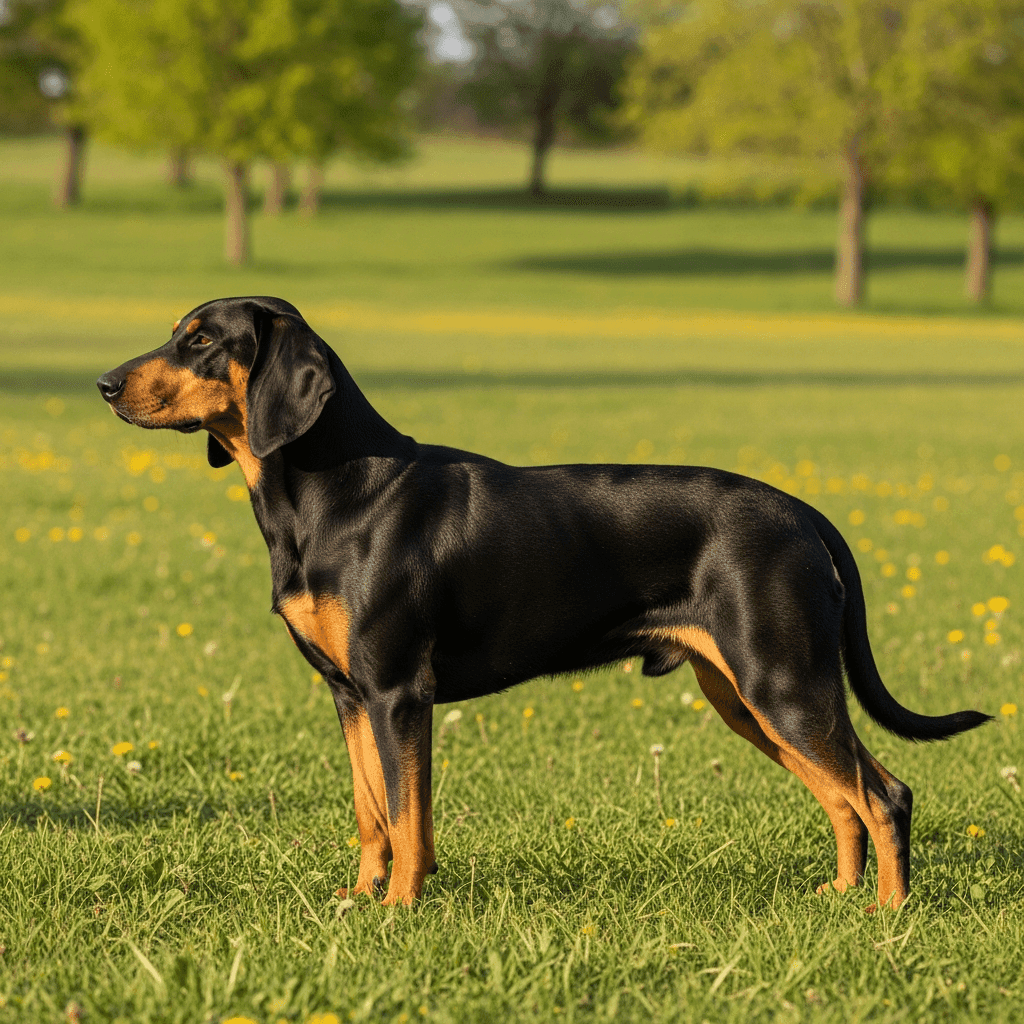
Austrian Hound
FCI Group
6• FCI 63
Size
Medium
Origin Country
AT
Height
48-56 cm
Weight
15-22 kg
Lifespan
12-14 years
Temperament
Overview
Austrian Hound, also known as Brandlbracke or Vieräugl (which in German means 'four-eyed'), is a unique medium-sized hunting dog that is sure to attract the attention of both hunters and dog lovers. Originating from Austria, this dog has a rich history dating back to Celtic times when it was used for hunting large game in the mountainous regions of the Alps. Its exceptional endurance, speed, and excellent sense of smell make it an indispensable assistant for hunters, but also an ideal companion for active families and lovers of long mountain hikes.
What makes the Austrian Hound so special? First and foremost, its characteristic light tan-brown markings above the eyes, which look like an extra pair of eyes – hence the name 'Vieräugl'. This unique feature of its appearance, combined with its black coat, gives it a distinguished and elegant look. This breed is recognized by the FCI (Fédération Cynologique Internationale) and classified in group 6, section 1.2 – medium-sized hounds.
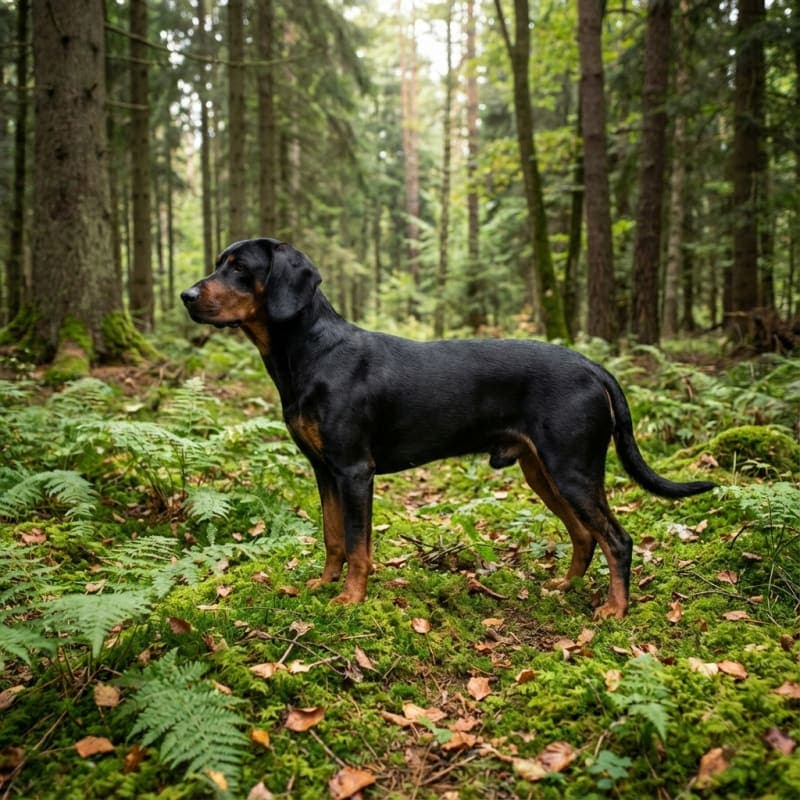
The Austrian Hound is distinguished by its strong, long, and flexible body structure, which allows it to work in the most challenging terrain conditions – from steep mountain paths to dense forests and wetlands. Its short, smooth, and shiny black coat with light brown tan markings not only adds to its elegance but is also practical – dirt-resistant and easy to maintain. With a height at the withers ranging from 48 to 56 cm, it falls into the medium-sized dog category, although its physique is very strong and well-muscled.
This dog is extremely intelligent and hardworking, making it relatively easy to train – provided that the trainer has experience working with hunting dogs. Its independence and strong hunting instinct require a consistent approach and sufficient amounts of exercise and mental stimulation. The Austrian Hound is not a dog for those leading a sedentary lifestyle – it needs an active owner who will provide it with daily long walks, scent training, or hunting.
The temperament of the Austrian Hound is friendly, balanced, and loyal. Within the family, it is affectionate and devoted, getting along well with children and other dogs. However, it can be somewhat wary of strangers, making it an excellent guard dog – always alert but not aggressive. Its strong hunting instincts may complicate cohabitation with small pets such as cats, rabbits, or rodents, so it feels better in the company of other dogs with a similar temperament.
The Austrian Hound thrives best in active families that spend a lot of time outdoors – especially in mountainous areas, forests, and rural regions. This is a dog for someone who loves hiking, running, cycling, or hunting. If you are looking for a companion for shared adventures in the field, the Austrian Hound will be an ideal choice. We invite you to further explore this fascinating dog in our guide, where we will discuss its health, grooming, training, dietary needs, as well as historical and behavioral aspects in detail.
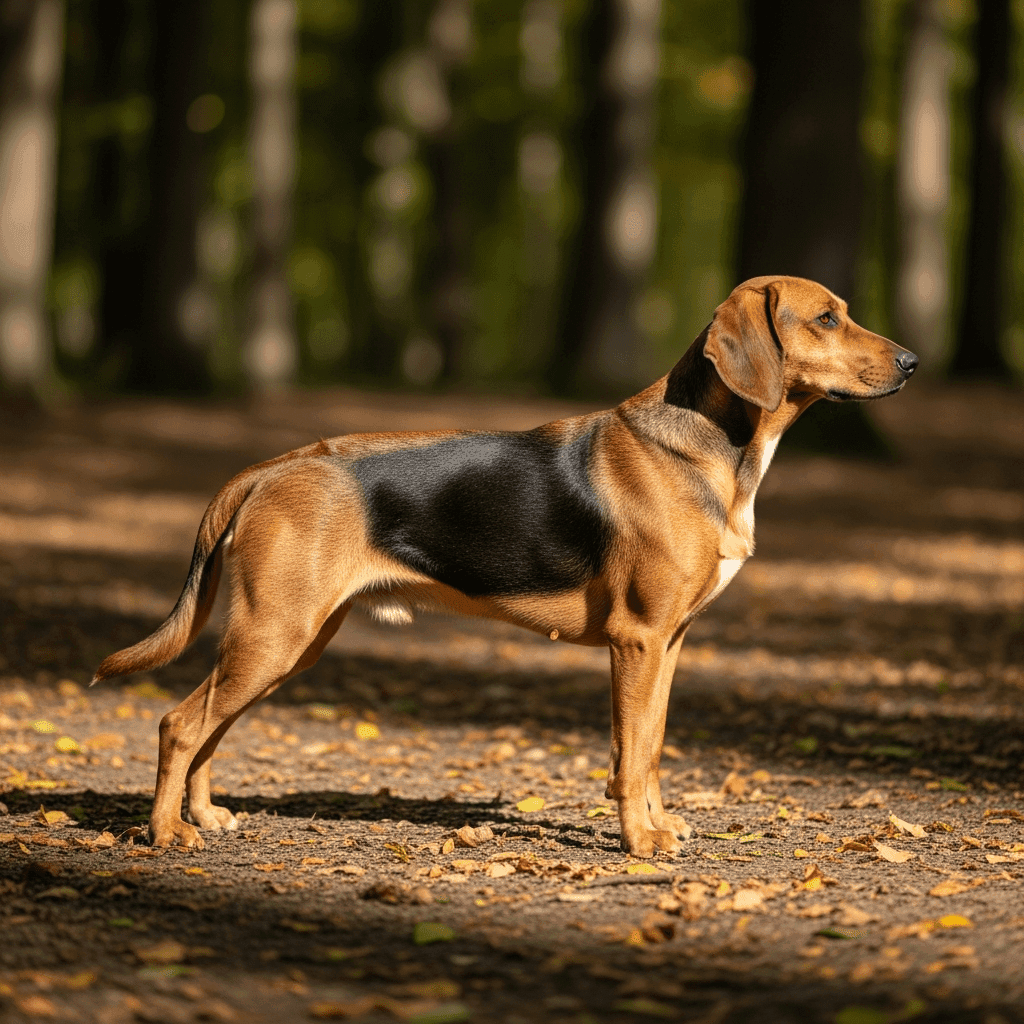
The Austrian Hound is a medium-sized dog with a characteristic silhouette that combines strength, endurance, and elegance. According to the FCI standard, the height at the withers ranges from 48 to 56 cm, with females being slightly smaller than males. The weight varies between 15 and 22 kg, depending on gender and build. Its body is strong, long, and very flexible, allowing it to move freely in the most challenging terrain conditions – from mountain paths to dense underbrush.
Head and face structure:
- Head – proportional to the body, with a broad skull and a barely noticeable occipital bump
- Muzzle – strong, straight nose bridge, well-developed lips tightly adhering to the jaws
- Nose – black, with wide nostrils (typical for hunting dogs)
- Eyes – dark brown, round, expressing intelligence, alertness, and liveliness of character
- Ears – long, drooping, slightly rounded at the tips, set high, covered with fine hair
- Teeth – a full set of 42 teeth, scissors bite (the FCI standard allows for the absence of a maximum of two PM1 or PM2)
Characteristic coat features:
The coat of the Austrian Hound is short, smooth, dense, shiny, and tightly adhering to the body. The coloration is exclusively black with light brown tan markings, which occur in characteristic places:
- Two distinct tan-brown markings above the eyes (known as 'Vieräugl' – four eyes), which are the breed's hallmark
- Tan markings on the sides of the muzzle, around the nose, on the lips
- Tan markings on the inner side of the ears
- Two tan markings on the chest (characteristic of the breed)
- Tan markings on the inner side of the limbs, under the tail, and around the anus
Body and limb structure:
- Neck – strong, medium length, slightly arched, without a dewlap
- Back – long, straight, strong, well-muscled
- Loin – short, wide, very muscular
- Chest – deep, well-developed, reaching to the elbows, with an oval cross-section
- Tail – long, thick at the base, tapering towards the end, slightly curved, hanging down when at rest, raised to the level of the back when working
- Front and hind limbs – strong, well-muscled, with a sturdy bone structure, paws are compact, round, with dark claws
Thus, the Austrian Hound is not only a beautiful dog with a distinguished appearance but also a well-built worker, whose anatomy is perfectly adapted for work in difficult terrain. Its elegant silhouette combined with the characteristic black and tan coloration makes it easily recognizable and attracts attention both at shows and in the forest during hunting.
The Austrian Hound is a dog with a balanced, friendly, and loyal temperament, combining traits typical of hunting dogs with excellent predispositions for family life. Its disposition makes it get along well with children and other dogs, provided it has been properly socialized from puppyhood. It is a dog with a high hunting instinct, which can make its behavior unpredictable in the presence of small animals such as cats, rabbits, chickens, or rodents.
Key character traits:
- Intelligent and hardworking – learns new commands quickly, has an excellent memory
- Loyal and devoted – very attached to its owner and family
- Alert and attentive – a great watchdog, reacts to unusual sounds
- Sensitive and empathetic – senses the mood of its caregiver, does not cope well with loneliness
- Energetic and full of life – needs physical activity and mental stimulation
- Independent and self-reliant – can make decisions while hunting
Behavior in the family:
Within the family, the Austrian Hound is gentle, patient, and sociable. It gets along well with children, with whom it enjoys playing, although due to its energy and strength, it requires supervision around small children. This is a dog that wants to be part of the family and participate in all activities – from walks to hikes to relaxing together on the couch after a tiring day. It is not a dog that can be kept in a kennel or on a chain – it needs close contact with the family.
Behavior towards strangers:
The Austrian Hound is usually not very fearful, but it can be somewhat distrustful and cautious of strangers, which makes it a good watchdog. It is not aggressive, but barks loudly when it notices someone unfamiliar on the property. After proper socialization, it accepts guests, although it may maintain some distance. This is a desirable trait in hunting dogs, which need to be alert but not overly nervous.
Hunting instinct and behavior in the field:
This is an aspect that every future owner must understand well. The Austrian Hound has a very strong hunting and scent instinct, which means that:
- During walks, it may follow a scent and ignore calls
- It may chase wild animals, birds, or cats
- When tracking a scent, it is very focused and persistent
- It can work independently, without constant direction from the hunter
- It tends to bark loudly while tracking (known as 'baying')
Relationships with other animals:
The Austrian Hound gets along well with other dogs, especially those with a similar temperament and energy. It is sociable and enjoys playing together. However, its hunting instincts complicate life with small animals – cats, rabbits, chickens, or rodents may be seen as prey. Therefore, it is not the best choice for households with such animals unless the dog has been raised with them from puppyhood and taught to accept them.
Activity level and mental stimulation:
The Austrian Hound is a high-energy dog that requires at least 2-3 hours of activity daily. Without adequate exercise and mental stimulation, it may become destructive, exhibit undesirable behaviors (chewing furniture, digging holes, excessive barking), or become unhappy and apathetic. It needs:
- Long walks and hikes (at least 1-2 hours daily)
- Scent games and tracking (hiding treats, scent trails)
- Obedience training and tricks
- Hunting or hunting training (ideally)
- Playtime with other dogs
Recommendations for owners:
The Austrian Hound will thrive best in active families that:
- Live in a house with a garden (not in an apartment)
- Spend a lot of time outdoors (mountains, forests, rural areas)
- Have experience with hunting dogs or dogs with strong instincts
- Are willing to dedicate time to regular training and long walks
- Are patient and consistent in training
This is not a dog for novice owners or for those leading a sedentary lifestyle. The Austrian Hound is a wonderful companion for active people who will love its energy, intelligence, and loyalty.
The Austrian Hound is generally a healthy and resilient breed, which is the result of centuries of selection focused on functionality and endurance. The average lifespan is between 12 and 14 years, although many individuals with proper care and good genes can live up to 15-16 years. Like all dog breeds, the Austrian Hound can also be prone to certain health issues that prospective owners should be aware of.
Most common health problems:
1. Hip and elbow dysplasia (HD and ED)
These are the most common musculoskeletal disorders found in medium and large dogs. Dysplasia involves the abnormal formation of the joint, leading to pain, stiffness, and ultimately arthritis. The risk in the Austrian Hound is moderate, but it is recommended to:
- Conduct X-ray examinations in breeding dogs (before allowing them to breed)
- Maintain a healthy body weight (overweight worsens joint conditions)
- Avoid excessive jumping and intense training in puppies under 12 months of age
- Supplement with glucosamine and chondroitin in older dogs
2. Ear infections (otitis externa)
Due to their long, droopy ears that limit ventilation of the ear canal, the Austrian Hound is prone to ear infections. Moisture, dirt, earwax, and plant debris (after hiking in the woods) can lead to inflammation. Symptoms include:
- Frequent scratching and shaking of the ears
- Unpleasant odor from the ears
- Redness and swelling of the inner ear
- Discharge (brown, yellow, or green)
Prevention: Regularly check the ears (2-3 times a week), clean with special ear solutions, and thoroughly dry after baths and walks in the rain.
3. Demodicosis (demodectic mange – skin inflammation caused by Demodex mites)
Demodicosis is a skin condition caused by an excessive proliferation of the Demodex canis mite, which normally lives on the skin of dogs in small amounts. In the Austrian Hound, it can occur in a juvenile form (in puppies) or an adult form (related to a weakened immune system). Symptoms include:
- Hair loss around the eyes, muzzle, and on the limbs
- Redness and flaking of the skin
- Itching (in complicated forms with bacterial infection)
Treatment: Requires veterinary intervention – topical medications, medicated shampoos, and sometimes antibiotics.
4. Excessive drooling and overheating
Although the Austrian Hound has short fur, during very intense exertion (especially on warm days), it may show a tendency to excessive drooling and overheating. This is typical for working dogs. It is important to:
- Ensure access to fresh water during walks and hunts
- Avoid training in full sun on hot days (in the morning or evening)
- Monitor for signs of overheating: heavy breathing, excessive drooling, lethargy, vomiting
- If necessary, cool the dog in the shade, provide water, and moisten the coat (but not with ice-cold water!)
5. Injuries while working in the field
Due to work in difficult terrain (forests, thickets, mountain paths), the Austrian Hound may be exposed to mechanical injuries, such as:
- Cuts on the paws (glass, sharp stones, thorns)
- Bruises, sprains, strains (while running on uneven terrain)
- Ticks, grass seeds lodged in ears, eyes, between toes
- Bites from wild animals (wild boars, foxes)
Prevention: After each walk, thoroughly check the paws, ears, and body; remove ticks, clean wounds, vaccinate against rabies, and regularly deworm.
Prevention and health care:
To ensure the Austrian Hound enjoys good health throughout its life, owners should:
- Regular veterinary visits – at least once a year for check-ups, vaccinations, and deworming
- Healthy diet – high-quality food tailored to age, activity, and health status
- Maintain a healthy weight – obesity is an enemy of joints and heart
- Appropriate amount of exercise – an active dog is a healthy dog
- Hygiene – regular cleaning of ears, teeth, and nail trimming
- Protection against parasites – deworming every 3 months, tick and flea treatments
Although the Austrian Hound may be prone to certain conditions, it is generally a strong, resilient, and long-lived dog. With proper care, regular veterinary check-ups, and a healthy lifestyle, most individuals reach a ripe old age in excellent condition.
The Austrian Hound is a breed that does not require complicated or time-consuming grooming, making it an ideal choice for people who prefer dogs with low grooming needs. Their short, smooth, and shiny coat is very practical – dirt-resistant, self-cleaning (to some extent), and easy to maintain. However, like any hunting dog working in the field, the Austrian Hound requires regular checks and basic grooming.
1. Coat Care – Brushing
The coat of the Austrian Hound is short and closely fitting to the body, so it does not require frequent brushing. Usually, once a week is sufficient to:
- Remove dead hair and distribute natural skin oils
- Minimize shedding
- Check the condition of the skin (for wounds, ticks, irritations)
During shedding seasons (spring and autumn), more frequent brushing may be necessary – 2-3 times a week – to effectively remove dead hair and keep the home clean. A soft rubber brush or grooming glove that massages the skin and catches dead hair is sufficient for brushing.
2. Bathing
The Austrian Hound does not require frequent baths. Its coat is quite resistant to dirt and has a natural ability to self-clean. Bathing is recommended:
- Every 2-3 months or when the dog is really dirty (mud, swamps, smelly trails)
- After intense hunting or hiking in the field
- When an unpleasant odor appears
Important: Use gentle dog shampoos (preferably made from natural ingredients) that do not dry out the skin. After bathing, thoroughly dry the dog with a towel, especially the ears!
3. Ear Care (CRITICAL!)
This is the most important aspect of grooming the Austrian Hound. Due to its long, drooping ears that limit ventilation, this dog is prone to ear infections. Regular checking and cleaning of the ears is absolutely necessary:
- Check the ears 2-3 times a week – especially after walks in the woods, meadows, wetlands
- Clean once a week with special ear cleaning solutions (available from veterinarians or pet stores)
- Remove plant debris – grass seeds, burrs, leaves can get deeply embedded in the ear canal
- Thoroughly dry after bathing, swimming, or walking in the rain (moisture = environment for bacteria and fungi)
How to clean ears:
- Pour a few drops of ear cleaning solution into the ear canal
- Massage the base of the ear for 20-30 seconds (the dog should enjoy this)
- Let the dog shake its head (dirt and wax will come out)
- Wipe the outer part of the ear with a cotton ball or gauze (NEVER push cotton swabs deep!)
4. Dental Care
Oral hygiene is often neglected, and tartar and periodontal disease can lead to serious health problems (including heart and kidney diseases). Recommendations:
- Brush teeth 2-3 times a week with a specialized toothbrush and toothpaste for dogs
- Provide dental chews (natural or specialized)
- Regular scaling at the veterinarian (removal of tartar) – once every 1-2 years or as needed
5. Nail Trimming
If the Austrian Hound runs a lot on hard surfaces (asphalt, stones, concrete paths), its nails wear down naturally. However, if it mainly walks on soft soil, in the woods, or on grass, regular nail trimming is necessary – every 4-6 weeks.
- Too long nails can break, grow in, cause pain, and lead to walking problems
- Use specialized nail clippers for medium-sized dogs
- Be careful not to cut the nerve and blood vessels (the pink part of the nail)
- If you lack experience, ask a veterinarian or groomer for help
6. Post-Walk Inspection (IMPORTANT!)
As a hunting dog working in the woods, the Austrian Hound requires a thorough check after every walk, especially after long hikes in forests, thickets, and meadows:
- Check the paws – cuts, embedded thorns, stones between toes, cracked pads
- Check the ears – grass seeds (barbs) can get deeply embedded in the ear canal (very painful!)
- Check the whole body – ticks (especially on the belly, armpits, neck, behind the ears), wounds, scratches
- Remove ticks – as soon as possible with a specialized hook or tweezers (do not crush!)
- Clean wounds – rinse with soap and water, disinfect, monitor (for signs of infection)
7. Parasite Prevention
Due to frequent exposure to the outdoors (forests, meadows, fields), the Austrian Hound is at risk of contact with ticks, fleas, and worms. Regular prevention is essential:
- Tick and flea treatments – spot-on treatments, collars, tablets (choose the form recommended by your veterinarian)
- Worming – every 3 months (especially for hunting dogs that may eat carrion or come into contact with wild animals)
- Tick vaccination (babesiosis) – in high-risk areas
8. Other Grooming Aspects
- Wipe the muzzle and chin – especially after intense activity when the dog may drool excessively
- Check the eyes – remove discharge from the corners of the eyes, monitor for redness
- Check the skin – for rashes, irritations, hair loss, lumps
Summary – Grooming Schedule:
| Activity | Frequency |
| Coat brushing | Once a week (2-3x during shedding season) |
| Bathing | Every 2-3 months or as needed |
| Ear cleaning | Once a week + check 2-3x a week |
| Teeth brushing | 2-3 times a week |
| Nail trimming | Every 4-6 weeks |
| Post-walk inspection | After every walk in the field |
| Parasite prevention | Ticks/fleas: monthly, worming: every 3 months |
The Austrian Hound is a dog with minimal grooming needs, but it requires regular checks and attention to hygiene – especially of the ears, paws, and teeth. With the right grooming routine (15-30 minutes a week), your hound will remain healthy, clean, and looking beautiful throughout its life.
The Austrian Hound is a dog with a very high energy level that requires a lot of exercise to stay healthy, happy, and mentally balanced. This breed is definitely not suitable for apartment living or for people with a sedentary lifestyle. The Austrian Hound needs an active owner, space to run, and a minimum of 2-3 hours of activity per day. It is a dog for people who love long hikes in the mountains, forests, running, or hunting.
Daily exercise needs – minimum:
- 2-3 hours of physical activity per day – walks, running, hiking, training
- At least 2-3 walks per day – each lasting 45-60 minutes
- The ability to run freely in a safe area (garden, forest, meadow)
- Mental stimulation – scent training, obedience, intellectual games
Ideal activities for the Austrian Hound:
1. Long hikes in the mountains and forests
This is absolutely the best form of activity for the Austrian Hound. This breed was bred to work in the challenging mountainous terrain of the Alps, so:
- It loves long trekking hikes (5-10 km or more)
- It excels on steep paths, rocks, and in underbrush
- It has inexhaustible stamina – can hike for many hours
- It loves exploring new areas and tracking scents
2. Running and jogging
The Austrian Hound is a great running partner. It loves to run alongside a bike, accompany you while jogging, or run freely in the field. Ideally:
- Running next to a bike – 30-60 minutes at a moderate pace (be careful not to overexert the dog!)
- Jogging – the Austrian Hound can run alongside you for many kilometers
- Canicross (running with a dog in a harness) – an excellent discipline for this breed
Important: Do not run with your dog on asphalt on hot days! Avoid running with young dogs (under 12-15 months) – it harms joint development.
3. Hunting and hunting training
This is absolutely the natural form of activity for the Austrian Hound. If you are a hunter or have the opportunity to participate in hunting training:
- Hunting for hares, foxes, wild boars – the Austrian Hound excels at this
- Tracking and trailing game – utilizing its phenomenal sense of smell
- Field training – artificial trails, learning to track, obedience in the field
- Mantrailing (tracking people) – an alternative for non-hunting dogs
4. Scent games and mantrailing
If you do not hunt, you can satisfy the instincts of the Austrian Hound through scent games, which are extremely satisfying for it:
- Nosework – searching for hidden scents (essential oils, treats)
- Mantrailing – tracking people (a sport for dogs and their handlers)
- Hiding treats in the house or garden – simple but very engaging
- Artificial trails – dragging a cloth soaked in scent and then tracking it by the dog
5. Agility, obedience, rally-O
Although the Austrian Hound is not a typical sports dog (like a border collie), it can participate excellently in dog sports that provide it with mental and physical stimulation:
- Agility – an obstacle course that develops agility and obedience
- Obedience – advanced obedience, precise execution of commands
- Rally-O – a combination of obedience and fun on the course
Note: The Austrian Hound has an independent nature, so these sports may be a bit more challenging than with typical obedient breeds, but with proper training and motivation, it can achieve great results.
6. Free running and play in the garden
The Austrian Hound needs space to run freely. Ideally:
- A large garden (minimum 500-1000 m²) fenced (minimum height of 1.5 m)
- A safe area – forest, meadow, field, where the dog can run off-leash (if recall is well trained)
- Dog parks – safe, fenced areas where dogs can run freely
Important: The Austrian Hound has a strong hunting instinct – when running freely, it may follow a scent trail and ignore calls. Therefore, only let it off-leash in a safe, fenced area or when you are sure that recall works 100%.
7. Play with other dogs
The Austrian Hound is social and loves to play with other dogs. Regular meetings with dog buddies (especially those with a similar energy level) are an excellent form of physical and social activity:
- Running together, chasing, wrestling
- Hiking together with other dog owners
- Visits to the dog park
Consequences of insufficient exercise:
If the Austrian Hound does not receive enough physical and mental activity, it may develop serious behavioral problems:
- Destructive behaviors – chewing furniture, cushions, shoes, digging holes in the garden
- Excessive barking and howling – out of frustration and boredom
- Escaping – jumping fences, digging under to satisfy the need for movement
- Aggression or hyperactivity – excess pent-up energy
- Apathy and depression – in extreme cases, the dog may become apathetic and unhappy
- Obesity – lack of exercise + normal eating = overweight = health problems
Recommendations for owners:
To ensure the Austrian Hound receives the appropriate level of activity:
- Minimum 2-3 hours of activity per day – no compromises!
- Variety – walks + running + scent games + obedience training
- Rest – after intense exertion, provide the dog with quiet time to recover
- Weather adaptation – avoid very intense training on hot days
- Regular veterinary check-ups – checking joints, paws, overall condition
Who is the Austrian Hound for?
The Austrian Hound is a dog for:
- Active people who spend a lot of time outdoors
- Hunters who need a durable dog for hunting
- Residents of rural areas with a large garden or access to forests
- Trekking, running, mountain sports enthusiasts
- People with experience working with hunting dogs
IT IS NOT a dog for:
- People living in apartments without access to a garden
- People leading a sedentary lifestyle
- Beginner dog owners
- People who do not have time for 2-3 hours of activity per day
In summary: the Austrian Hound is a dog with extreme exercise needs. If you are ready to provide it with the right amount of activity, you will have a tireless adventure companion who will love hiking, running, and exploring the world together.
The Austrian Hound is a breed that is intelligent, eager to learn, and hardworking, which makes training effective and satisfying – provided that the trainer understands the specifics of hunting dogs. With a natural inclination to work and a strong hunting instinct, these dogs can be very well trained for various tasks, including hunting, tracking, obedience, and dog sports. However, the Austrian Hound also has an independent nature typical of hunting dogs, which means that sometimes it may make its own decisions instead of blindly following commands.
Key traits influencing training:
- High intelligence – quickly learns new commands and can solve problems
- Strong hunting instinct – may be distracted by scents and tracks
- Independence – can think independently, which is an advantage during hunting but a challenge in obedience training
- Sensitivity – responds well to positive reinforcement, poorly tolerates harsh punishments
- Motivation to work – loves tasks that require scent and physical effort
Basic training principles for the Austrian Hound:
1. Positive reinforcement – the key to success
The Austrian Hound is a sensitive and empathetic dog that responds best to positive training methods. Owners should:
- Reward desired behaviors – with treats, praise, play
- Ignore undesirable behaviors – instead of punishing, it’s better not to reinforce bad behaviors with attention
- Avoid physical punishments and shouting – this weakens the bond with the dog and can lead to fear or aggression
- Be patient and consistent – repeat exercises, gradually increase difficulty
2. Early socialization (from 8 weeks of age)
Socialization is the most important element of raising an Austrian Hound. The puppy should be exposed to various stimuli from a young age:
- Different environments – city, forest, meadow, river, shops, train station
- Different people – children, adults, seniors, people in uniforms, with hats, glasses
- Other animals – dogs (various breeds and sizes), cats (if they are to be in the home), horses, cows
- Various sounds – cars, trams, thunder, fireworks, loud music
- Different surfaces – grass, asphalt, metal, stairs, bridges
Goal: To raise a confident, balanced dog that is not afraid of new situations.
3. Basic obedience commands
Every Austrian Hound should master basic commands that ensure safety and control:
- Sit – basic command, easy to learn
- Lie down – important for calming the dog
- Stay – teaches patience and self-control
- Come / Here – the most important command for safety (especially for dogs with a strong hunting instinct!)
- Leave it / No – prevents eating dangerous things, chasing animals
- Heel – walking by the side during walks
Tip: Train these commands in different places (home, garden, park, forest) and with various levels of distraction so that the dog listens in every situation.
4. Recall – the most important command!
Due to the strong hunting instinct, the Austrian Hound may follow a trail during walks and ignore the owner's call. Therefore, learning a reliable recall is absolutely crucial:
- Start training at home – without distractions
- Gradually increase distance and distraction – garden, park, forest
- Use high-value treats – chicken, cheese, liver (something the dog does NOT get every day)
- Always reward the return – even if the dog returns after a long time, NEVER punish for returning!
- Practice regularly – several times a day in different situations
- Consider a long training leash (10-20 m) at the beginning to maintain control when the dog starts tracking
Goal: The dog should return immediately on command, even when distracted by scents.
5. Control of the hunting instinct
This is the biggest challenge in training the Austrian Hound. The strong hunting instinct means the dog can:
- Chase hares, deer, birds, cats
- Ignore calls while tracking
- Be overly excited in the presence of wild animals
How to control the hunting instinct:
- Training in controlled conditions – on a long leash, with artificial tracks
- Teaching the command Leave it – when the dog wants to chase an animal
- Rewarding for ignoring stimuli – when the dog sees a hare but does not chase, HUGE reward!
- Regular scent training – mantrailing, nosework, to satisfy the need to track in a controlled way
- Realistic expectations – the Austrian Hound will ALWAYS have a hunting instinct; it cannot be completely eliminated
6. Scent training – a natural form of stimulation
The Austrian Hound LOVES working with its nose. Scent training is extremely satisfying for it and provides excellent mental stimulation:
- Nosework – searching for hidden scents (essential oils, treats)
- Mantrailing – tracking people (a sport for dogs and handlers)
- Artificial tracks – dragging a cloth soaked in scent for the dog to track
- Hiding treats – simple but very engaging
Benefits: A satisfied, mentally tired dog that does not seek other ways to release energy (destructive behaviors).
7. Hunting training
If you are a hunter or have the opportunity to participate in field training, this is absolutely the best form of training for the Austrian Hound:
- Tracking game – utilizing natural abilities
- Obedience in the field – listening to commands despite distractions (scents, animals)
- Working in difficult terrain – mountains, thickets, wetlands
- Collaboration with the hunter – building a bond and understanding
8. Agility, obedience, and other dog sports
Although the Austrian Hound is not a typical sporting dog, it can excel in dog sports:
- Agility – obstacle course, agility, obedience
- Obedience – advanced obedience
- Rally-O – a combination of obedience and fun on the course
Challenge: The Austrian Hound has an independent nature, so achieving the highest levels in these disciplines may be more challenging than with more obedient breeds (border collie, German shepherd). But with the right training and motivation, it can achieve great results.
9. Consistency and patience
The key to effective training of the Austrian Hound is consistency and patience:
- Regular training sessions – 10-20 minutes daily (short, intense sessions are more effective than long, exhausting ones)
- Consistent rules – if it’s not allowed on the couch once, it’s never allowed (do not change the rules)
- All family members apply the same rules – the dog must know what is allowed
- Gradually increase difficulty – do not skip stages; first master the basics
- Reward small progress – do not wait for perfection; reward every step in the right direction
10. Challenges in training the Austrian Hound
Owners should be aware of certain challenges:
- Distraction by scents – during walks, the dog may be very focused on tracks
- Delayed reactions to commands – when the dog is tracking, it may ignore calls (not out of spite but due to excessive concentration)
- Independence – this is not a breed that will blindly follow every command without thinking
- High energy – without the right amount of exercise, training will be very difficult (the dog will not be able to concentrate)
Recommendations for owners:
- Start training from puppyhood (from 8 weeks of age – socialization, from 3-4 months – basic commands)
- Consider a puppy school – professional training, socialization with other dogs
- Be patient and consistent – training the Austrian Hound takes time
- Utilize scent training – it’s a natural way to stimulate and tire the mind
- If you have difficulties, seek help from a professional trainer – especially one experienced in working with hunting dogs
Summary:
The Austrian Hound is intelligent, eager to learn, and can be well-trained – provided that the trainer uses positive methods, is patient, and consistent. It requires an experienced owner who understands the specifics of hunting dogs and can control their strong hunting instinct. With the right approach, the Austrian Hound will be a obedient, well-mannered dog that excels both at home and in the field.
Proper nutrition for the Austrian Hound is key to its health, physical condition, and longevity. As a high-energy hunting dog, the Austrian Hound requires high-quality food that provides the right amount of protein, fats, vitamins, and minerals to maintain optimal body weight, strong muscles, healthy joints, and a shiny coat.
Basic principles of feeding the Austrian Hound:
1. High-quality food – the foundation of health
Owners should choose high-quality food tailored to the dog's age, activity level, and health status. It's important to pay attention to the food's ingredients:
- Protein (25-30%) – of animal origin (chicken, beef, fish, lamb) as the first ingredient
- Fats (12-18%) – a source of energy, supports skin and coat health, omega-3 and omega-6 fatty acids
- Carbohydrates (30-50%) – a source of energy, preferably from whole grains (brown rice, oats) or vegetables (potatoes, sweet potatoes)
- Fiber (3-5%) – supports intestinal function
- Vitamins and minerals – a complex of vitamins A, D, E, K, B group, calcium, phosphorus, zinc, iron
Avoid foods containing:
- Artificial colors, flavors, preservatives
- Low-quality fillers (meat meal, meat by-products)
- Excess grains (corn, wheat) – can cause allergies
2. Meal frequency and portions
Typically, an adult Austrian Hound should be fed twice a day – in the morning and evening. Puppies require more frequent meals:
- Puppies (2-3 months) – 4 meals a day
- Puppies (4-6 months) – 3 meals a day
- Young dogs (7-12 months) – 2-3 meals a day
- Adult dogs (from 12 months) – 2 meals a day
- Senior dogs (over 8 years) – 2 meals a day (smaller portions, easier to digest)
Portion size:
Depends on the dog's weight, activity level, and type of food. A typical adult Austrian Hound (weight 15-22 kg) requires:
- Dry food – 250-400 g per day (divided into 2 meals)
- Wet food – 600-1000 g per day (divided into 2 meals)
- BARF diet (raw meat) – about 2-3% of body weight per day (300-600 g)
Important: Active hunting dogs during the hunting season may need even 20-30% more calories than dogs with normal activity!
3. Adjusting the diet to the activity level
The Austrian Hound is a dog with a very high energy level, especially if used for hunting or intense training. The diet must be adjusted to its activity:
- Low activity (walks, no hunting) – regular food for active dogs
- Moderate activity (long walks, training) – food for active dogs, increased protein and fat content
- High activity (hunting, intense training, sports) – food for sporting/working dogs, high protein (28-32%) and fat (16-20%) content
4. Types of feeding – dry, wet, BARF
Owners have several feeding systems to choose from:
A) Dry food (kibble)
- Advantages: convenient, long shelf life, cleans teeth, good ingredient ratio
- Disadvantages: less palatable, contains preservatives, some dogs may be allergic to grain-based foods
- Recommendations: choose premium foods (Royal Canin, Hill's, Eukanuba, Acana, Orijen, Taste of the Wild)
B) Wet food (cans, pouches)
- Advantages: tasty, easily digestible, high water content, good for dogs with dental issues
- Disadvantages: more expensive, shorter shelf life after opening, does not clean teeth
- Recommendations: can be mixed with dry food (50/50)
C) BARF diet (Biologically Appropriate Raw Food)
- Advantages: natural, fresh, preservative-free, similar to the diet of wild ancestors
- Disadvantages: requires time to prepare, risk of bacterial infections (Salmonella, E. coli), requires knowledge of ingredient balancing
- BARF diet composition: 70% raw meat (beef, chicken, lamb), 10% meaty bones (wings, necks), 10% organ meats (liver, heart), 10% vegetables and fruits
- Recommendations: if choosing BARF, consult a veterinarian or canine nutritionist to ensure a balanced diet
D) Homemade food (cooked)
- Advantages: you control the ingredients, fresh, preservative-free
- Disadvantages: time-consuming, risk of an unbalanced diet
- Example meal: cooked meat (chicken, beef) + rice/grains + vegetables (carrots, broccoli) + a bit of oil (flaxseed, salmon)
5. Water – an essential element of the diet
The Austrian Hound, being an active dog, needs access to fresh water 24/7, especially:
- After intense exertion (walks, hunting, training)
- On hot days
- When feeding dry food (contains little water)
Important: A dog should drink about 50-70 ml of water per kg of body weight daily (e.g., a 20 kg dog = 1-1.4 liters). If a dog drinks significantly more, it may be a sign of health problems (diabetes, kidney issues) – consult a veterinarian.
6. Treats and snacks – in moderation
Treats are a great training tool, but excessive feeding should be avoided to prevent obesity:
- A maximum of 10% of daily caloric intake should come from treats
- Natural treats: dried meat, pig ears, chew bones, carrots, apples
- Avoid: human candies, chocolate (toxic to dogs!), salty snacks, fatty foods
7. Puppy nutrition – the foundation of health
Puppies of the Austrian Hound require special puppy food for medium breeds, which contains more protein, calcium, and phosphorus for proper bone and muscle development:
- From 2 to 12 months – puppy food
- From 12 months – gradual transition to adult dog food
Important: Do not overfeed the puppy! Overweight puppies can lead to joint problems (hip dysplasia).
8. Nutrition for senior dogs
Dogs over 8 years require senior food, which contains:
- Fewer calories (decreased activity)
- More fiber (supports digestion)
- Glucosamine and chondroitin (support joints)
- Antioxidants (support the immune system)
9. Nutrition for dogs with health issues
If the Austrian Hound has health problems, the diet should be adjusted:
- Food allergies – hypoallergenic food (lamb, salmon, potatoes)
- Joint issues – food with glucosamine and chondroitin, supplements (omega-3)
- Digestive problems – easily digestible food, low fat content
- Overweight – light food (fewer calories, more fiber)
10. Common feeding mistakes
- Overfeeding – leads to obesity, joint problems, shortened lifespan
- Low-quality food – fillers, artificial additives, lack of nutritional value
- Feeding from the table – human food is too fatty, salty, unhealthy for dogs
- Lack of access to water – dehydration is dangerous
- Too frequent changes in food – can cause diarrhea
11. Monitoring weight and condition
Regularly check the dog's weight and condition:
- Ideal weight – ribs palpable under a thin layer of fat, visible waist from above
- Overweight – ribs not palpable, no waist, layer of fat on the back
- Underweight – ribs and vertebrae clearly visible
If you notice sudden weight changes, consult a veterinarian.
Summary – key points:
- Choose high-quality food tailored to age and activity
- Feed twice a day at regular times
- Adjust caloric intake to activity level (hunting dogs need more)
- Ensure access to fresh water 24/7
- Avoid overfeeding and table scraps
- Regularly monitor weight and condition
- Consult a veterinarian if in doubt
Proper nutrition is the foundation of the Austrian Hound's health. With the right diet tailored to its needs, it will enjoy a long, healthy, and active life.
Characteristic Traits
Pros
- Intelligent and easy to train
- Resilient hunter with an excellent sense of smell
- Friendly and loyal to the family
- Great watchdog
- Healthy and long-lived breed
- Minimal grooming requirements.
Cons
- Requires a lot of exercise and mental stimulation
- May be wary of strangers
- Strong hunting instinct complicates life with small animals
- Not suitable for apartment living
- Requires an experienced owner
- May ignore recall when tracking.
Behavioral Ratings
Breed History
The Austrian Hound, also known as Brandlbracke (literally 'hound with fire-like coloring'), has a long, fascinating history dating back to ancient times. It is one of the oldest hunting dog breeds in Central Europe, with roots deeply embedded in the history of Austria and the Alpine countries. This breed has been valued for centuries for its exceptional hunting abilities, endurance in difficult mountainous terrain, and loyalty to hunters.
Ancient Roots – Celts and Romans
Historians and cynologists believe that the ancestors of the Austrian Hound were already used by the Celts, an ancient people inhabiting what is now Austria, Germany, France, and Switzerland around 500-100 BC. The Celts bred dogs with a strong hunting instinct, which they used to hunt boars, deer, and bears in dense forests and mountainous areas.
Later, during the Roman Empire (1st-5th century AD), hunting dogs from the Alpine regions were prized by Roman legionaries and aristocrats. The Romans imported dogs from the Alpine provinces (including present-day Austria) to Italy, where they were used for hunting large game. These ancient dogs became the foundation for later hound breeds, including the Austrian Hound.
The Middle Ages – Formation of the Breed
In the Middle Ages (6th-15th century), hunting became the domain of the aristocracy and nobility. Owning good hunting dogs was a sign of prestige and wealth. During this period, more controlled breeding of hounds began at the courts of Austrian emperors and princes, which were used for hunting deer, boars, hares, and foxes in the Alps.
The Austrian Hound was particularly valued for:
- Exceptional endurance – able to work for many hours in difficult mountainous terrain
- Excellent sense of smell – capable of tracking a scent even hours after the game has passed
- Loud barking while tracking (known as 'chasing with a voice') – the hunter always knows where the dog is
- Independence – able to make decisions during hunting without constant direction
The 19th Century – Formalization of the Breed and Standard
By the 19th century, the breeding of the Austrian Hound was conducted in an unsystematic manner – there were no breed standards, pedigrees, or controlled crossings. Various lines of hunting dogs from Austria, Tyrol, and Styria were crossed, leading to some diversity in appearance and abilities.
In the mid-19th century (around 1850-1880), more systematic breeding of the Austrian Hound began. Breeders from Austria, particularly from mountainous regions (Tyrol, Styria, Carinthia), started keeping pedigree records and controlled crossings aimed at solidifying desired traits:
- Characteristic black and tan coat with 'four eyes'
- Average size (48-56 cm at the withers)
- Strong, flexible body structure
- Excellent sense of smell and tracking abilities
- Friendly, balanced temperament
During this period, the breed began to be officially referred to as 'Brandlbracke', which comes from the German word 'Brand' (fire, flame) – referring to the light brown tan markings on the black coat, reminiscent of the color of flames. An alternative name 'Vieräugl' (four-eyed) refers to the characteristic tan markings above the eyes.
The 20th Century – International Recognition and Breeding Development
In 1896, the Austrian Kennel Club (Österreichischer Kynologenverband, ÖKV) was established, which began formally registering Austrian breeds, including the Austrian Hound. At this time, the first official breed standard was established, describing the desired characteristics of appearance, structure, and temperament.
In 1995, the FCI (Fédération Cynologique Internationale – International Canine Federation) officially recognized the Austrian Hound as a breed and assigned it the standard number FCI No. 63. The breed was classified in:
- Group 6 – Hounds, tracking dogs, and related breeds
- Section 1.2 – Medium-sized hounds
- With working trial – breeding dogs must pass hunting ability tests
This international recognition opened doors for the breed's popularity beyond Austria, although the Austrian Hound remained relatively rare outside the Alpine countries.
The Breed Today – Tradition and Modernity
Today, the Austrian Hound is still primarily a hunting dog, used by hunters in Austria, Germany, Switzerland, and Italy for hunting:
- Hares – traditional hunting with hounds
- Foxes – tracking and flushing from burrows
- Wild boars – tracking injured animals
- Deer – following tracks over long distances
However, more and more families are discovering the Austrian Hound as a wonderful family companion – loyal, friendly, active, and excellent for those who love long hikes in the mountains and forests.
Breeding and Population
The Austrian Hound is a relatively rare breed. According to ÖKV (Austrian Kennel Club) data:
- Approximately 100-150 puppies are registered annually in Austria
- The total population in Europe is estimated at 2000-3000 individuals
- Most breeding occurs in Austria, Germany, and Switzerland
- The breed is virtually unknown outside Central Europe
Historical Facts:
- The Austrian Hound was the favorite dog of Emperor Franz Joseph I (Emperor of Austria-Hungary, 1848-1916), who regularly hunted with these dogs in the Alps
- During World War I, Austrian Hounds were used by the Austro-Hungarian army as tracking dogs to locate injured soldiers in the mountains
- In the 1930s, the Austrian Hound was one of the most popular hunting breeds in Tyrol
- The breed survived World War II thanks to the efforts of Austrian breeders who hid the best individuals from requisitions
Cultural Significance
The Austrian Hound is a symbol of Austrian hunting tradition and Alpine culture. In Austria, it is regarded as a national breed and is a source of pride for breeders. Its image appears on:
- Postcards and tourist posters of Austria
- Postage stamps
- Paintings depicting traditional mountain hunting
Summary:
The Austrian Hound is a breed with a remarkably rich history that dates back to Celtic times. For centuries, it has been bred as a hunting dog for work in difficult mountainous terrain, valued for its endurance, excellent sense of smell, and loyalty. International recognition by the FCI in 1995 highlighted its significance in the world of cynology. Today, the Austrian Hound is not only a popular hunting dog but also increasingly chosen as a family companion for active people who love nature and the mountains.