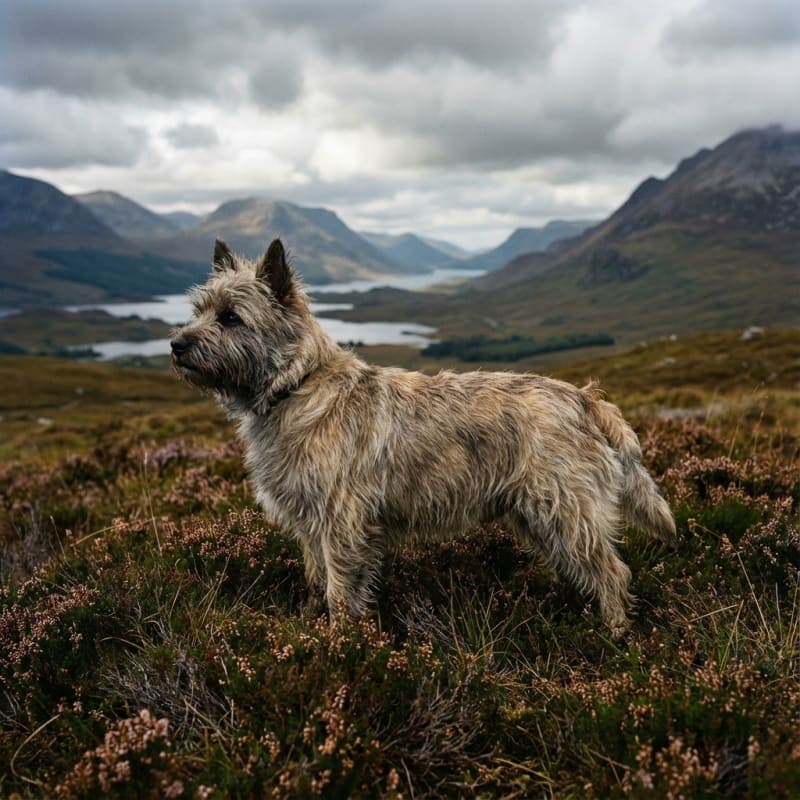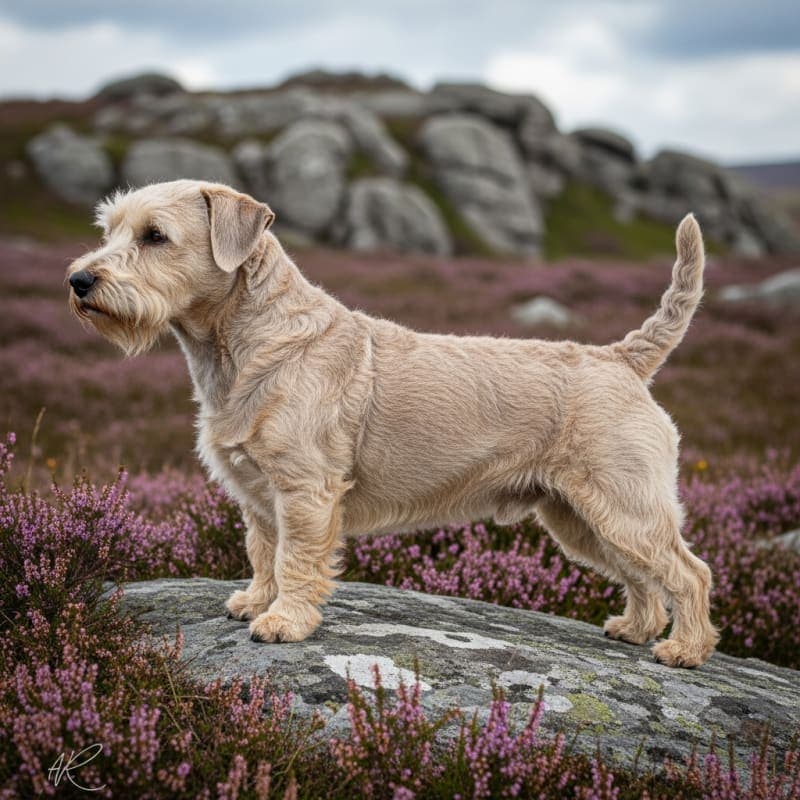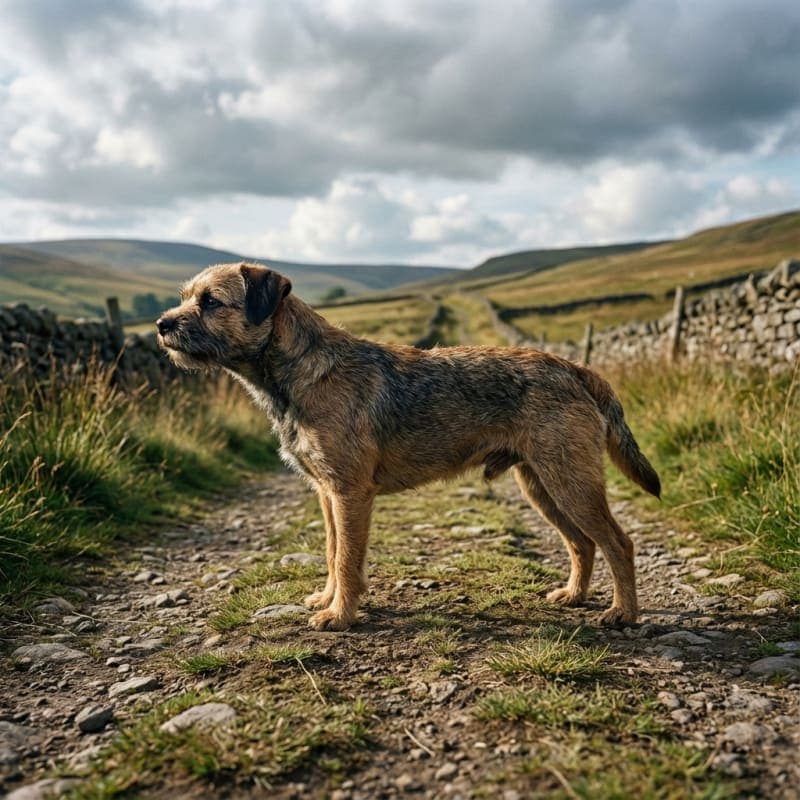
Border Terrier
FCI Group
3• FCI 10
Size
Small
Origin Country
GB
Height
N/A
Weight
5.1-7.1 kg
Lifespan
12-14 years
Temperament
Overview
Border Terrier is a unique breed originating from the picturesque areas of the border between Scotland and England, where it has accompanied hunters on their expeditions for centuries. It is one of the oldest British terriers, with a history that dates back at least to the 19th century, although the breed's roots may be much older. The name 'Border' refers to the border (Scottish Borders), where the breed was developed for specific hunting tasks.
The Border Terrier was primarily bred for hunting foxes that were destroying sheep on the farms of the border. Its task was to follow packs of foxhounds, then crawl into fox dens to flush out or kill the prey. This required a dog of extraordinary endurance, courage, and determination. The Border had to be fast enough to keep up with the horse, yet compact enough to fit into tight burrows. The FCI describes it as 'essentially a working terrier' - primarily a working terrier.
Its distinctive otter-like head is the most recognizable feature of the breed. A moderately broad skull combines with a short, strong muzzle, creating a unique profile. Dark eyes with a keen expression reveal intelligence and alertness. Small, V-shaped ears of moderate thickness fold forward, laying against the cheeks - a detail that adds to its unique expression.
The body structure of the Border Terrier reflects its working function. The torso is deep, narrow, fairly long, with well-set back ribs but not excessively arched. The FCI standard emphasizes that the terrier should be narrow enough to be spanned by both hands behind the shoulders - a test of chest width that ensures the dog will fit in a burrow.
The coat of the Border Terrier is its battleship armor. Rough and dense, with a hard outer coat and thick skin, it protects against thorns, stones, and the teeth of opponents while working in the field. The undercoat is soft and insulating. The colors include red, wheaten, grizzle and tan, and blue and tan.
The Border Terrier combines activity with gameness, as the FCI standard puts it. It is a dog with a strong hunting instinct that has retained its original nature despite years of living as a companion dog. It requires an active owner who will provide enough exercise, mental stimulation, and tasks to perform. With proper upbringing, it becomes a wonderful family companion, although its terrier temperament means it does not tolerate being treated like a plush toy.
Border Terrier is a medium-sized dog, classified by the FCI as a large and medium-sized terrier, although in practice it is one of the smaller in this group. Its appearance is entirely functional, subordinated to work tasks. The FCI standard does not specify height, focusing instead on proportions and working ability.
The head resembling that of an otter is the most characteristic feature of the breed:
- Skull: moderately broad, not too heavy
- Muzzle: short and strong
- Nose: black preferred, but liver or flesh color is not a serious fault
- Teeth: scissor bite, where the upper teeth closely overlap the lower ones and are set perpendicular to the jaws; level bite acceptable
- Eyes: dark, with a keen expression
- Ears: small, V-shaped, of moderate thickness, falling forward and lying close to the cheeks
Body structure reflects the function of a burrowing and hunting dog:
- Neck: of moderate length
- Body: deep, narrow, fairly long
- Loin: strong
- Chest: ribs well tucked up, but not excessively arched; the dog should be narrow enough to be grasped with both hands behind the shoulders
- Tail: moderately short, fairly thick at the base, tapering; set high, carried cheerfully, but not curled over the back
Front limbs: straight, not too heavy-boned; small paws with thick pads
Hind limbs: strong, with good angles
Coat and color:
- Coat harsh and dense, with a wiry outer coat
- Thick skin - protection against injuries
- Color: red, wheaten, grizzle and tan, blue and tan
Weight: The FCI standard does not provide official ranges, but typically:
- Males: 5.9-7.1 kg (13-15.5 lbs)
- Females: 5.1-6.4 kg (11.5-14 lbs)
The overall appearance of the Border Terrier should suggest strength, endurance, and working ability. It is not a show dog, but a functional working terrier, with every aspect of its build serving a specific hunting function. Its proportions allow it to run with foxhounds all day and then squeeze into a tight fox den - a unique combination of traits that defines the breed.
Border Terrier combines two seemingly contradictory traits: combining activity with gameness, as stated in the FCI standard. 'Activity' means high energy, liveliness, and a willingness to act, while 'gameness' refers to terrier-like courage, determination, and readiness to face an opponent, regardless of its size. This combination makes the Border Terrier a unique companion for the right people, but it can pose a challenge for inexperienced owners.
Working temperament:
- Strong hunting instinct: The Border has been bred for centuries to hunt foxes, badgers, and other predators. This instinct remains strong even in dogs that have never seen a burrow. This means that the Border will chase anything that moves - cats, squirrels, rabbits, and even bicycles or joggers can trigger its chasing instinct.
- Gameness (terrier courage): The Border does not shy away from a challenge and is ready to fight an opponent much larger than itself. In the context of burrows, this meant confronting an enraged fox in a dark, tight space - requiring extraordinary courage.
- High energy: This is a dog that could run with foxhounds all day. The modern Border has retained this endurance and needs 1-2 hours of intense activity daily.
- Intelligence and independence: Working in burrows required making independent decisions. The Border can think for itself, which may mean selectively listening to commands if it believes it has a better idea.
Relationships with people:
- Attachment to family: The Border is deeply devoted to its family and loves spending time with them.
- Not a 'lap dog': Although it enjoys human company, it does not tolerate being treated like a plush toy or mascot. Children must learn to respect its space.
- Alertness towards strangers: It may be reserved towards strangers at first, but it should not be aggressive.
- Requires an engaged owner: The Border needs a leader who understands its terrier nature and provides the appropriate structure.
Relationships with other animals:
- With other dogs: It can be conflictual, especially males with males. Terrier courage means that the Border does not shy away from confrontation, even with much larger dogs. Early socialization is key.
- With small animals: The strong hunting instinct means that cats, rabbits, hamsters, or birds may be seen as prey. Living with a cat is possible with proper upbringing from puppyhood, but it will never be completely safe.
- With livestock: The Border was bred to work on farms and usually works well with sheep and cows.
Characteristic behaviors:
- Digging: The instinct to dig burrows is strong. The Border can destroy a garden in a short time if it gets bored.
- Barking: It uses its voice to communicate, especially when something excites or worries it.
- Escaping: If it catches the scent of prey, it may ignore calls and follow the trail. A secure fence is a must.
- Destructiveness: A bored Border can be very destructive. It needs both physical and mental stimulation.
Ideal family for a Border Terrier:
- Active, enjoying outdoor activities
- Experienced dog owners or willing to learn
- Without very small children (preferably children 10+)
- With a securely fenced garden
- Time for training and play
- Understanding and accepting terrier nature
The Border Terrier is not a dog for everyone. Its terrier nature, strong hunting instinct, and high energy mean that it requires an engaged, active owner. But for the right person, the Border is a wonderful companion - loyal, brave, fun, and always ready for adventure. Its gameness and activity make life with it never boring.
Border Terrier is a breed known for its exceptional health and longevity. It is one of the healthiest terrier breeds, largely because it was bred primarily as a working dog rather than a show dog. Selection focused on functionality and endurance, resulting in solid genetics.
Life expectancy:
- Average: 12-15 years
- Many individuals live 15-17 years with proper care
- There are cases of Border Terriers reaching 18-19 years
- This longevity is a result of solid genetics and the absence of extreme anatomical features
Overall health condition:
The Border Terrier has thick skin and a harsh coat, which protects it from injuries while working in the field. Its functional body structure - without extreme features like a very short muzzle, long back, or excessively arched ribs - means fewer orthopedic and respiratory problems than many other breeds.
Potential health issues:
Although the Border is generally healthy, some conditions occur more frequently in the breed:
- CECS (Canine Epileptoid Cramping Syndrome): Also known as 'Spike's disease'. This condition is specific to Border Terriers, characterized by episodes resembling cramps, often associated with meals. Symptoms: muscle stiffness, trembling, discomfort, unusual posture. The cause is not fully understood but may be related to a reaction to gluten or stress. It is not epilepsy, although the symptoms may resemble seizures.
- Hip Dysplasia (HD): Less common than in larger breeds, but it can occur. Responsible breeders screen breeding stock.
- Luxating patella: May occur, especially in smaller individuals.
- Ocular issues: - Progressive Retinal Atrophy (PRA) - progressive retinal atrophy - Juvenile cataracts - juvenile cataracts - Genetic tests are available.
- Heart diseases: Some lines may have a predisposition to valvular heart diseases in older age.
- Allergies: Food or environmental allergies may occur, manifesting as skin itching.
Weather resistance:
- Cold: The Border has a double coat - a harsh outer coat and a dense undercoat, providing excellent insulation. It tolerates cold and rain well.
- Heat: The dense coat can be a problem in very high temperatures. On hot days, activity should be limited, and a cool place and access to water should be provided.
- Thick skin: Protects against scratches, thorns, and bites while working in the field.
Prevention and healthcare:
- Choosing a breeder: The most important step. A responsible breeder tests breeding stock for HD, PRA, and other genetic conditions.
- Regular veterinary check-ups: Annual examinations, vaccinations, parasite prevention.
- Weight control: Borders tend to overeat. Obesity puts strain on joints and the heart.
- Physical activity: Regular exercise keeps muscles and joints in good condition.
- Dental health: Regular tooth brushing and check-ups prevent periodontal disease.
- Diet: If CECS symptoms occur, a gluten-free diet may help.
Health tests recommended by breed clubs:
- Hip scoring
- Eye testing (ocular examinations, CERF/ECVO)
- Cardiac evaluation
- DNA tests for PRA
Summary:
The Border Terrier is one of the healthiest dog breeds, especially compared to many show breeds. Its functional structure, solid genetics, and absence of extreme features mean fewer health problems. With the right choice of breeder, a balanced diet, regular activity, and basic veterinary care, a Border can enjoy a long, healthy, and active life for 12-15 years or longer. CECS is a breed-specific condition worth knowing about, but it does not affect all Border Terriers and can often be managed through diet and stress management.
The grooming of the Border Terrier is relatively simple, but requires knowledge of the specifics of its hard, wiry coat. This is not a breed that requires visits to a professional groomer every few weeks, but it does require regular work at home and periodic hand stripping.
Coat structure:
- Guard hair: hard, wiry, weather-resistant
- Undercoat: dense, soft, insulating
- Thick skin: an additional layer of protection
- This structure has developed over centuries of selection for work in harsh conditions of the Border Country
Hand Stripping - the key to healthy coat:
Hand stripping is a technique for removing dead guard hair by plucking it by hand or with a special stripping knife. It is CRUCIAL for maintaining the proper texture and color of the Border Terrier's coat.
Why hand stripping and not clipping?
- Clipping cuts the hair, leaving a soft undercoat
- Stripping removes dead, hard guard hair along with the root
- After clipping, the coat becomes soft, fluffy, loses color and protective properties
- Stripping maintains hardness, color, and structure - the coat remains weather-resistant
How often to strip?
- Full stripping: 2-4 times a year (every 3-6 months)
- The frequency depends on the growth rate of the hair of the specific dog
- Some owners use rolling coat - gradual removal of mature hair every 4-6 weeks, so the dog always looks tidy
Can stripping be learned independently?
- YES! Many people learn hand stripping at home
- It is best to start with lessons from an experienced groomer or breeder
- Online courses and video tutorials are available
- It takes time (2-4 hours for full stripping), but it is cheaper than a professional groomer
Alternative: clipping
If the dog is not shown and the owner does not intend to maintain the traditional coat:
- Clipping can be done
- The coat will become soft and change color, but this does not affect the dog's health
- It is easier and faster than stripping
- A compromise: functionality vs. aesthetics and tradition
Regular home grooming:
- Brushing: 2-3 times a week with a bristle brush or pin brush
- Removing dead hair: A stripping comb helps remove dead hair between stripping sessions
- Tangle control: Behind the ears, under the armpits, in the groin - areas prone to tangles
- Bathing: Rarely, only when the dog is dirty (every 2-3 months or less). Too frequent baths soften the coat
- Use shampoo for rough-coated dogs
Shedding:
- The Border Terrier sheds minimally with regular stripping
- Dead hair is removed manually before it falls out naturally
- This is one of the breed's advantages for people with mild allergies
- Without stripping - the coat sheds moderately
Other grooming aspects:
- Nails: Trimming every 2-4 weeks if they do not wear down naturally
- Ears: Weekly check, cleaning with ear solution when needed. Borders have floppy ears, which increases the risk of infection
- Teeth: Brushing 2-3 times a week (daily is ideal). Borders can be prone to tartar
- Eyes: Wiping tear stains with a damp cotton ball
- Hair between pads: Trimming if too long
Grooming for show dogs:
Show dogs must be stripped according to a strict schedule to keep the coat in perfect condition for shows. This requires specialized knowledge and often the work of a professional handler/groomer.
Summary:
The grooming of the Border Terrier is moderately demanding. The key is hand stripping 2-4 times a year, which maintains the characteristic hard coat. Between stripping sessions, regular brushing 2-3 times a week is sufficient. You can learn stripping on your own or hire a professional. Alternatively, you can clip the dog (the coat will become soft). With regular grooming, the Border sheds minimally and looks tidy. This is not a breed that requires daily grooming, but it does require commitment a few times a year to maintain its characteristic appearance and protective properties of the coat.
Border Terrier is a dog with a high energy level, bred to run with foxhounds all day and then work in burrows. The FCI standard describes him as 'capable of following a horse' - able to follow a horse. This is not a dog that will be satisfied with a short walk around the block. He requires an active owner who will provide both physical and mental stimulation.
Minimum exercise requirements:
- 1-2 hours of activity per day - this is the absolute minimum
- A leash walk is not enough - the Border needs opportunities to run, explore, and exert himself
- Activity should be varied - walks, running, play, training, sports
- Young dogs (1-3 years) may require even more - 2-3 hours
Types of activities ideal for a Border Terrier:
1. Long walks and hikes:
- The Border loves long hikes in scent-filled areas
- Forest trails, fields, hills - areas resembling his natural habitat, Border Country
- Important: secure fencing or a long line - strong hunting instincts mean that the Border may run after a scent and ignore calls
- Do not let him off-leash in areas where small animals may be present unless he has excellent recall
2. Running:
- The Border can be an excellent jogging partner for those running at a moderate pace
- He can run 5-10 km without any problem (adult dog)
- NOTE: puppies and young dogs (up to 12-18 months) should not run long distances - risk of joint damage
3. Agility:
- The Border Terrier is a great agility dog - agile, fast, intelligent
- He loves obstacles, tunnels (they resemble burrows!), slalom
- Excellent form of both physical and mental stimulation
- He can be stubborn and independent, but with the right motivation, he performs excellently
4. Earth Dog Trials / Go-to-Ground:
- Tests mimicking work in burrows - a tunnel with obstacles leading to a 'cage' with rats (behind bars)
- This is a natural activity for the Border Terrier, utilizing his instincts
- Available in some countries as a sport (AKC Earthdog, Working Terrier Club in the UK)
- The Border loves these tests - it's true joy for him
5. Fetch games:
- Many Border Terriers love to fetch balls, frisbees, toys
- Great way to burn energy in a shorter time
- 15-20 minutes of intense fetching can tire a dog as much as an hour of walking
6. Swimming:
- Some Border Terriers love water, others do not - it depends on the individual
- If the dog enjoys swimming, it is an excellent full-body workout, gentle on the joints
- Thick skin and dense coat protect against the cold
7. Obedience training / nosework / trick training:
- The Border also needs mental stimulation
- 10-15 minutes of training new commands or tricks can tire him more than half an hour of walking
- Nosework utilizes his natural tracking abilities
8. Play with other dogs:
- If the Border is well-socialized, playing with other dogs can be a great way to burn energy
- NOTE: watch to ensure play does not turn into conflict (terrier temperament)
What happens if the Border does not get enough exercise?
A bored, insufficiently stimulated Border Terrier may develop behavioral problems:
- Destructiveness: chewing furniture, cushions, shoes - especially young dogs
- Excessive barking: expressing frustration through noise
- Digging: holes in the garden, destroying the lawn
- Escaping: attempts to dig under the fence or jump over it in search of adventure
- Hyperactivity: hyperactivity, jumping, inability to calm down
- Aggression: frustration may manifest as aggression towards people or other dogs
Adjusting exercise to age:
- Puppies (2-12 months): Short, frequent sessions (5-15 minutes several times a day). Avoid long distances and jumps - bones and joints are still growing
- Young dogs (1-3 years): Highest energy level. 2-3 hours of activity per day
- Adult dogs (3-8 years): 1-2 hours of intense activity
- Seniors (8+ years): Adjust to fitness - still need exercise, but shorter, less intense activity. Walks, gentle play
Weather conditions:
- Cold and rain: The Border, with his tough coat and dense undercoat, tolerates bad weather well. Can be active in rain and snow
- Heat: Thick coat can be a problem. On hot days (25°C+) limit activity to early morning and evening. Provide a cool place and water
Summary:
The Border Terrier is not a dog for sedentary people. He requires 1-2 hours of activity per day, including running, exploring, playing, and mental stimulation. Ideal for active individuals who enjoy outdoor activities - hiking, jogging, dog sports. A bored Border can be destructive and difficult to manage. But with the right physical and mental effort, he becomes a wonderful, balanced companion. His endurance and energy mean he is ready for any adventure - and that is what defines the Border Terrier.
The training of the Border Terrier can be both rewarding and frustrating. It is an intelligent dog that learns quickly, but its terrier independence and gameness mean that it has its own opinions about what is worth doing. Success in training a Border Terrier requires understanding its nature, consistency, and appropriate motivation.
Characteristics of Border Terrier learning:
- High intelligence: The Border quickly understands what you expect from it
- Independence: For centuries, it has been bred to make decisions independently in the den, without human assistance. This means it can think for itself and may selectively listen to commands
- Gameness (determination): If the Border decides to do something (e.g., follow a scent), it is hard to stop
- Motivation by food and play: Most Border Terriers are highly motivated by food, which makes positive training easier
- Quick boredom: Repetitive exercises bore it. It prefers variety and challenges
Key training principles:
1. Positive reinforcement:
- The Border responds best to reward-based training (positive reinforcement)
- Use treats, praise, and toys as motivators
- Avoid harsh punishments or coercion - the Border may become stubborn and unwilling to cooperate
- Timing is key - the reward must occur within 1-2 seconds of the desired behavior
2. Consistency:
- The Border tests boundaries - you must be consistent
- If you allow something once (e.g., jumping on the couch), and then forbid it the next time, the dog will become confused
- All family members must apply the same rules
3. Short, varied sessions:
- 5-10 minutes of training several times a day is better than a one-hour session
- The Border quickly gets bored with repetition - introduce variety
- End the session on a positive note, when the dog still wants more
4. High motivation:
- Use high-value rewards (high-value treats) - chicken, cheese, liver
- Some Border Terriers are more motivated by play than food - find what works for your dog
- A reward can also be allowing sniffing or a short sprint
5. Early socialization:
- Crucial for the Border Terrier due to its hunting instinct and potential aggression towards other dogs
- Introduce the puppy to diverse situations, people, dogs, and sounds between 8-16 weeks
- Positive experiences at a young age prevent behavioral problems later
Basic commands and skills:
1. Recall:
- The most important command for the Border Terrier due to its strong chase instinct
- Train in controlled conditions with a long line initially
- Use VERY high-value rewards
- Never call the dog to punish it - always associate recall with a positive
- Even a well-trained Border may ignore the recall if it is tracking prey - a secure fence is a must
2. 'Leave' / 'Drop':
- Important due to the tendency to grab things in its mouth
- Train exchanges - the dog drops the item in exchange for something better
3. Basic obedience:
- 'Sit', 'Stay', 'Heel', 'Down'
- The Border can master these in a few days, but consistent performance in a distracting environment takes time
4. Loose leash walking:
- The Border tends to pull due to high energy and a desire to explore
- It requires patience and consistency
- 'Stop and go' method - when the dog pulls, you stop; you move only when the leash is loose
Challenges in training a Border Terrier:
- Selective deafness: The Border may ignore commands if something more interesting catches its attention (squirrel!)
- Stubbornness: If it decides to do something, it is hard to convince it otherwise
- Easy boredom: Repetitive exercises bore it
- Aggression towards other dogs: Males, in particular, can be conflictual - requires early and ongoing socialization
- Strong hunting instinct: Difficult to train a reliable recall in the presence of prey
Advanced training and sports:
- Agility: The Border Terrier can perform excellently, although it may be more independent than the Border Collie
- Earthdog trials: A natural activity where the Border shines
- Nosework / scent work: Utilizes its tracking abilities
- Obedience: Can achieve high levels, although it requires more work than in more 'obedient' breeds
- Trick training: The Border loves to learn new tricks - it is fun and stimulating
Behavioral issues and their resolution:
- Barking: 'Quiet' training on command, managing triggering stimuli
- Digging: Provide a designated digging area, increase mental stimulation
- Destructiveness: Increase physical and mental activity, interactive toys
- Aggression: Professional behaviorist, desensitization, counter-conditioning
When to start training?
- Basic commands: from 8 weeks
- Socialization: 8-16 weeks (critical period)
- Advanced sports: after 12-18 months (bones are mature)
Summary:
The Border Terrier is a smart but independent learner. It is best trained using positive reinforcement methods, with high motivation, short sessions, and plenty of variety. Early socialization and consistency are key. The Border can master advanced skills and excel in dog sports, but it will never be as unconditionally obedient as some working breeds. Its terrier nature means it will always have its own opinions. But for an owner who accepts this and works with its nature rather than against it, the Border can be a wonderful, responsive training partner. Remember: we do not train a Border Terrier the same way we train a Golden Retriever - you must understand and accept its terrier DNA.
The Border Terrier's diet should be balanced, high-quality, and tailored to its activity level. This is a high-energy dog that requires the right fuel to maintain its vitality, but it also has a tendency to overeat, which necessitates portion control.
Basic feeding guidelines:
- High-quality food: Choose food with meat as the first ingredient, without unnecessary fillers (corn, wheat as main ingredients)
- Protein: The Border Terrier, being an active dog, needs a diet rich in protein (min. 25-30% for adult dogs, 28-32% for puppies)
- Fats: Healthy fats (omega-3, omega-6) for energy and healthy skin/coats (15-20%)
- Carbohydrates: A moderate amount from quality sources (sweet potatoes, brown rice, oats)
Food quantity:
The Border Terrier is a small dog, but its caloric needs are relatively high due to its activity:
- Adult dog (5-7 kg): about 400-600 kcal per day, depending on activity level
- Very active dog (agility, long hikes): may need up to 700-800 kcal
- Less active / senior: 350-450 kcal
- Always check the manufacturer's feeding guidelines and adjust to the individual needs of the dog
Meal frequency:
- Puppies (8 weeks - 6 months): 3-4 meals per day
- Young dogs (6-12 months): 2-3 meals per day
- Adult dogs (1+ year): 2 meals per day (better than one large meal)
- Dividing the daily portion into 2 meals reduces the risk of digestive problems and maintains stable energy levels
Weight control:
The Border Terrier has a tendency to overeat and can easily gain weight if its diet is not controlled:
- Ideal weight: 5.1-7.1 kg (females lighter, males heavier)
- Condition test: You should feel the ribs under a thin layer of fat, but they should not be clearly visible. Visible waist when viewed from above
- Obesity is a serious problem - it burdens the joints, heart, increases the risk of diabetes, and shortens lifespan
- Weigh the dog regularly (every 2-4 weeks) and adjust portions
Treats and snacks:
- Training treats should make up max 10% of daily caloric intake
- The Border is very food motivated, which makes training easier, but it’s easy to exceed the calorie limit
- Use small treats (pea-sized) during training
- Alternative: use part of the daily food portion as training rewards
- Healthy options: carrot, apple (without seeds), green beans, cooked chicken
Water:
- Fresh water should be available at all times
- Especially important after intense activity
- Change the water daily, clean the bowl regularly
Types of diet:
1. Dry food (kibble):
- The most convenient option
- Helps maintain dental health (scraping tartar)
- Choose high-quality brands (Orijen, Acana, Taste of the Wild, Carnilove)
2. Wet food:
- Higher water content, more palatable
- More expensive, less convenient
- Can be mixed with dry food
3. BARF / raw diet:
- Raw meat, bones, vegetables, fruits
- Requires knowledge and time
- Potential benefits: better condition, healthy coat
- Risks: unbalanced diet, bacteria (Salmonella)
- Consultation with a veterinarian recommended
4. Home-cooked diet:
- Meat, rice, vegetables, supplements
- Requires consultation with a veterinary nutritionist to ensure balance
Special dietary considerations:
CECS (Canine Epileptoid Cramping Syndrome):
- If the Border Terrier suffers from CECS (a breed-specific condition), a gluten-free diet may help reduce symptoms
- Avoid food with wheat, barley, rye
- Choose grain-free foods or those with alternative carbohydrate sources (sweet potatoes, peas)
Food allergies:
- Some Border Terriers may develop allergies (symptoms: itchy skin, digestive issues)
- Most common allergens: beef, chicken, wheat, soy, corn
- An elimination diet with a single protein source (e.g., lamb, fish) may help identify the allergen
Adjusting diet by age:
- Puppies (up to 12 months): Puppy food for small breeds, higher protein and calorie content
- Adults (1-8 years): Adult dog food, tailored to activity level
- Seniors (8+ years): Senior dog food, lower calorie content, joint supplements (glucosamine, chondroitin)
Supplements:
- Omega-3 (fish oil): healthy skin and coat, joint support
- Glucosamine and chondroitin: joint support, especially for older dogs
- Probiotics: gut health
- Most high-quality foods contain appropriate nutrients - supplements only after consultation with a veterinarian
Summary:
The Border Terrier needs a high-quality, balanced diet rich in protein and healthy fats, tailored to its high activity level. Portion control is crucial - the Border has a tendency to overeat and can easily gain weight. The ideal weight is 5.1-7.1 kg. Feed the dog twice a day, monitor treats (max 10% of calories), and regularly check weight. If the Border suffers from CECS, consider a gluten-free diet. With proper nutrition, the Border can maintain great physical condition throughout its life and enjoy energy for its beloved activities - running, digging, and exploring the world.
Characteristic Traits
Pros
- Exceptional health and longevity (12-15+ years)
- Versatility - working and companion dog
- Brave and loyal character (gameness)
- Weather-resistant coat with minimal shedding when stripped
- Small size with great endurance
- Excellent for dog sports (agility earthdog)
- Intelligent and quick to learn
- Low grooming requirements (no groomer needed).
Cons
- Requires 1-2 hours of intense activity daily
- Strong hunting instinct - dangerous for small animals
- Independent and stubborn - not always obedient
- Can be aggressive towards other dogs (especially males)
- Tendency to dig and be destructive when bored
- Not suitable for families with very small children
- Selective deafness when tracking
- Hand stripping coat 2-4 times a year recommended.
Behavioral Ratings
Breed History
Border Terrier has a long and rich history dating back to at least the 18th century, although the breed's roots may be much older. The breed originated in the picturesque yet harsh region of the Scottish and English borders (Scottish Borders and Northumberland), around the Cheviot Hills - areas characterized by stones, hills, and difficult terrain. It was these conditions that shaped the Border Terrier into the dog we know today.
Origins and working function:
The Border Terrier was bred by farmers and hunters of the border region for one specific purpose: hunting foxes and other predators that threatened sheep and poultry. In this region, sheep farming was the main source of livelihood, and foxes posed a serious threat - they could kill dozens of lambs in a single night.
- The Border had to be fast and durable enough to run with foxhounds all day across the Cheviot hills
- At the same time, it had to be compact and flexible enough to enter fox dens and confront the fox in tight, dark spaces
- This required extraordinary courage (gameness), endurance, and intelligence
- It was a purely utilitarian breed - character and working ability mattered, not appearance
Characteristic features shaped by work:
- Otter-like head: narrow and moderately wide to fit into a den
- Narrow chest: could be grasped by hands behind the shoulders - a test for appropriate width for working in a den
- Hard, weather-resistant coat: protection against thorns, stones, and fox teeth
- Thick skin: additional protection against injuries
- Long legs for a terrier: to keep up with the foxhounds
Early history and nomenclature:
For most of its history, the Border Terrier was known by various local names:
- Coquetdale Terrier (from the River Coquet in Northumberland)
- Redesdale Terrier (from the Redesdale valley)
- Reedwater Terrier
- Each valley had its lines, but they were all essentially the same type of terrier
The name 'Border Terrier' refers to the Scottish Borders region where the breed was developed. It was officially adopted in the 20th century to standardize the breed.
Official recognition:
- 1920: The Border Terrier was officially recognized by the English Kennel Club
- 1921: The Border Terrier Club was established
- 1930: The breed was recognized by the American Kennel Club (AKC)
- FCI Standard: Classified in Group 3 (Terriers), Section 1 (Large and medium-sized terriers), without a working trial
Breed evolution in the 20th century:
Despite official recognition, the Border Terrier remained a little-known breed for a long time, primarily recognized in its native region and among hunters. This actually protected the breed from commercialization and excessive breeding for appearance at the expense of working ability.
- In the 1950s to 70s, the Border began to gain popularity as a companion dog
- Its size (small enough to fit in an apartment, large enough to accompany outdoor activities), resilience, and character attracted attention
- In the 1990s and 2000s, the breed gained significant popularity in the UK, USA, and other countries
Border Terrier in contemporary work:
Although most Border Terriers live today as companion dogs, some still work:
- Working terrier clubs in the UK organize hunts and go-to-ground tests, where the Border can showcase its natural abilities
- Some Borders work with Border Hunt and other packs of foxhounds
- Earthdog trials in the USA and other countries allow Border Terriers to demonstrate their den instincts
Famous Border Terriers and popular culture:
- The Border Terrier has appeared in British literature as a typical rural dog
- They are still popular on farms and among hunters
- In recent years, the breed has gained popularity among celebrities, increasing its recognition
Behavior of working lines:
Interestingly, there are still two somewhat distinct lines of Border Terriers:
- Show lines: slightly heavier, more 'polished', bred for appearance in accordance with the standard
- Working lines: lighter, more athletic, with a stronger hunting instinct, bred for function
- The differences are not as drastic as in some breeds (e.g., Cocker Spaniel), but they are noticeable
Summary:
The Border Terrier is a genuine working breed with a rich history dating back to the 18th century. It was developed in the harsh conditions of the Scottish-English border as a fox-hunting dog - a task requiring endurance, courage, and intelligence. For most of its history, it was a little-known local breed, which protected it from excessive commercialization. Officially recognized in 1920, the Border has retained its working character, and many individuals still work in the field. Today, it is valued both as a companion dog for active families and as a partner in dog sports and work. Its history as a 'working terrier capable of following a horse' continues to define its character - it is a dog full of energy, courage, and determination, always ready for adventure.