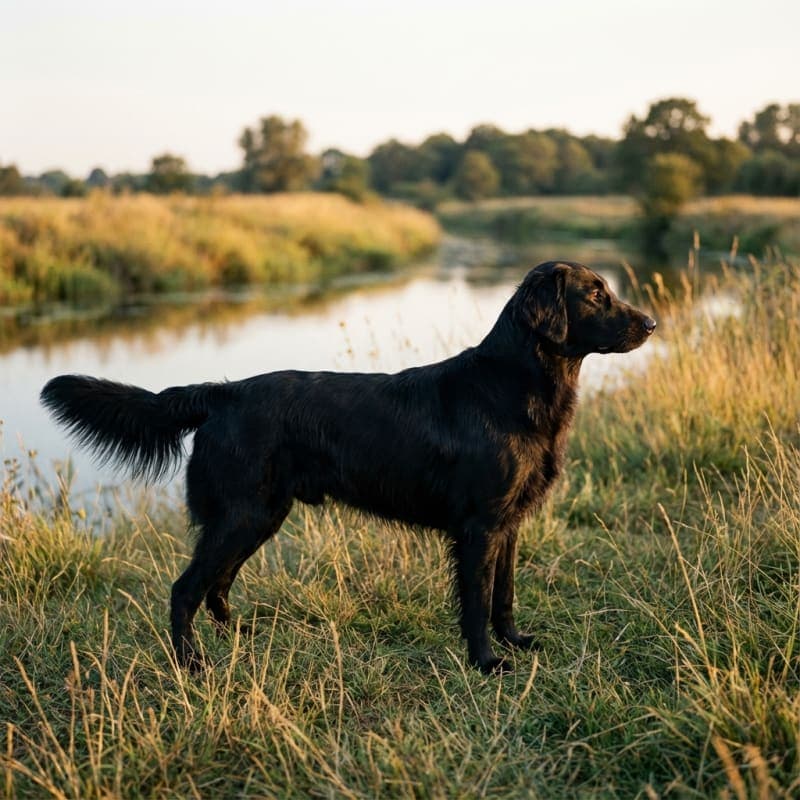
Flat Coated Retriever
FCI Group
8• FCI 121
Size
Medium
Origin Country
GB
Height
56-61 cm
Weight
25-36 kg
Lifespan
8-10 years
Temperament
Overview
The Flat Coated Retriever is a unique medium-sized hunting dog that originates from Great Britain and was bred during the Victorian era (mid-19th century). Since then, it has won the hearts of countless dog lovers around the world thanks to its unwavering optimism, friendly nature, and contagious joy for life. This magnificent dog combines the traits of a retriever, a flushing dog, and a water dog, making it an extremely versatile companion both in hunting and in everyday family life.
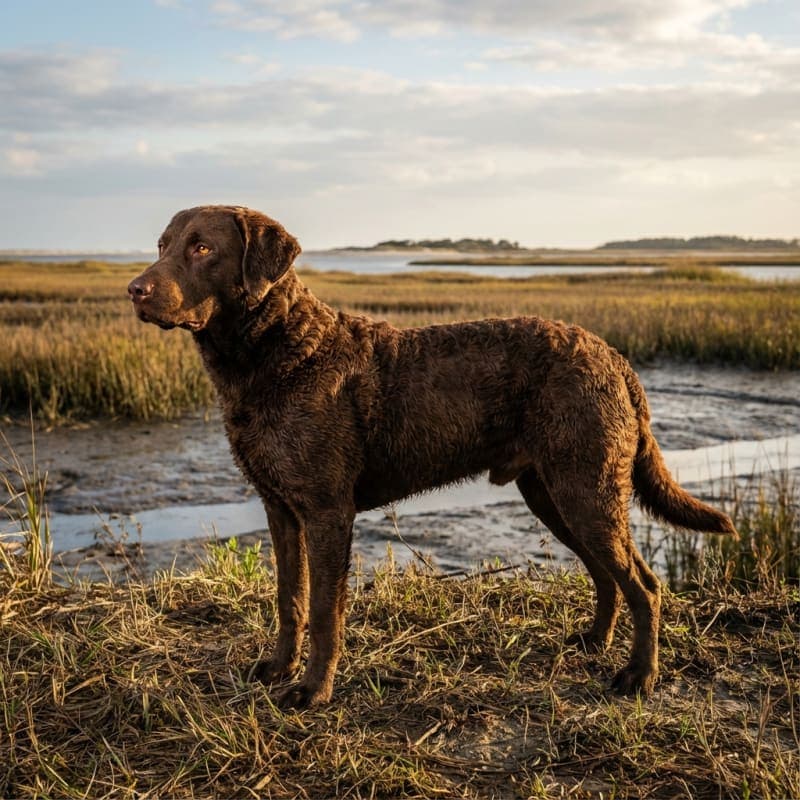
The elegant appearance of the Flat Coated Retriever is highlighted by its dense, shiny coat with a flat lay (hence the name - flat coated), which comes exclusively in black or liver (dark brown). Its characteristic long and beautifully sculpted head with a flat skull and medium-sized, dark brown or hazel eyes full of intelligence add to its noble charm and express its remarkable mental sharpness.
The FCI standard describes the breed as a bright, active dog of medium size with an intelligent expression - a lively, active medium-sized dog with an intelligent look, showing strength without heaviness and slimness without frailty. It is the perfect combination of strength, elegance, and harmony of build.
The Flat Coated Retriever loves to be the center of attention and to be part of the family. Its sociable character, cheerful disposition, and constant desire to play make it an ideal family dog. Enthusiastic tail wagging is a hallmark of this breed mentioned directly in the FCI standard - its tail is in constant motion, expressing the joy, optimism, and friendship that are the essence of the Flat Coated Retriever's character.
However, it is important to remember that this is a dog with a very high energy level, which means it requires regular, intense physical and mental activity. This breed is not suitable for people leading a sedentary lifestyle or those who prefer short walks. The Flat Coated Retriever is perfect for active families who love spending time outdoors, going on long hikes, swimming, and engaging in various dog sports.
The Flat Coated Retriever is a dog that needs proper training and socialization from a young age. This breed has a prolonged puppyhood - Flat Coats retain their puppy temperament, energy, and sometimes lack of seriousness until the age of 3-4 years, which is significantly longer than most breeds. Although its temperament is generally gentle and friendly, it can be too exuberant and enthusiastic for very small children (under 5-6 years) or elderly individuals with balance issues. Therefore, it is important to provide it with the right conditions for learning, developing skills, and channeling energy in a positive way.
If you are ready to invest time, energy, and a tremendous amount of love into its upbringing, this wonderful dog will repay you with absolute loyalty, boundless love, and constant joy in everyday life. However, potential owners must be aware that the average lifespan of a Flat Coated Retriever is unfortunately only 8-10 years, which is relatively short compared to other breeds of similar size. This sad reality makes every day with a Flat Coat even more precious and special.
Our detailed guide offers comprehensive information on the health, grooming, activity, training, nutrition, history, appearance, and behavior of the Flat Coated Retriever. It will help you better understand this unique breed and provide valuable tips on how to be the best guardian for your joyful four-legged friend and how to make the most of every moment spent together.
The Flat Coated Retriever is a dog with a elegant, harmonious silhouette and medium size, exuding strength, athleticism, and grace at the same time. The FCI standard emphasizes that it should show power without lumber, and raciness without weediness - strength without heaviness and racing slimness without frailty. This means that the Flat Coat should be strong and muscular, but not massive or clumsy, and slim and elegant, but not weak or fragile.
Height at the withers is:
- Males: 59-61.5 cm (ideal height around 60-61 cm)
- Females: 56.5-59 cm (ideal height around 57-58 cm)
Body weight typically ranges from 25-36 kg, with males generally heavier (30-36 kg) and females lighter (25-32 kg). It is important for the dog to be slim, muscular, and in good condition - ribs should be felt under a thin layer of fat, but not visible.
The head of the Flat Coated Retriever is one of the most distinctive features of the breed - long and beautifully molded. The skull is flat and moderately wide - this is a key feature that distinguishes the Flat Coat from other retrievers (e.g., the Golden Retriever has a more rounded skull). The stop (the transition from the skull to the muzzle) is gentle, barely marked between the eyes, in no way emphasized, avoiding a concave or convex facial profile.
The nose is of good size with open nostrils, usually black (in black dogs) or brown (in liver-colored dogs).
Jaws and teeth are long and strong, capable of carrying a hare or pheasant without damage. The bite is ideal, regular, and complete scissors - the upper teeth closely overlap the lower ones and are set perpendicular to the jaws. The teeth are healthy and strong.
Eyes are medium-sized, dark brown or hazel, with a very intelligent expression. Round, protruding eyes are highly undesirable. The eyes should not be set obliquely. The expression of the eyes should be friendly, alert, and full of life - reflecting the temperament of the breed.
Ears are small and well-set, lying close to the sides of the head. They should not be large or hanging loosely.
Neck is moderately long, free of throatiness (loose skin), symmetrical, and sloping into the shoulders, smoothly transitioning into the back. The head is well set on the neck.
The body is proportional and athletic:
- Chest is deep, wide between the shoulders, with well-arched ribs. The breastbone should not be excessively protruding
- Back is short, straight, and well-connected (strong)
- Loin is short and square
- Rear is very short, square, and well-muscled
Front limbs:
- Shoulders are long, well-retracted (sloped)
- Forearms are straight, with strong bones
- Paws are round, strong, with well-closed toes and thick pads
Hind limbs:
- Thighs are muscular
- Knees are well-bent (not straight)
- Hocks are set low
- Hind paws similar to the front ones - round and compact
The tail is short, straight, and well-set, carried joyfully (level with the back or slightly above), but never significantly above the back. The FCI standard particularly emphasizes enthusiastic tail wagging as a characteristic feature of the breed - the Flat Coat's tail is in constant, joyful motion, expressing optimism and friendliness.
The movement of the Flat Coated Retriever is free and fluid, both in front and behind. During walking, the front limbs move straight forward, without bending the elbows. The hind limbs move parallel, with strong propulsion. The movement is efficient, covering large spaces with ease - typical of a working dog capable of working for many hours.
The coat of the Flat Coated Retriever is dense, medium-length, of good texture, and lies flat against the body (hence the name of the breed - flat coated). Key features of the coat:
- On the body, head, ears, and front sides of the limbs, the coat is short, dense, and flat
- On the back side of the front limbs (feathering), the coat is longer
- On the back side of the thighs and tail, the coat is abundantly feathered
- The coat is straight or slightly wavy, but never curly
- It has a waterproof undercoat, which is important for a dog working in water
The coat should be natural - excessive trimming or styling is undesirable. The dog should look natural and functional.
The coloring of the Flat Coated Retriever is limited to two colors:
- Black - intensely black, shiny, without brown shades
- Liver - dark brown, rich in color, without yellowish shades
These two colors are the only allowed ones - there are no Flat Coated Retrievers in golden (that would be a Golden Retriever) or cream. Small white markings on the chest are permissible but undesirable.
The combination of a long, elegantly molded head, flat skull, intelligent eyes, harmonious body structure, and shiny, flat coat in black or liver color makes the Flat Coated Retriever look noble, elegant, and athletic - a true adornment of the retriever world.
The Flat Coated Retriever is a dog with a remarkably cheerful, optimistic, and friendly disposition, which is a true joy for its family. The FCI standard describes the breed's temperament as generously endowed with natural gundog ability, optimism and friendliness demonstrated by enthusiastic tail action; confident and kindly - generously endowed with natural hunting dog ability, optimism, and friendliness demonstrated by enthusiastic tail wagging; confident and gentle.
These words perfectly capture the essence of the Flat Coat - it is a dog that radiates joy for life at all times. Its tail is in constant motion, expressing happiness and a desire to play. It is no coincidence that Flat Coats are called eternal puppies - they maintain puppy-like enthusiasm, energy, and joy throughout their lives, even in old age.
It is very sociable and not afraid of strangers, making it an excellent family dog, but not a very good guard dog. The Flat Coat typically greets everyone - friends and strangers alike - with the same enthusiasm and joy. Its attitude is more Hello, friend! Will you play with me? than any sign of suspicion or aggression.
Flat Coated Retrievers are known for their high energy levels and intense need for play, making them ideal companions for active families who love outdoor activities. They love:
- Fetching - their natural passion; they can fetch for hours without getting tired
- Swimming - most Flat Coats love water and are excellent swimmers
- Running - they need plenty of exercise and space
- Interactive play - frisbee, agility, hide-and-seek
- Spending time with family - being part of everything that happens
Their intelligence and natural eagerness to learn make them relatively easy to train, provided positive methods are used. However, their prolonged adolescence can lead to difficulties - Flat Coats mature mentally very slowly, often retaining puppy-like carefree behavior, impulsiveness, and lack of focus until the age of 3-4 years. This is significantly longer than in most breeds!
This means that owners must be patient, consistent, and have a good sense of humor. A 2-year-old Flat Coat may still behave like an overly excited puppy, jumping for joy, forgetting commands in exciting situations, and doing various antics. If they are not properly socialized, trained, and engaged, they can develop behavioral problems:
- Hyperactivity
- Jumping on people (out of excitement)
- Pulling on the leash
- Excessive barking
- Destructive behaviors (chewing furniture, digging)
Flat Coated Retrievers are loyal and deeply attached to their owners, often becoming true shadows - they want to be wherever the family is. They do not tolerate loneliness and may suffer from separation anxiety if left alone for extended periods. Symptoms of separation anxiety include:
- Destruction of household items
- Excessive barking, howling
- Attempts to escape
- House soiling (even if the dog is trained)
- Excessive excitement upon the owner's return
This breed is also known for its tendency towards destructive behaviors if it does not receive enough physical and mental activity. A bored Flat Coat is an unhappy Flat Coat that will seek its own entertainment - often destroying the home in the process.
Flat Coated Retrievers generally get along great with children and are patient, gentle, and loving. However, due to their size, strength, and exuberance, they may accidentally knock over very small children (under 5-6 years old) during enthusiastic greetings or play. Therefore, interactions with the youngest children should always be supervised.
With other dogs, Flat Coats are usually very sociable and friendly, enjoying play and antics together. They can live harmoniously with other pets (cats, rabbits) if properly socialized from puppyhood, although their hunting instinct may sometimes emerge.
Proper upbringing, consistent training based on positive reinforcement, appropriate socialization, a huge amount of activity, and above all, lots of love, patience, and a sense of humor will help develop a balanced, obedient, and happy Flat Coated Retriever, which will be an excellent companion for its family for those too short but beautiful years.
The Flat Coated Retriever, despite its vitality and joy for life, unfortunately has one of the shorter average lifespans among breeds of similar size - it is only 8-10 years. Some Flat Coats live longer - up to 12-13 years - but this is more of an exception than a rule. This sad reality is one of the main challenges for owners of this breed and makes every day with a Flat Coat even more precious.
The main reason for the shortened lifespan is the high susceptibility to cancer. Flat Coated Retrievers have one of the highest cancer incidence rates among all dog breeds - it is estimated that about 50-60% of Flat Coats die from cancer. The most common types of cancer include:
- Hemangiosarcoma - an aggressive cancer of the blood vessels, often affecting the spleen or heart
- Osteosarcoma - a bone cancer, usually affecting the long bones of the limbs
- Lymphoma - a cancer of the lymphatic system
- Fibrosarcoma - a cancer of connective tissue
- Mastocytoma - a cancer of mast cells in the skin
Unfortunately, many of these cancers develop quickly and aggressively, often without prior symptoms. Therefore, regular veterinary check-ups (at least twice a year, especially for dogs over 6 years old) are absolutely crucial for early detection of problems.
In addition to cancers, Flat Coated Retrievers may be prone to other conditions:
Hip dysplasia (HD) and elbow dysplasia (ED) are common orthopedic issues in Flat Coats. They can lead to pain, lameness, arthritis, and limited mobility. Responsible breeders perform X-ray examinations of the hips and elbows of the parents before allowing them to breed.
Gastric torsion (GDV - Gastric Dilatation-Volvulus), commonly known as bloat, is a potentially fatal threat to Flat Coated Retrievers. Symptoms include:
- Enlarged, hard abdomen
- Restlessness, pacing
- Attempts to vomit without results
- Heavy breathing, drooling
- Pale gums, weakness
This is an emergency that requires immediate veterinary intervention. Prevention: feed 2-3 smaller meals a day instead of one large meal, avoid intense exercise an hour before and after meals.
Distichiasis is a condition where additional eyelashes grow on the edge of the eyelid and rub against the cornea, causing irritation, tearing, and pain. It requires surgical correction.
Entropion is the inward rolling of the eyelid, causing the eyelashes to rub against the cornea. It leads to irritation, corneal ulcers, and requires surgical correction.
Progressive retinal atrophy (PRA) is a hereditary eye condition that leads to gradual vision loss and ultimately blindness. There is no treatment. Responsible breeders conduct genetic testing of the parents.
Hypothyroidism is a hormonal condition that causes weight gain, lethargy, skin problems, and hair loss. It is easy to diagnose (blood test) and treat (regular hormone supplementation).
Epilepsy may occur in Flat Coats, causing seizures. It can be controlled with anticonvulsant medications.
Obesity is a problem that Flat Coats are prone to due to their large appetite and love of food. Being overweight can lead to joint issues, cardiovascular problems, and diabetes. Owners must monitor their dog's weight and adjust food portions according to activity level.
Flat Coated Retrievers have dense fur with a waterproof undercoat, which helps them stay warm and allows them to swim in cold water. However, on hot days, they may have problems with overheating. On hot days, it is advisable to:
- Avoid intense exercise during the hottest part of the day
- Provide access to shade and fresh water
- Consider walks early in the morning and late in the evening
- Watch for signs of overheating: heavy breathing, drooling, lethargy
Proper health care includes:
- Regular veterinary visits (at least twice a year, especially for older dogs)
- Vaccinations and deworming as recommended by the veterinarian
- Parasite prevention (ticks, fleas)
- Maintaining a healthy weight
- Proper diet and regular exercise
- Early detection - reporting any concerning symptoms to the veterinarian
Despite health challenges, with proper care, love, and attention, Flat Coated Retrievers can enjoy a happy, active life. Awareness of potential health problems and a proactive approach to veterinary care can help maximize the quality and length of life of this wonderful, joyful companion.
The grooming of a Flat Coated Retriever is relatively simple and not very time-consuming compared to some other long-haired breeds, but it requires regularity and consistency to keep the coat in excellent condition and the dog's health at a high level.
Brushing is the foundation of Flat Coat care. Their dense, flat coat with a waterproof undercoat requires brushing at least 2-3 times a week to:
- Remove dead hair and prevent matting
- Distribute natural skin oils, giving the coat a healthy shine
- Check the skin for ticks, wounds, and skin changes
- Strengthen the bond with the dog (most Flat Coats love to be brushed)
Their coat is prone to shedding, especially during intense shedding periods in spring and autumn (the change from winter to summer coat and vice versa). During this time, daily brushing may be necessary to remove large amounts of dead hair and prevent it from settling on furniture and clothing.
The best grooming tools for a Flat Coat:
- Pin brush - for daily brushing
- Slicker brush - for removing dead undercoat during shedding
- Wide-toothed comb - for detangling the feathering on the legs and tail
- Undercoat rake - a special tool for removing undercoat
Particular attention should be paid to:
- Feathering on the back of the front legs - can mat
- Feathering on the back of the thighs - collects dirt, leaves, and mats
- Tail - heavily feathered, requires detangling
- Ears - hair behind the ears can mat
- Chest and groin - areas prone to matting
Bathing a Flat Coated Retriever should be done only when necessary - usually every 2-3 months or when the dog is very dirty (after swimming in a muddy pond, rolling in something unpleasant). Bathing too frequently can:
- Dry out the skin and coat
- Disrupt the natural lipid barrier
- Reduce the coat's natural waterproofing
Use a high-quality dog shampoo (never human shampoo!) that won't dry out the skin. After bathing, a dog conditioner can be applied to make detangling easier and give the coat shine. It is very important to thoroughly rinse out all products - residues can cause skin irritation and itching.
After bathing, you should thoroughly dry the dog, especially the ears and the hair underneath. You can use a hairdryer (on low heat) while brushing the coat.
Many Flat Coat owners, especially those with working or frequently swimming dogs, prefer to let the dog air dry after swimming - their coat has natural waterproofing that quickly sheds water.
Trimming for Flat Coated Retrievers should be minimal. The breed standard requires a natural appearance, without excessive styling. However, some light trims are acceptable:
- Hair between the paw pads - to prevent mud, ice (in winter), and grass seeds from accumulating
- Hair around the ears - for better ventilation of the ear canal
- Hair around the anus - for hygiene
Show dogs may require more advanced trimming to highlight the silhouette lines according to the standard.
Ears require regular attention. They should be checked at least once a week and cleaned as needed using veterinary ear cleaning solutions. Symptoms of problems include:
- Unpleasant odor
- Redness, swelling
- Excessive wax or purulent discharge
- The dog shakes its head, scratches its ears
Flat Coats love to swim, so after every swim, you should clean and dry the ears to prevent infections.
Nails should be trimmed regularly - usually every 3-4 weeks. Overgrown nails can cause discomfort, posture problems, and pain. If you can hear the nails clicking on the floor, they are too long.
Dental hygiene is crucial for health. It is recommended to brush the dog's teeth 2-3 times a week using dog toothpaste. Dental chews and toys can also be used to clean teeth.
After walks in the woods, meadows, or near water, you should check the dog for:
- Ticks (especially on the ears, neck, armpits, groin)
- Thorns (grass seeds that can embed in the skin, paws, ears)
- Minor wounds, abrasions
- Foreign objects in the paws
Maintaining good coat and skin condition not only improves the dog's appearance but also positively affects its health and well-being. Regular grooming is also an excellent opportunity to check the overall health - during brushing, you can detect lumps, wounds, skin changes, or other concerning symptoms.
Grooming a Flat Coated Retriever is therefore an important but not very time-consuming aspect of responsible ownership of this breed, which, with a bit of regularity and consistency, ensures a beautiful, healthy, and shiny companion.
The Flat Coated Retriever is a breed with a very high energy level and intense exercise needs, requiring a significant amount of daily physical and mental activity to remain healthy, happy, and mentally balanced. This is not a dog for people who lead a sedentary lifestyle or prefer short walks around the block. The Flat Coat is a full-blooded working dog that was bred for intensive, long hours of work during hunts and needs appropriate outlets for its almost inexhaustible energy.
It is recommended to provide a Flat Coated Retriever with at least 2 hours of intense physical exertion daily, but in reality, many Flat Coats need more - 3-4 hours of activity per day is not uncommon, especially for young, energetic dogs (1-5 years old). This is not a breed that will be satisfied with a leisurely walk around the neighborhood - the Flat Coat needs to RUN, SWIM, RETRIEVE, and EXPLORE.
An ideal daily activity plan should include:
- Long walks - a minimum of 1.5-2 hours daily (divided into 2-3 outings)
- Free running in a safe, fenced area where the dog can be off-leash and run freely
- Swimming - FLAT COATS LOVE WATER! It’s an excellent exercise that engages the whole body without straining the joints. If you have access to a lake, river, sea, or pool - the Flat Coat will be in seventh heaven
- Retrieving - a natural passion of Flat Coats; they can retrieve balls, frisbees, dummies for hours without getting tired
- Playing with other dogs - socialization and energy release
- Climbing on uneven terrain - forests, hills, beaches
Flat Coated Retrievers are natural swimmers and love water - most of them will happily jump into any body of water, regardless of the temperature. Swimming is:
- Excellent cardio exercise
- Gentle on the joints (important for dogs with dysplasia)
- Engaging for the whole body
- Mental enrichment (new scents, surroundings, stimuli)
- Absolute joy for the Flat Coat!
If you have access to water, regular swimming should be part of the Flat Coat's routine. Just remember to clean and dry their ears after swimming to prevent infections.
Retrieving is another natural passion of Flat Coated Retrievers (retriever = fetcher). They can retrieve endlessly - balls, frisbees, dummies, sticks. It’s an excellent way to:
- Release energy in a shorter time
- Utilize natural instincts
- Strengthen the bond with the owner
- Train obedience (recall, drop, wait)
It’s also worth incorporating dog sports and activities that engage both body and mind into the routine:
- Agility - an obstacle course ideal for athletic and intelligent Flat Coats
- Flyball - a competitive sport for fast and energetic dogs
- Dock diving - jumping into water for distance/height (Flat Coats are often natural champions!)
- Hunting training - dummy work, tracking, retrieving from water (even if we don’t hunt, we can train natural instincts)
- Canicross - running with the dog in a harness
- Rally obedience - a combination of obedience and fun
- Nosework - scent training, searching for scents
However, physical activity alone is not enough - mental stimulation is equally important. Flat Coated Retrievers are intelligent and need tasks to perform, problems to solve, and new things to learn. Without appropriate mental challenges, they can quickly become bored. It’s worth including in the daily routine:
- Obedience training - short, regular sessions (10-15 minutes, 2-3 times a day)
- Learning new tricks - Flat Coats love to learn and show off their skills
- Scent games - hiding treats or toys that the dog must find
- Dog puzzles - interactive toys that require problem-solving
- Variety in routine - new walking routes, new environments, new scents
Regular exercise is absolutely crucial to prevent boredom and frustration, which can lead to serious behavioral problems. A bored Flat Coat is an unhappy Flat Coat that will:
- Bark or howl excessively
- Chew furniture, shoes, cushions, carpets
- Dig holes in the garden
- Jump on people (out of frustration and excess energy)
- Be hyperactive, nervous, difficult to manage
- Develop separation anxiety
- Try to escape the yard in search of adventures
A tired Flat Coated Retriever is a happy, calm, and well-behaved dog at home - this is the golden rule for this breed. After the right amount of exercise and stimulation, the Flat Coat is eager to rest, calm, and pleasant to be around.
Important exercise notes:
- Puppies and young dogs (up to 12-18 months) should not be subjected to overly intense exertion - their joints and growth plates are still developing. Shorter, more frequent sessions are better than long walks. Avoid jumping and intense running on hard surfaces
- On hot days (above 25-28°C), Flat Coats may have problems with overheating due to their thick coat - walk early in the morning and late in the evening, ensure access to shade and water
- In winter, Flat Coats tolerate the cold well due to their thick fur and love snow
- After a meal, wait at least 60-90 minutes before intense exercise (risk of bloat)
- Swimming in cold water - most Flat Coats have no problem swimming in cool water, but watch for signs of hypothermia during very long sessions in very cold water
The Flat Coated Retriever feels best in homes with a large, fenced garden (fence at least 150 cm high) and access to open spaces - forests, parks, water. Living in a small apartment without access to regular, long activities will be insufficient for them.
Properly meeting the physical and mental needs of a Flat Coated Retriever not only improves their physical condition and health but also strengthens the bond with the owner and makes the dog happy, balanced, and pleasant in daily life. For the right owner - very active, energetic, and ready to dedicate several hours a day to activities with the dog - the Flat Coated Retriever will be a wonderful, loyal companion in every adventure.
Training a Flat Coated Retriever can be both a great pleasure and a certain challenge, depending on the owner's approach, patience, and understanding of the unique character of the breed. Flat Coats are intelligent, eager to learn, and love to work with humans, which makes them potentially easy to train. However, their prolonged puppyhood and intense energy can create difficulties, especially for inexperienced owners.
Prolonged puppyhood is a key characteristic of Flat Coated Retrievers that owners MUST understand. Flat Coats mature mentally very slowly - they often retain puppy-like carefreeness, impulsiveness, energy, and lack of focus until they are 3-4 years old. This is significantly longer than most breeds! This means that:
- A Flat Coat at 2-3 years old may still behave like an overly excited puppy
- They may forget commands in exciting situations
- They may be distracted and have difficulty concentrating
- They may test boundaries and try to circumvent rules
- They may be impulsive and act before thinking
Owners must be patient, consistent, and have a good sense of humor. One should not expect perfect obedience at a young age - it will come with time and maturity, provided there is consistent training.
Training methods should be based SOLELY on positive reinforcement. Flat Coats are sensitive and do not respond well to harsh methods, yelling, or coercion. They respond best to:
- Treats - as an immediate reward (Flat Coats are VERY food motivated!)
- Play - for many Flat Coats, play is as motivating as food
- Verbal praise - an enthusiastic, cheerful tone of voice
- Fetching - as a reward (throw the ball after the command is performed)
Training sessions should be:
- Short - 10-15 minutes, no longer (Flat Coats have a short attention span)
- Frequent - 2-3 times a day is better than one long session
- Diverse - change locations, commands, rewards
- Fun-based - training should be FUN, not work
- Ended on a success - always finish when the dog has done something well
- Enthusiastic - the dog responds to our energy and mood
Early socialization (8-16 weeks of age) is absolutely crucial. Flat Coat puppies should be exposed to:
- Diverse people (different ages, appearances, behaviors)
- Other dogs and animals
- Diverse environments (city, countryside, forest, beach, stores)
- Diverse sounds (cars, children, fireworks, thunder)
- Diverse surfaces (grass, concrete, sand, water, stairs)
- Diverse situations (car rides, vet visits, grooming)
Proper socialization will prevent behavioral problems in the future.
Key commands for a Flat Coated Retriever:
- Come / Recall - THE MOST IMPORTANT command! Flat Coats can be distracted by exciting smells, sights, and other dogs. A solid recall can save a dog's life
- Leave it / Drop it - important for a dog that retrieves everything
- Stay / Wait - self-control, impulsiveness
- Sit - basic control
- Heel - walking without pulling (a challenge for energetic Flat Coats!)
- No jumping - Flat Coats love to jump on people out of excitement
Specific training challenges for Flat Coated Retrievers:
- Pulling on the leash - young Flat Coats often pull like a draft horse out of pure enthusiasm. It requires consistent loose leash training
- Jumping on people - out of joy and greeting. Teach alternative behaviors (sit when greeting)
- Distraction - Flat Coats can be distracted by exciting stimuli. Focus and recall training in the presence of distractions
- Impulsiveness - they act before thinking. Self-control training (wait, leave it)
- Selective hearing - a Flat Coat hears the command perfectly but decides something else is more interesting. Requires very high-value rewards during training
Flat Coated Retrievers are excellent for specialized training:
- Hunting training - dummy work, water retrieves, pointing (though Flat Coats are retrievers, not pointers)
- Agility - excellent for athletic and intelligent Flat Coats
- Flyball - a competitive sport ideal for this breed
- Dock diving - jumping into water (a natural passion of Flat Coats!)
- Rally obedience - a combination of obedience and fun
- Therapy dog training - for gentle, friendly Flat Coats
- Search and rescue - utilizing natural scenting and retrieving abilities
Common owner mistakes:
- Expecting too rapid progress - remember the prolonged puppyhood!
- Too long training sessions - Flat Coats get bored
- Lack of consistency - if a rule applies, it applies ALWAYS, not just sometimes
- Using harsh methods - this will destroy the spirit of the Flat Coat
- Lack of mental stimulation - training is not just about obedience, but also mental challenges
For owners who lack experience in dog training, consider taking an obedience course (puppy class, basic obedience) or working with a trainer. A professional trainer can help tailor methods to the individual character of the dog and address behavioral issues.
Proper training of a Flat Coated Retriever is an investment in a long-lasting, harmonious relationship with the dog. A well-trained Flat Coat (even if it retains some puppy-like carefreeness!) is a obedient, balanced, happy, and reliable companion that brings immense joy and satisfaction throughout those too short but wonderful years.
The diet of a Flat Coated Retriever should be balanced, high-quality, and carefully controlled in terms of quantity, as this breed has a large appetite and a tendency to obesity if not properly fed. Due to their very high physical activity, Flat Coats need an appropriate amount of nutrient-rich food to maintain energy, muscle mass, and health.
The basis of the diet should be based on high-quality animal protein:
- Meat - poultry (chicken, turkey), beef, lamb, game
- Fish - salmon, mackerel, herring (omega-3 for joint and coat health)
- Eggs - an excellent source of complete protein
The protein content in the food should be 22-28% for active adult dogs. The fat content: 12-18% (fats provide energy, but excess can lead to obesity).
VERY IMPORTANT: Portion control and preventing obesity
Flat Coated Retrievers have a huge appetite and will eat anything they find. They are known for:
- Begging for food (looking with those intelligent eyes...)
- Stealing food from the table, trash
- Eating things they shouldn't (socks, toys, stones!)
- Convincing all family members that they are hungry (even though they have already eaten)
Owners must be consistent and disciplined in feeding. Obesity is a serious problem in Flat Coats and can lead to:
- Joint problems (dysplasia, arthritis)
- Cardiovascular diseases
- Diabetes
- Shortened lifespan
- Reduced quality of life
The amount of food for an adult Flat Coated Retriever (25-36 kg) with high activity:
- Dry food: about 300-450 g per day (divided into 2 meals)
- Wet food: about 800-1200 g per day (divided into 2 meals)
Always adjust to individual needs - if the dog is gaining weight, reduce; if losing weight, increase. Ideal condition: ribs should be felt under a thin layer of fat, but not visible.
Feeding frequency:
- Puppies 8-12 weeks: 4 meals a day
- 3-6 months: 3 meals a day
- 6-12 months: 2-3 meals a day
- Adults (12 months+): 2 meals a day
CRITICAL: Preventing gastric bloat
Flat Coated Retrievers are prone to gastric bloat - a potentially life-threatening condition. To minimize the risk:
- Feed 2-3 smaller meals instead of one large one
- Avoid intense exercise 60-90 minutes before and after meals
- Avoid large amounts of water right after meals
- Use slow feeder bowls if the dog eats very quickly
- Do not elevate the bowl - keep it at floor level
- Reduce stress during feeding
Important feeding rules:
- NEVER give table scraps - they can be harmful, containing excess fat, spices
- Regularly monitor weight - weigh the dog monthly
- Fresh water always available - especially after exercise and swimming
- Control treats - they should make up MAX 10% of daily calorie intake
- All family members must be consistent - one feeding system, no feeding from the table
TOXIC products for dogs (NEVER give):
- Chocolate
- Onion, garlic, leeks
- Grapes, raisins
- Xylitol (artificial sweetener)
- Avocado
- Alcohol
- Caffeine
- Macadamia nuts
- Raw dough
Puppies need food specifically for large breed puppies, which has the appropriate calcium to phosphorus ratio to support proper bone and joint development and prevent excessive growth (which can lead to dysplasia).
Older dogs (over 6-7 years) may need senior food with:
- Lower calorie content (metabolism slows down)
- Addition of glucosamine and chondroitin for joints
- Antioxidants to support the immune system
- Easier to digest formula
Supplements that may be beneficial (after consulting with a veterinarian):
- Glucosamine and chondroitin - joint support (especially important in breeds prone to dysplasia)
- Salmon oil - omega-3 for joints, coat, skin
- Probiotics - digestive system support
- Antioxidants - vitamins C and E
If there are any doubts regarding diet, sudden weight changes, allergies, or digestive issues, consult a veterinarian, who can help create an optimal feeding plan.
Proper nutrition and weight control are the foundation of a Flat Coated Retriever's health. A dog in good condition has more energy, fewer health problems, and a greater chance of a longer life - which is particularly important for a breed with unfortunately short average lifespan.
Characteristic Traits
Pros
- Extremely friendly and optimistic character
- Enthusiastic tail wagging expressing the joy of life
- Intelligent and eager to learn
- Excellent companion for very active families
- Gets along great with other dogs
- Natural love for water and swimming
- Versatile - hunting
- dog sports
- family
- Elegant appearance with a shiny black or liver coat
- Relatively easy grooming compared to other long-haired breeds.
Cons
- Short average lifespan of 8-10 years
- High susceptibility to tumors
- Requires a LOT of exercise and activity (minimum 2-3 hours a day)
- Extended puppyhood - matures mentally by 3-4 years
- May be too energetic and enthusiastic for small children and elderly people
- Cannot stand loneliness - prone to separation anxiety
- Destructive when bored
- Large appetite - tendency to obesity
- May pull on the leash and jump on people out of enthusiasm
- Not suitable for living in a small apartment
- Prone to gastric torsion
- Can be distracted and impulsive for long periods.
Behavioral Ratings
Breed History
The history of the Flat Coated Retriever dates back to the mid-19th century, when this breed was created in Great Britain during the Victorian era. It was a time of great interest in bird hunting, and British hunters were looking for the perfect dog capable of retrieving shot birds from both land and water.
The Flat Coated Retriever was created from crossbreeds of various breeds, which contributed to its unique characteristics:
- Newfoundland - contributed a love of water, swimming skills, and a gentle temperament
- Setter - contributed intelligence, elegance, and pointing instinct
- Collie - contributed agility and a willingness to work with humans
- North American Water Spaniels - contributed water skills and retrieving instinct
The combination of these breeds created a versatile retriever capable of working in diverse terrains - fields, forests, marshes, and water.
Early Flat Coated Retrievers were known as Wavy-Coated Retrievers due to their slightly wavy coat. As breeding progressed, breeders preferred a flatter coat, which led to the name change to Flat-Coated Retriever.
In 1880, the first breed standard was established, defining the desired physical and temperamental traits. From that moment on, breeding became more systematic and focused.
In the late 19th and early 20th centuries, the Flat Coated Retriever was one of the most popular retrievers in Great Britain. In addition to hunters who valued its excellent retrieving abilities, Flat Coats became popular companions in the homes of wealthy people - their elegant appearance and friendly nature made them ideal dogs for the upper class.
The breed participated in the first dog shows and field trials, where it regularly demonstrated its exceptional hunting abilities. Flat Coats were particularly valued for:
- Soft mouth - the ability to retrieve birds without damaging them
- Enthusiasm for work - tireless energy and passion
- Excellent water skills - natural swimmers
- Intelligence and independence - the ability to make decisions in the field
- Friendly temperament - gentle at home, energetic at work
However, in the early 20th century, the popularity of the Flat Coated Retriever began to decline due to the rising popularity of the Labrador Retriever and Golden Retriever. These two breeds gradually took over the position of the most popular retrievers, mainly due to:
- Shorter coats (easier to groom)
- Faster mental maturity
- Diversity of colors (yellow, chocolate in Labs; golden in Goldens)
The World Wars I and II dramatically affected the population of Flat Coated Retrievers - many breeding lines were lost, and the breed's numbers fell to critically low levels. After World War II, the breed was on the brink of extinction.
Fortunately, thanks to the efforts of a small group of dedicated breeders and enthusiasts, the population was rebuilt in the 1950s and 1960s. These individuals preserved the best breeding lines and continued reproduction, focusing on maintaining the original traits of the breed - both physical and temperamental.
In the 1970s and 1980s, the Flat Coated Retriever began to slowly regain popularity, mainly among:
- Hunters who value traditional retriever breeds
- Dog sports enthusiasts (agility, flyball, dock diving)
- Families looking for an energetic, friendly companion
- People who appreciate the elegance and unique appearance of the breed
Today, the Flat Coated Retriever remains a relatively rare breed compared to the Labrador or Golden Retriever, but it has its dedicated fans around the world. The breed is valued for:
- Constant optimism and joy of life - enthusiastic tail wagging
- Excellent hunting abilities - still used in hunting
- Success in dog sports - agility, flyball, dock diving, rally obedience
- Wonderful family companion - for active families
- Elegant appearance - black or liver coat, long head
Flat Coated Retrievers participate in field trials and working tests, where they regularly prove their natural hunting abilities. Many dogs work as hunting dogs, rescue dogs, and therapy dogs.
In Poland, the Flat Coated Retriever is a relatively rare breed, valued mainly by hunters and dog sports enthusiasts. The breed has a group of dedicated fans who appreciate its unique character, unending enthusiasm, and versatility.
The Flat Coated Retriever has retained its original working traits - hunting instinct, passion for retrieving, love of water, intelligence, and joy in work. Although it is less popular than its cousins (Labrador and Golden), for those who get to know this breed, the Flat Coat becomes a memorable, beloved companion that brings immense joy, laughter, and endless adventures to life.
For the right owner - active, patient, with a sense of humor and ready to accept prolonged puppyhood - the Flat Coated Retriever remains one of the most unique and satisfying choices among retriever breeds, combining elegance, intelligence, and unending optimism in one wonderful package.