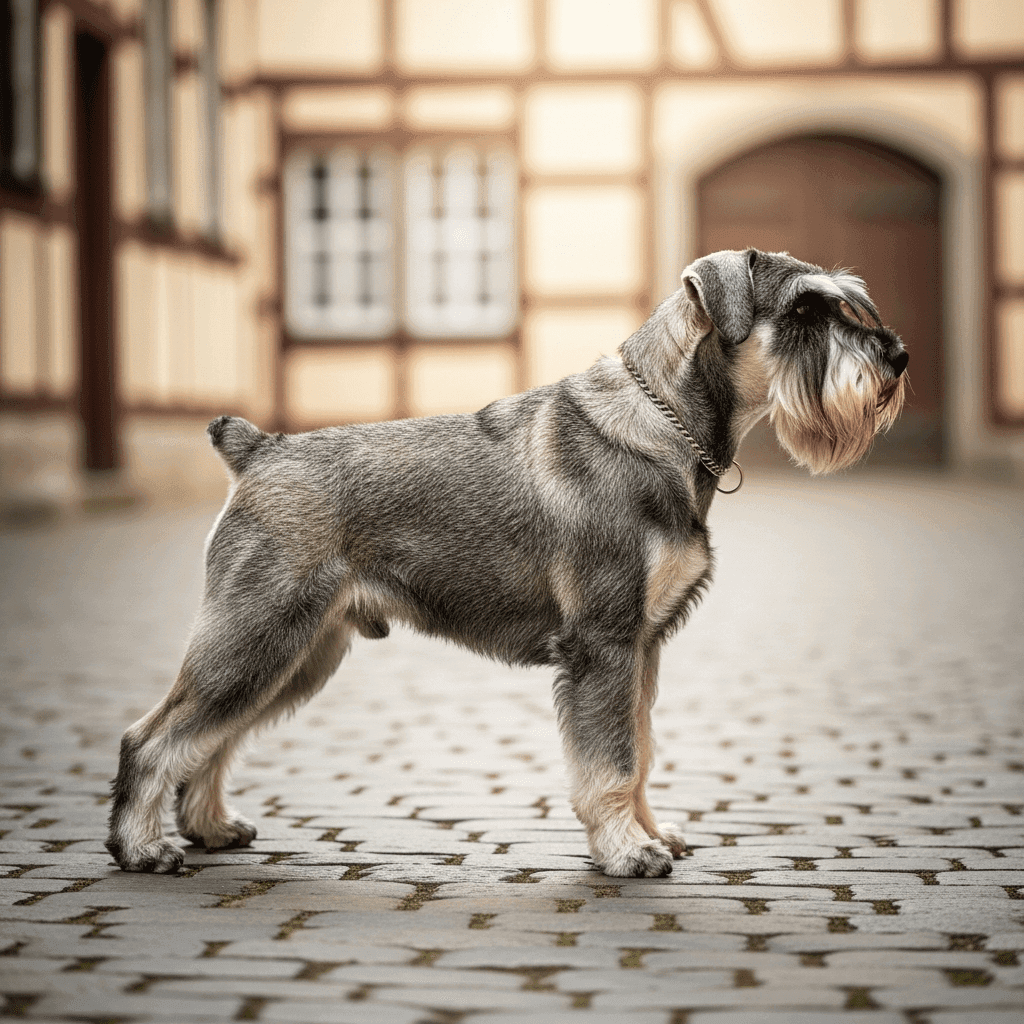
Medium Schnauzer
FCI Group
2• FCI 182
Size
Medium
Origin Country
DE
Height
45-50 cm
Weight
14-20 kg
Lifespan
10-15 years
Temperament
Overview
The Standard Schnauzer is a dog breed of exceptional versatility, combining the traits of an excellent family dog and a guard dog. It originates from southern Germany, where it originally served as a stable dog – it felt right at home, especially in the company of horses. Its task was to guard the stables and ruthlessly exterminate rodents, which quickly earned it the nickname rat catcher (German: Rattler).
When the Pinscher-Schnauzer Club was established in 1895, the breed was registered under the name rough-haired pinscher. The characteristic rough coat and strong, square build make the Standard Schnauzer stand out among other breeds. Its height at the withers is nearly equal to its body length, which emphasizes its athletic silhouette and proportions.
The Standard Schnauzer is a dog with a lively temperament combined with a calm disposition. It is good-natured, sociable, and renowned for its deep devotion to its owner. It loves children and becomes a loyal playmate for them. This dog is tenacious, alert, and at the same time not overly noisy – it makes an excellent guardian of the home.
Highly developed senses, intelligence, and ease of training make the Standard Schnauzer an excellent choice for both families with children and active individuals seeking a loyal companion. Its strong, long skull, characteristic V-shaped ears, and dark, lively eyes radiating intelligence are features that attract attention and remain in memory.
If you are interested in the Standard Schnauzer, we invite you to continue reading our guide. You will learn more about the health, grooming, exercise needs, training, diet, history, and behavior of this fascinating breed.
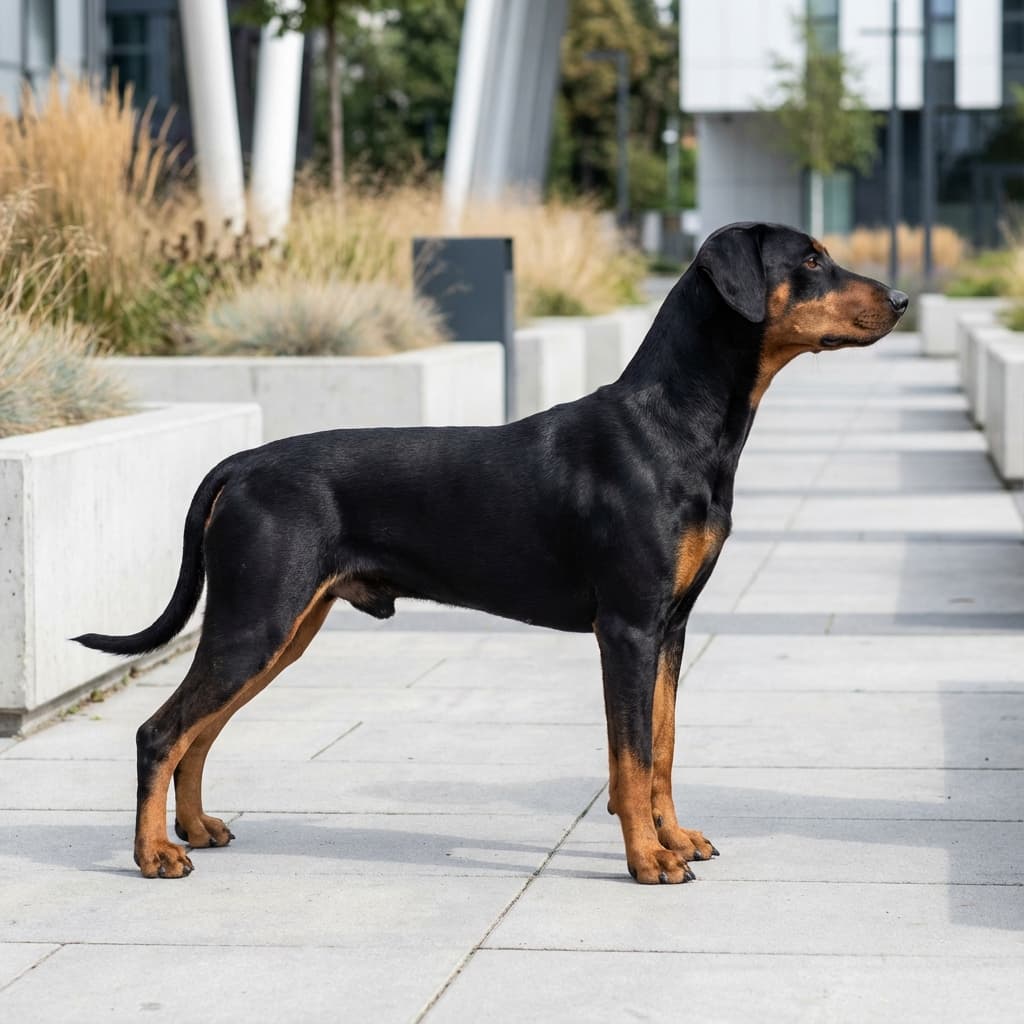
Medium Schnauzer is a dog with a distinctive, unique appearance. Its most recognizable features are its rough, dense coat and strong, compact body structure. The silhouette of the schnauzer is square – the height at the withers ranges from 45 to 50 cm and is almost equal to the length of the body. The weight oscillates between 14–20 kg, making it a medium-sized dog with great strength and endurance.
The head of the medium schnauzer is strong and long. The length of the head (measured from the tip of the nose to the occiput) is roughly half the length of the topline (from the withers to the base of the tail). The top of the head is flat, and the stop is clearly defined, giving the dog a characteristic, determined expression. Black, well-developed nostrils and a blunt wedge-shaped muzzle complete its expressive profile.
The eyes are medium-sized, oval, and dark – full of life and intelligence. The ears are V-shaped, hanging down, and their inner edges lie close to the cheeks, which adds to the dog's symmetrical and harmonious appearance.
The neck is strong, well-muscled, and smoothly transitions into the shoulders. The body is short and strong, with a slightly sloping topline from the withers to the base of the tail. The chest is moderately wide and deep, reaching to the level of the elbows, which provides the dog with stability and strength.
The tail of the schnauzer is natural and can take the shape of a sickle or saber – both variants are accepted by the breed standard.
The limbs are strong, straight, and well-muscled, ensuring agility, speed, and a large amount of energy. The schnauzer moves lightly and elegantly, despite its strong build.
The coat is the hallmark of the breed – hard, rough, and dense, consisting of a thick undercoat and a topcoat that lies close to the body. The coloration can be:
- Solid black with a black undercoat
- Pepper and salt – a characteristic pattern in shades of gray
The medium schnauzer is a dog that attracts attention and can certainly become a source of pride for its owner. Its striking appearance and harmonious proportions make it one of the most easily recognizable dog breeds.
Medium Schnauzer is a dog with a unique temperament that combines lively character with gentleness and devotion. Typical traits of this breed include an energetic nature paired with a calm disposition, good-naturedness, sociability, and the proverbial loyalty to its owner. The Schnauzer loves children and becomes not only a playmate but also a guardian and friend to them.
Schnauzers are alert but not noisy, making them excellent guard dogs. They possess highly developed senses, excellent observational skills, and are always ready to protect their owner and family. Despite their alertness, they do not bark without reason – they can recognize real threats and respond appropriately to the situation.
The medium schnauzer is a smart, quick-learning dog eager to cooperate, which makes training smooth and enjoyable for both the dog and the owner. Its intellectual abilities and willingness to work allow for achieving excellent results in various dog sports disciplines.
Schnauzers have a strong hunting instinct, stemming from their historical roots as stable dogs that hunted rodents. This can sometimes lead to unpredictable behavior towards small animals, so early socialization and training are important to ensure appropriate behavior in various life situations.
The medium schnauzer is a family dog that values the closeness of its owner. Its devotion and loyalty make it a full-fledged member of the family. Schnauzer owners should be prepared to spend active time with their pet, as these dogs need not only physical exercise but also mental stimulation to be happy, healthy, and emotionally balanced.
Medium Schnauzer generally enjoys very good health and with proper care can live 12–15 years. However, like any breed, it may be prone to certain genetic and acquired health issues, so it is important to be aware of potential health risks.
Diseases that may occur in medium schnauzers include:
- Eye diseases – cataracts, retinal dysplasia, progressive retinal atrophy (PRA)
- Circulatory system problems – heart valve defects
- Skin problems – food or contact allergies, atopic dermatitis
- Urinary stones – particularly struvite stones in females
Therefore, regular veterinary visits are crucial – routine check-ups allow for early detection of potential health problems. It is recommended to perform eye and heart examinations and to monitor the condition of the skin and coat.
A proper diet and regular physical activity are the foundation of a medium schnauzer's health. Dogs of this breed tend to be overweight, so it is important to control food portions and avoid overfeeding.
Schnauzers should be vaccinated according to veterinary recommendations and regularly dewormed. Owners should also take care of their dog's oral hygiene – regular tooth brushing prevents gum disease and periodontitis, which can lead to more serious health problems, including heart and kidney diseases.
Overall, with proper care, health prevention, and love, a medium schnauzer can enjoy a long, healthy, and active life alongside its owner.
Grooming a medium schnauzer is somewhat time-consuming, but the results are definitely worth it. The coat of this breed is rough, hard, and dense, which requires regular grooming to avoid mats, dullness, and skin problems.
Brushing should be done at least 2–3 times a week – we use a brush with stiff bristles or a comb with metal teeth to remove dead hair, dirt, and prevent matting. Schnauzers have a characteristic beard and eyebrows that require special attention and daily cleaning, as food and water residues accumulate in them.
Plucking is essential for maintaining the proper texture and color of the coat. Schnauzers should not be clipped with clippers, as this weakens the coat structure, causing it to lose its hardness and become soft. Plucking should be done every 8–12 weeks by an experienced groomer or by yourself after proper training.
Bathing should only be done when necessary (e.g., after getting dirty) to avoid destroying the natural protective layer of the skin. We use gentle shampoos designed for dogs with rough coats.
Ear care – regular checking and cleaning of the ears (every 1–2 weeks) prevents infections and the buildup of wax.
Eye hygiene – the schnauzer's eyes should be clean and free of discharge. We regularly remove any discharge with a gentle, damp gauze.
Nail trimming – if the dog does not wear them down naturally during walks, they should be trimmed every 3–4 weeks.
Oral hygiene – regular tooth brushing (2–3 times a week) and providing dental chews help maintain healthy teeth and gums.
Grooming a medium schnauzer is not just a duty but also a great opportunity to build a strong bond with your pet. Regular contact during grooming allows you to monitor the dog's health and build mutual trust.
Medium Schnauzer is a dog with high energy and endurance, requiring regular and intense physical activity to maintain health, well-being, and balanced behavior. The daily dose of exercise should be at least 60–90 minutes, but active schnauzers will gladly accept more.
Physical activity can include:
- Walks – daily walks of varying intensity, preferably in different environments (park, forest, meadow)
- Running – schnauzers love to run alongside a bicycle or while jogging with their owner
- Playtime in the park – fetching balls, frisbees, tug-of-war
- Mountain trekking – a great activity for active owners
- Swimming – some schnauzers enjoy water, and swimming is an excellent low-impact exercise
Thanks to their intelligence, agility, and willingness to cooperate, schnauzers excel in dog sports:
- Agility – an obstacle course, ideal for agile and energetic dogs
- Obedience – a sport of obedience requiring precision and concentration
- Rally-O – a combination of obedience and agility
- Nosework – using the sense of smell to search for scents
- Flyball – a dynamic team sport
Regular exercise not only helps maintain appropriate weight and physical condition, but also supports the dog's mental health, preventing boredom, depression, and destructive behaviors (such as furniture destruction, excessive barking, or hyperactivity).
Schnauzer owners should remember that lack of sufficient exercise can lead to serious behavioral problems – hyperactivity, aggression, separation anxiety. Therefore, it is crucial to provide variety in daily exercises and introduce interactive games and mentally stimulating toys for the dog (puzzles, scent mats, kong toys).
The medium schnauzer is an ideal partner for active individuals who enjoy movement and spending time outdoors. Shared activity is the key to happiness and health for this breed.
Standard Schnauzer is a dog extremely intelligent, easy to train, and eager to cooperate, making it an ideal candidate for both novice and experienced owners. With a lively temperament, high motivation, and the ability to quickly learn new commands, Schnauzers excel in training.
Training should start as early as possible – ideally from the moment the puppy is introduced to the home (around 8 weeks of age). Early socialization and learning basic commands are the foundation for later educational success.
Training methods should be based on positive reinforcement – rewards (treats, toys, praise, petting), as Schnauzers respond best to positive motivation. We avoid physical punishment and shouting, which can destroy trust and lead to behavioral problems.
Basic commands to teach:
- Sit, Lie down, Stay – basics of obedience
- Come, Stay – crucial for safety
- Leave it, No – impulse control
- Shake, Spin – tricks that build bonds
Training should be regular and consistent – short sessions (10–15 minutes) 2–3 times a day are more effective than long, exhausting training. Consistency in enforcing rules is key – all family members must adhere to the same rules.
The Standard Schnauzer is a great candidate for dog sports:
- Obedience – a sport that enhances the precision of command execution
- Agility – an obstacle course requiring agility and concentration
- Rally-O – a combination of obedience and agility with elements of fun
- Nosework – scent work, ideal for dogs with a developed hunting instinct
It is also crucial to teach the Schnauzer obedience in various situations – at home, on walks, in the presence of other dogs and people. A well-trained Schnauzer is a dog that not only behaves wonderfully in the company of people and other animals but also becomes a full-fledged, safe, and joyful member of the family.
Training the Schnauzer should be enjoyable for both the dog and the owner. Working, playing, and learning together strengthen the bond and provide satisfaction for both parties. Remember – a well-trained dog is a happy dog!
The medium schnauzer's diet should be balanced, high-quality, and tailored to its age, weight, level of physical activity, and health status. Proper nutrition is the foundation of a dog's health, fitness, and longevity.
Choosing food – owners should select premium or super-premium foods that contain:
- High-quality protein (meat, fish) – at least 25–30% of the composition
- Healthy fats (omega-3 and omega-6) – for skin and coat health
- Vitamins and minerals – to support the immune system
- Fiber – for proper digestion
What to avoid:
- Foods containing artificial colors, preservatives, and flavors
- Excess fillers (grains, corn) – can cause allergies
- Low-fiber foods, which can lead to digestive problems
Medium schnauzers have a tendency to obesity, so it is crucial to:
- Control food portions – according to the manufacturer's recommendations and veterinary guidelines
- Avoid overfeeding and excessive snacking between meals
- Regularly weigh the dog and monitor body condition
Meal regularity – adult schnauzers should receive 2 meals a day at set times. Puppies require 3–4 meals a day. Regularity helps maintain a healthy metabolism and prevents digestive issues.
Access to fresh water – the dog must have unlimited access to clean, fresh water throughout the day.
Treats – can be part of training and rewards, but should not exceed 10% of daily caloric intake. Choose healthy treats: dried meat, vegetables (carrots, broccoli), fruits (apple, banana in small amounts).
What NOT to give:
- Chocolate, onions, garlic, grapes, raisins – toxic to dogs
- Chicken bones – can splinter and cause throat injuries
- Salty, fatty, or spicy food – leads to health problems
If you have doubts about the diet, food allergies, or digestive issues, consult your veterinarian, who can help choose the right food, recommend possible supplementation, or implement an elimination diet.
Remember – proper diet is an investment in the health and long life of your medium schnauzer!
Characteristic Traits
Pros
- Versatile character
- Friendly and devoted disposition
- Ease of training and intelligence
- Alert guardian of the home
- Good with children
- Healthy breed.
Cons
- Requires regular coat care
- May be too energetic for less active individuals
- Needs a lot of attention and stimulation
- Strong hunting instinct towards small animals.
Behavioral Ratings
Breed History
The Standard Schnauzer has a rich and fascinating history dating back to the Middle Ages in southern Germany. This breed was originally used as a stable dog, whose main task was to guard cattle, horses, and ruthlessly exterminate rodents – rats and mice, which were a plague in stables and granaries. The Schnauzer felt particularly comfortable around horses and quickly gained recognition among farmers and breeders.
Its extraordinary hunting abilities and agility in hunting rodents earned it the nickname Rattler (German: Rattenfänger). Schnauzers were highly valued not only for their hunting skills but also for their vigilance, intelligence, and loyalty, making them excellent guardians of farms.
In the 19th century, breeders began systematic work to standardize the appearance, character, and utility traits of the Schnauzer. In 1879, the Schnauzer was first presented as a separate breed at a dog show in Hanover. In 1895, the Pinscher-Schnauzer Club (PSK) was established, which contributed to the official registration of the breed under the name rough-haired pinscher (Rauhaariger Pinscher). Only later did the name Schnauzer become established, derived from the German word Schnauze (muzzle), referring to the dog's characteristic beard and whiskers.
As a result of selective breeding and crossbreeding with other breeds (probably with the pinscher, poodle, and herding dogs), the Schnauzer gained its distinctive features: rough coat, strong build, intelligence, and versatility. Breeders identified three sizes of the breed:
- Miniature Schnauzer (Zwergschnauzer) – the smallest
- Standard Schnauzer (Mittelschnauzer) – the original size
- Giant Schnauzer (Riesenschnauzer) – the largest
The Standard Schnauzer was used not only as a guard and stable dog but also as a travel companion – accompanying stagecoach drivers, protecting cargo from thieves. In the 20th century, with the development of motorization, the role of the Schnauzer as a working dog diminished, but its versatility and friendly nature made it a popular family dog and companion.
Today, the Standard Schnauzer is recognized worldwide. Its natural instincts, intelligence, loyalty, and ability to adapt to life in the modern world make it an ideal dog for families, active individuals, and as a service dog (e.g., in therapeutic work, drug detection).
The Standard Schnauzer is a living legacy of German dog breeding – a breed that has evolved over the centuries while retaining its best traits and winning the hearts of owners around the world.