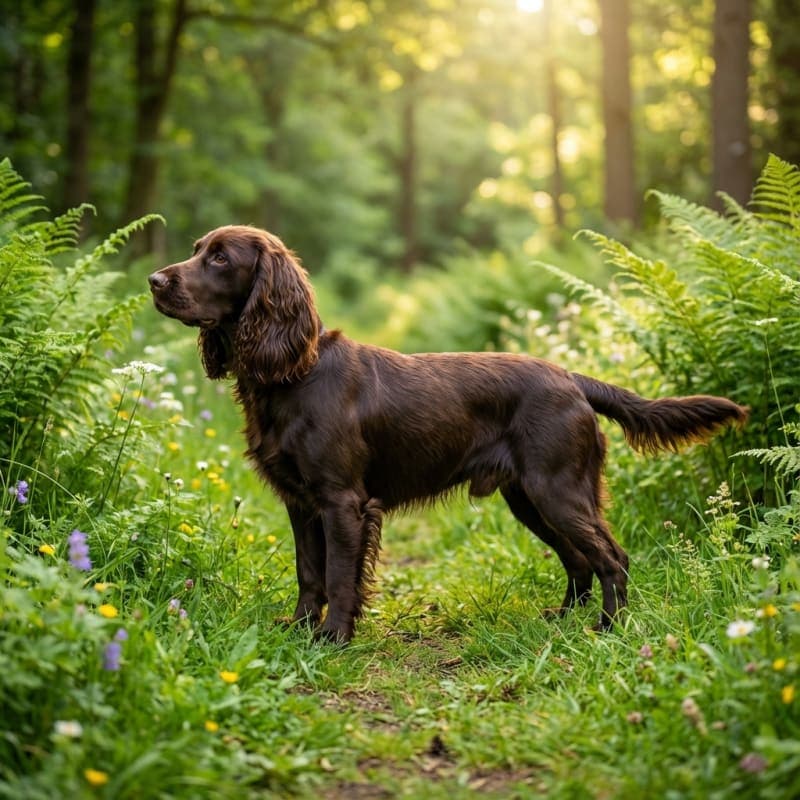
English cocker spaniel
FCI Group
8• FCI 5
Size
Medium
Origin Country
GB
Height
38-41 cm
Weight
13-14.5 kg
Lifespan
12-14 years
Temperament
Overview
The English cocker spaniel is one of the most charming and recognizable dog breeds in the world, which has delighted dog lovers for generations with its extraordinary character and exceptional beauty. Originating from picturesque Great Britain, this medium-sized dog has gained international fame due to its cheerful disposition, friendly nature, and exceptional hunting skills. The history of this breed dates back to the 18th century when these dogs were used for hunting waterfowl and woodland birds, particularly woodcocks – hence the name "cocker" (from the English "woodcock"). In 1873, a groundbreaking moment occurred: the breed was officially recognized by the prestigious Kennel Club, which initiated its dynamic development and spread worldwide.
What makes the English cocker spaniel so special? Above all, its extraordinary variety of coat colors, which delights even the most demanding aesthetes. The color palette includes:
- Solid colors: black, red, golden, chocolate
- Two-color combinations: black and white, red and white, gold and white
- Tricolor varieties: black and white with tan, chocolate and white with tan
- Roan and belton patterns: delicate speckled coats
These dogs typically reach 38-41 cm in height at the withers and weigh between 13 to 14.5 kg, making them ideal dogs for both apartments and homes with gardens. Their strong, harmoniously built physique combined with long, silky fur creates a unique picture of elegance and grace. The characteristic coat requires regular grooming, but owners unanimously agree that the result is worth it – the shiny, wavy hair of the cocker spaniel attracts attention and delights with its softness.
However, the true treasure of the English cocker spaniel is its temperament. These dogs have an intelligent and gentle expression in their eyes, which perfectly reflects their inner nature. A well-structured head with a distinct stop, large, dark, expressive eyes, and long, velvety ears that hang along the cheeks – all of this contributes to the irresistible charm of this breed. But it’s not just their appearance that makes the cocker spaniel so beloved. These dogs are full of life energy and always ready to play. They love spending time with people, including children, to whom they are exceptionally attached and patient. Their strong hunting instinct makes them ideal partners for hunters, but their cheerful, sociable nature also makes them excellent family dogs.
English cocker spaniels have a distinctive feature – a constantly wagging tail, which is a true barometer of their moods. This dog is happy almost all the time, and its enthusiasm is contagious. Nevertheless, potential owners should be aware that this breed requires a lot of exercise and mental stimulation to be truly happy. Without the right amount of activity, a cocker spaniel can become restless or bored. Proper training and socialization from a young age are crucial to ensure that this dog does not become too hyperactive or dominant – although with the right approach, they are incredibly obedient and eager to cooperate.
This is a breed that will undoubtedly bring immense joy and plenty of love to anyone who decides to have one. The English cocker spaniel is not just a dog – it is a true family member, a devoted friend, and an unwavering companion for all adventures.
The English Cocker Spaniel has a distinctive, exceptionally harmonious appearance, making it one of the most recognizable dogs in the world. Its silhouette is strong, compact, and well-balanced, with perfectly developed musculature that is not overly massive. Ideal body proportions ensure that the distance from the withers to the ground is roughly the same as from the withers to the base of the tail, creating an effect of balanced, elegant structure.
Dimensions and weight:
- Height at the withers: males 39-41 cm, females 38-39 cm
- Weight: from 13 to 14.5 kg (depending on sex and build)
- Proportions: square, compact silhouette
The head of the Cocker Spaniel is one of its most distinctive features. It is well-formed, clearly sculpted, but not too delicate or too massive. The skull is rounded, with a well-defined occiput. The stop (the transition from forehead to muzzle) is distinct, positioned exactly halfway between the tip of the nose and the back of the head. The muzzle is square, of appropriate length, never too short or too sharp. The nose is wide enough for excellent scenting, which is crucial for a hunting dog.
The eyes are large but not bulging, dark brown or hazel (depending on coat color), full of intelligent expression and gentleness. The gaze of the Cocker Spaniel is extremely characteristic – soft, friendly, full of devotion. The ears are one of the most recognizable features of this breed: they are long, drooping, set at eye level or slightly below, well-coated with long, silky hair. Their velvety softness and elegant fall along the cheeks add charm to the dog.
Body structure:
- Neck: medium length, strong, muscular, elegantly tapering towards the head
- Back: strong, level, short, and compact
- Loin: wide, muscular, slightly arched
- Chest: deep, well-developed, with well-arched ribs
- Tail: set slightly below the line of the back, carried cheerfully (never above the back), with a characteristic "happy action"
The limbs of the Cocker Spaniel are strong and straight. The front legs are straight, with a strong bone structure, well-muscled shoulders set at an angle. The elbows are close to the body, neither turned outward nor inward. The hind legs are very muscular, with well-muscled thighs and strong knee joints at a good angle of flexion. The hocks are set low, providing excellent drive while running. The paws are compact, well-padded, round, resembling "cat paws".
Coat and color:
The coat of the English Cocker Spaniel is one of its most beautiful features. It is long, smooth, and silky to the touch, never rough, curly, or overly abundant. The hair structure is delicate yet strong. On the head, the hair is shorter and more close-lying, while on the body, it forms a slight wave. The characteristic feathering occurs on:
- Ears – long, abundant wavy hair
- Chest and belly – long, silky fringes
- Back of the front legs
- Hind legs – abundant skirts
- Tail – long, elegant fringes
The coloration of this breed is extremely diverse and fascinating:
- Solid colors: black, red in various shades (from golden to dark red), chocolate, golden
- Two-color: black and white, red and white, orange and white, chocolate and white
- Tricolor: black with white and tan, chocolate with white and tan
- Roan: blue roan, orange roan, lemon roan, chocolate roan
In the case of solid colors, a small white spot on the chest is allowed. Dogs with two colors should have clearly separated patches. The English Cocker Spaniel in motion is a picture of grace – its smooth, effortless movements, constantly wagging tail, and cheerful disposition create an unforgettable image of a joyful, lively hunting dog.
The English Cocker Spaniel is a dog with a remarkably friendly, sociable, and joyful character that literally radiates positive energy. His temperament can be summed up in one word: "merry" – cheerful. This description appears in every breed standard and not without reason – the constantly wagging tail of the Cocker Spaniel is tangible evidence of his enthusiastic approach to life.
Family Relationships:
The English Cocker Spaniel is extremely attached to his human family. He is a dog that lives for his owners and needs their presence. He is characterized by high emotional sensitivity – he perfectly senses the moods of household members and often adjusts his behavior to the prevailing atmosphere. If his owner is sad, the Cocker Spaniel will try to comfort him by bringing a toy or simply sitting beside him. When the atmosphere is joyful, his enthusiasm doubles!
- Attachment: Strong, loyal, devoted – the Cocker Spaniel is a true "shadow dog"
- Need for companionship: Very high – does not tolerate long periods of solitude
- Interaction: Actively seeks physical contact – loves to be petted and cuddled
Behavior Towards Children:
The English Cocker Spaniel is a perfect dog for families with children. He is extremely patient, gentle, and tolerant of the youngest family members. He loves playing together, running in the garden, and participating in all family activities. His energy and playfulness perfectly match the vitality of children, and at the same time, he has such a gentle temperament that he can be trusted around little ones. However, it is important to remember, as with any breed, to:
- Teach children respect for the dog and his space
- Not leave very small children unsupervised with the dog
- Allow the dog to rest peacefully when he is tired
Relationships with Strangers:
Cocker Spaniels are usually very friendly towards strangers, which makes them poor guard dogs – they are more likely to greet an intruder with a wagging tail than with barking! They may initially show some shyness towards unfamiliar people, but they quickly warm up and often greet guests with the same enthusiasm as their own family. This trait makes them ideal companion dogs in social situations.
Behavior Towards Other Animals:
The English Cocker Spaniel is usually friendly towards other dogs, especially if properly socialized from puppyhood. He loves the company of other four-legged friends and enjoys playing with dogs of various sizes. However, his hunting instinct may cause him to show interest in smaller animals – birds, rodents, and even cats. Therefore:
- Early socialization with other animals is crucial
- Supervision during initial encounters with small animals
- Proper training can minimize chasing tendencies
Energy and Activity Level:
The Cocker Spaniel is a dog with a high energy level that requires regular physical and mental activity. He is extremely playful and always ready for action. His natural behaviors include:
- Tracking: Constantly sniffing trails during walks
- Fetching: Loves to bring back thrown items
- Swimming: Most Cocker Spaniels are water lovers
- Exploring: Curious about the world and eager to discover new places
Behavioral Problems (when lacking activity):
A Cocker Spaniel that does not receive enough exercise and stimulation may develop behavioral problems such as:
- Excessive barking – expressing frustration and boredom
- Destruction of objects – releasing excess energy
- Hyperactivity – difficulty calming down
- Separation anxiety – especially during long periods of solitude
- Persistent begging – seeking attention and interaction
Intelligence and Learning:
The English Cocker Spaniel is a smart dog that quickly learns new commands. He is eager to learn and cooperate with his owner, especially when training is based on positive methods. However, he may exhibit some stubbornness or a tendency to make decisions independently, which is a remnant of his hunting past. The key is consistency, patience, and positive reinforcement.
Characteristic Behavioral Traits:
- "Busy" temperament: Always on the move, always doing something, always ready for action
- Fearlessness in the field: Not afraid of dense brush or difficult terrain while tracking
- Sensitivity: Cannot stand harsh treatment – requires a gentle but consistent approach
- Cheerful disposition: Rarely in a bad mood, almost always joyful
- Gluttony: Loves to eat and may be prone to overeating
In summary, the English Cocker Spaniel is a perfect dog for active families who can provide him with plenty of attention, love, and opportunities to expend energy. His sociable, joyful, and devoted character makes him not just a pet but a true family member who brings immense joy and positive energy into the home.
The English Cocker Spaniel is a breed with generally good health, which, with proper care, can enjoy a long and happy life. The average lifespan of this breed is 12 to 14 years, although many dogs, with a proper diet, regular exercise, and veterinary care, can live even longer – up to 15-16 years.
Like any breed, the English Cocker Spaniel does have certain predispositions to specific genetic disorders. Responsible breeders conduct health tests before breeding to minimize the risk of passing on hereditary diseases. Potential owners should be aware of possible health issues and regularly consult with a veterinarian.
Most common health problems:
1. Eye diseases:
- Progressive Retinal Atrophy (PRA): a hereditary condition leading to gradual vision loss. The first symptoms appear as limited visibility in darkness, and the disease progresses, leading to complete blindness. It can be detected through genetic testing before breeding.
- Cataracts: clouding of the eye lens, which can lead to impaired vision. It can be congenital or acquired. In advanced cases, surgical intervention may be possible.
- Glaucoma: increased intraocular pressure, which can be very painful and lead to vision loss. It requires immediate veterinary intervention.
- Retinal dysplasia: abnormal development of the retina, often congenital.
- Dystichiasis: additional eyelashes growing in abnormal places, which can irritate the cornea.
2. Ear problems:
Due to their long, drooping ears, Cocker Spaniels are particularly prone to ear infections (otitis externa and media). These ears create a warm, moist environment, ideal for the growth of bacteria and fungi. Symptoms include:
- Shaking the head or tilting it to the side
- Scratching the ears
- Unpleasant odor from the ears
- Redness or discharge from the ears
- Pain when touching the ears
Prevention: regular (weekly) ear cleaning, thorough drying after bathing, checking the condition of the ears after every swim.
3. Hereditary nephropathy (Familial Nephropathy):
This is a serious kidney condition that can lead to chronic kidney failure at a young age (2-5 years). Symptoms include:
- Increased thirst and urination
- Loss of appetite and weight
- Lethargy and weakness
- Vomiting
Genetic tests are available to detect carriers of this gene before breeding.
4. Hip dysplasia (HD):
Abnormal development of the hip joint, which can lead to pain, lameness, and arthritis. Although it is more common in larger breeds, Cocker Spaniels can also be affected by this condition. Responsible breeders perform X-rays and only breed dogs with normal joints.
5. Elbow dysplasia:
A similar condition affecting the elbow joints, leading to mobility issues and pain.
6. Obesity:
Cocker Spaniels have a tendency to gain weight, especially if they do not receive enough exercise or are overfed. Obesity leads to many serious health problems:
- Increased strain on joints and spine
- Heart disease
- Diabetes
- Breathing problems
- Shortened lifespan
Prevention: a properly balanced diet, portion control, limiting treats, regular exercise.
7. Skin diseases:
- Atopic dermatitis (atopy): an allergic skin condition causing itching, redness, and hair loss
- Seborrhea: excessive production of sebum leading to oily skin and coat
- Primary idiopathic nasal hyperpigmentation: a cosmetic condition related to depigmentation of the nose
8. Thyroid problems:
Hypothyroidism may occur in older Cocker Spaniels. Symptoms include:
- Weight gain despite a normal diet
- Lethargy, decreased activity
- Skin and coat problems (dull, brittle coat)
- Cold intolerance
9. Autoimmune Hemolytic Anemia (AIHA):
A serious autoimmune condition in which the body attacks its own red blood cells. It requires immediate veterinary assistance.
10. Epilepsy:
Some lines of Cocker Spaniels may be prone to seizures. They can be controlled with anticonvulsant medications.
Prevention and healthcare:
- Regular veterinary visits: annual check-ups (every 6 months for older dogs)
- Vaccinations: complete vaccination program according to the veterinarian's recommendations
- Worming: regular deworming (every 3 months)
- Parasite protection: using products against ticks and fleas
- Ear checks: weekly checking and cleaning of ears
- Dental care: regular tooth brushing, dental chews
- Weight control: regular weighing and adjusting diet
- Genetic testing: for breeding dogs – tests for PRA, nephropathy, dysplasia
Signs that something is wrong:
- Sudden change in behavior or appetite
- Lethargy, lack of energy
- Difficulty moving, lameness
- Excessive scratching, licking, biting themselves
- Eye problems (redness, tearing, squinting)
- Breathing problems
- Sudden weight gain or loss
- Vomiting, diarrhea lasting more than 24 hours
In summary, most English Cocker Spaniels are healthy dogs that, with proper care, can enjoy a long life. The key is choosing a responsible breeder who conducts health tests on the parents, as well as regular veterinary care and prevention. Owners should be aware of potential health issues specific to this breed and respond quickly to concerning symptoms.
The English cocker spaniel is a breed that requires regular and quite intensive grooming to keep its beautiful, long coat in excellent condition. While this may seem demanding, most owners agree that the end result – a shiny, silky coat – is absolutely worth it. Grooming a cocker spaniel is not just a matter of aesthetics, but above all caring for the dog's health and comfort.
Brushing the coat:
This is the most important element of grooming for the English cocker spaniel. Its long, silky coat tends to tangle, especially in areas where there is friction (behind the ears, under the armpits, on the inner thighs, on the belly). Without regular brushing, painful mats can form, which can lead to skin irritations.
Brushing frequency:
- Daily routine: Ideally brush daily for 10-15 minutes
- Minimum: 3-4 times a week (outside of shedding periods)
- During shedding: Daily, preferably twice a day (spring and autumn)
- After walks: Check the coat for dirt, leaves, grass seeds
- After bathing: Brush while drying
Brushing tools:
- Slicker brush: for daily detangling and removing dead hair
- Metal comb: for detecting and untangling small knots
- Pinf brush: for massaging the skin and final finishing
- Fringe comb: a special comb with long teeth for delicate areas
- Mat splitter: a tool for safely untangling mats (only as a last resort!)
- Detangling spray: makes brushing easier and adds shine
Brushing technique:
- Start with gently detangling with a comb, checking for mats
- Brush in layers – lift the hair and brush from the skin, gradually moving higher
- Pay special attention to problem areas: behind the ears, armpits, between the toes, belly
- Gently detangle the fringes on the legs and tail, holding the hair at the base to avoid pulling
- Finish brushing in the direction of hair growth for a smooth effect
Bathing:
English cocker spaniels require regular baths to keep their coat clean and in good condition. However, too frequent washing can remove the natural protective oils from the skin.
- Frequency: every 6-8 weeks (at home), every 4-6 weeks (for show dogs)
- Shampoo: high-quality shampoo for long-haired dogs or special for cocker spaniels
- Conditioner: essential for maintaining softness and silkiness of the coat
- Water temperature: lukewarm, never hot or cold
Bathing procedure:
- Before bathing: thoroughly brush the entire coat, removing any mats
- Pre-wet: thoroughly wet the entire coat down to the skin
- Shampooing: apply shampoo, gently massaging (do not rub the coat!) to avoid additional tangling
- Rinsing: very thorough rinsing – leftover shampoo can cause skin irritations
- Conditioner: apply to the fringes and longer hair, leave on for 2-3 minutes, rinse
- Drying: gently squeeze water from the coat, wrap in a towel (do not rub!)
- Blow-drying: dry with a hairdryer on low heat while brushing
Trimming and shaping:
The English cocker spaniel does not require as drastic trimming as the American cocker, but regular trimming of certain areas is necessary to maintain hygiene and a healthy appearance.
Hygienic trimming (every 6-8 weeks):
- Paws: trim hair between the toes (prevents slipping and dirt accumulation)
- Ears: trim hair from the inner part of the ear flap (prevents infections)
- Anal area: gentle trimming for hygiene
- Fringes: trim the ends for an even appearance
- Belly: shorten hair on the belly (prevents dirt accumulation)
Show trimming:
For show dogs, trimming is more complicated and is usually done by a professional groomer. It includes:
- Shaping the head (shortening hair on the skull)
- Trimming the neck and shoulders
- Evening out the back line
- Shaping the fringes
- Overall shaping of the silhouette
Ear care (CRITICALLY IMPORTANT!):
Due to long, drooping ears, cocker spaniels are extremely prone to ear infections. Regular checking and cleaning of the ears is an absolute necessity!
Ear care routine:
- Frequency: check daily, clean once a week (or more often if the dog swims)
- Tools: ear cleaning solution for dogs, cotton balls or gauze (NO cotton swabs!)
- Procedure:
- Visually check for redness, swelling, unpleasant odor
- Pour a few drops of ear cleaning solution into the ear canal
- Gently massage the base of the ear for 20-30 seconds
- Allow the dog to shake its head
- Wipe visible dirt with gauze or a cotton ball
- After bathing/swimming: always thoroughly dry the ears (also from the inside)
Signs of ear problems:
- Shaking the head
- Scratching the ears
- Unpleasant odor
- Redness or swelling
- Discharge (brown, yellow)
- Pain when touched
If any concerning symptoms arise – immediately go to the veterinarian!
Dental care:
- Brushing: at least 3 times a week, preferably daily
- Toothpaste: special toothpaste for dogs (never human!)
- Toothbrush: dog toothbrush or finger brush
- Alternatives: dental chews, tooth-cleaning toys
- Check-ups: regular dental examinations by the veterinarian, professional cleaning if needed
Nail trimming:
- Frequency: every 2-4 weeks (depending on the dog's activity)
- Tools: guillotine clippers or dog nail grinder
- Technique: trim small pieces, avoiding the quick (the pink part in light nails)
- Sign of long nails: the dog "clicks" when walking on hard surfaces
Skin check:
During grooming, always check the condition of the skin:
- Any changes, lumps, wounds
- Parasites (ticks, fleas)
- Redness, dandruff, hair loss
- Suspicious odors
Tips for new owners:
- Start the grooming routine from puppyhood – it will be a natural part of the dog's life
- Schedule the first visit to the groomer around 4-6 months of age (after full vaccination)
- Ask a professional groomer to show you how to properly groom at home
- Invest in high-quality tools – they last for years and make grooming easier
- Make grooming a pleasant experience – reward the dog, stay calm
Cost of professional grooming:
If you decide on regular visits to a professional groomer (every 6-8 weeks), be prepared for a significant expense – the cost of a single visit is usually 150-300 PLN, which amounts to about 1200-2400 PLN annually. Therefore, many owners choose to learn self-grooming.
In summary, grooming an English cocker spaniel requires time and effort, but it is essential for the dog's health, comfort, and beautiful appearance. Regular grooming routine is not just a matter of aesthetics – it is also a time to build a bond with your dog and an excellent opportunity to check its health.
The English Cocker Spaniel is a breed with high exercise needs that requires a significant amount of daily physical and mental activity. This is not a dog for people leading a sedentary lifestyle – the Cocker Spaniel is a hunter, with instincts and energy that must find an outlet. Without the proper amount of exercise, it can become restless, hyperactive, or develop behavioral problems.
Minimum exercise requirements:
- Daily activity time: at least 1.5-2 hours of intense movement
- Walks: at least 2-3 walks a day, each lasting 30-45 minutes
- Additional activities: play, training, mental exercises – an additional 30-60 minutes
- Days off: the Cocker Spaniel does NOT have days off from activity!
Types of physical activities:
1. Walks:
This is the foundation of the Cocker Spaniel's daily activity. However, walks cannot just be leisurely strolls – the dog needs opportunities for brisk walking and intense sniffing.
- Pace: energetic, fast pace (not slow walking)
- Terrains: diverse – parks, forests, meadows, built-up areas (for socialization)
- Sniffing: allow the dog to sniff and track – this satisfies its hunting instincts
- Leash vs. off-leash: if possible, let it run off-leash (in a safe area)
- Variety of routes: different routes provide new mental stimuli
2. Running:
The Cocker Spaniel is a great jogging partner, although due to its size, it performs better on medium distances. It can run with its owner, but remember:
- Age: start running only after 12-14 months of age (after growth has finished)
- Distance: gradually increase the distance, aiming for 5-10 km without problems
- Pace: adjust the pace to the dog's capabilities (do not push it!)
- Surface: prefer soft surfaces (grass, forest trails) over asphalt
- Weather: avoid running in hot weather (Cocker Spaniels do not tolerate high temperatures well)
3. Fetching:
This is one of the favorite activities of the Cocker Spaniel! As a retrieving dog, it loves to bring back thrown items. Benefits:
- Intense energy burning in a short time
- Development of obedience and cooperation
- Satisfaction of hunting instincts
- Ability to exercise even in a small space
What to fetch: balls, frisbees, bird dummies (for working dogs), pine cones, sticks (with caution!)
4. Swimming:
Most Cocker Spaniels are water lovers – after all, they are hunting dogs that traditionally worked with waterfowl. Swimming is:
- Excellent full-body exercise without stressing the joints
- Ideal for hot weather – cools and exercises at the same time
- A joy for the dog – most Cocker Spaniels love water
- Energy burning – intense training in a short time
Where to swim: lakes, rivers, seas, dog pools, natural water bodies
IMPORTANT after swimming: thoroughly dry the ears to prevent infections!
5. Play with other dogs:
Cocker Spaniels are usually very sociable and love to play with other dogs. Benefits:
- Natural energy release through play
- Socialization and learning dog body language
- Joy and mental stimulation
- The owner can relax while the dogs play
Where: dog parks, meet-ups with familiar dogs, organized playgroups
6. Dog sports activities:
The Cocker Spaniel excels in various canine sports:
- Agility: obstacle course – great fun and training
- Obedience: training – develops bond and cooperation
- Rally-O: course with tasks – for less athletic dogs
- Nosework: scent tracking – satisfies hunting instincts
- Flyball: racing with retrieving – intense fun
- Dummy-work: hunting training with dummies
- Canicross: running in harness with the owner
7. Hiking and trekking:
The Cocker Spaniel is a great hiking companion. Its endurance allows for long mountain or forest trips. Remember:
- Gradually increase the difficulty of the routes
- Proper preparation of the dog (fitness)
- Care for the paws (protection against cuts)
- Water and food for the dog in the backpack
- After returning – thoroughly check the body for ticks, wounds, and dirt
Mental activity (equally important!):
The Cocker Spaniel is a smart dog that also needs mental stimulation. A mentally tired dog is just as calm as a physically tired one.
Ways to stimulate mentally:
- Training and learning new commands: 10-15 minutes daily
- Scent games: searching for treats, nosework, scent trails
- Interactive toys: dog puzzles, treat balls, sniff mats
- Hiding toys/treats: the dog must search for them around the house/garden
- Tricks: teaching fun commands (spinning, shaking hands, playing dead)
- Toy rotation: changing available toys weekly – keeps novelty
- New walking routes: new scents and sights = mental stimulation
Exercise needs depending on age:
Puppy (2-12 months):
- Short walks (5 minutes per month of life, 2-3 times a day)
- Play in the garden/house – natural for puppies
- Avoid intense, long exercises (joint protection)
- Do not push – the puppy self-regulates activity
- Socialization and new experiences = mental stimulation
Adult dog (1-8 years):
- Full activity – 1.5-2 hours daily minimum
- Intense exercises, sports, long hikes
- Peak fitness and energy
Senior (8+ years):
- Adjust activity to the dog's capabilities
- Shorter, more frequent walks instead of long ones
- Gentler forms of movement (swimming is excellent for older dogs)
- Continue activity – movement is health!
- Watch for any joint problems, limping
Consequences of insufficient activity:
A Cocker Spaniel that does not receive enough exercise may exhibit behavioral problems:
- Excessive barking – frustration and boredom
- Destruction of objects – releasing energy
- Hyperactivity – difficulty calming down
- Persistent begging for attention – seeking stimulation
- Weight problems – tendency to obesity
- Depression, apathy – lack of life satisfaction
- Compulsive behaviors – licking paws, chasing tail
Practical tips:
- Routine: Cocker Spaniels love routine – fixed walk times
- Weather: walk in any weather (except extreme heat) – dress the dog in a raincoat in the rain
- Safety: leash in busy areas, off-leash only in safe areas
- Season: in summer, walk in the morning and evening (avoid heat), in winter – no problem, the Cocker has good fur
- After activity: check paws, ears, body for ticks and dirt
In summary, the English Cocker Spaniel is a dog for active people who can dedicate a significant amount of time to daily activities. However, this time investment pays off in the form of a happy, balanced, and healthy dog that is a wonderful companion in all adventures. Remember: a tired Cocker is a happy Cocker!
Training an English cocker spaniel is a joyful process, but it requires consistency and patience. These intelligent dogs quickly learn new commands and tricks, but their independent hunting nature can sometimes lead to stubbornness. The key to success is starting training early, positive training methods, and understanding the specific character traits of this breed.
When to start training?
- From the first day at home! Training begins the moment the puppy crosses the threshold of your home
- Optimal age: 8-16 weeks – the critical socialization period
- Basic commands: can be taught from 8 weeks of age
- Advanced training: after 6 months of age
- Remember: older dogs can also be trained – it’s never too late!
Characteristics of the cocker spaniel in the context of training:
- Intelligence: high – quickly absorbs new commands
- Willingness to cooperate: medium to high – likes to please the owner but has its own opinions
- Motivation: food, play, praise – best combined with all three
- Sensitivity: very high – does not tolerate harsh treatment
- Stubbornness: can be stubborn, especially when sniffing around or distracted
- Ease of distraction: medium to high – scent can interfere with concentration
Training methods – what works and what doesn’t:
✅ RECOMMENDED METHODS (positive reinforcement):
- Treat rewards: small bites of treats for correct execution
- Verbal praise: enthusiastic "Good job!", "Good dog!"
- Play: favorite toy as a reward
- Petting and affection: physical contact as reinforcement
- Clicker training: precise marking of desired behavior
- Consistency: clear rules that always apply
- Patience: time and repetition lead to success
❌ METHODS TO AVOID (punishment, coercion):
- Physical punishment: hitting, yanking – absolutely forbidden! Damages the dog's psyche and the bond with the owner
- Shouting: cocker spaniels are sensitive – shouting causes fear and blocks learning
- Forceful methods: forcing the dog into position – unnecessary and harmful
- "Choke" collars: painful and dangerous
- Long training sessions: bore the dog and decrease motivation
Basic commands (must-have):
1. "Sit":
- Basic command – foundation for other exercises
- How to teach: treat in front of the dog’s nose, slowly move it back over the head – the dog will naturally sit, say "Sit" and reward
- Application: calm waiting, control in various situations
2. "Stay":
- Teaches self-control and patience
- How to teach: dog in a sit, command "Stay", step back, return and reward. Gradually increase distance and time
- Application: safety (won’t run into the road), calmness at home
3. "Come":
- THE MOST IMPORTANT COMMAND for the dog's safety
- How to teach: in a safe area with a long leash, call "Come!", gently pull the leash if the dog hesitates, huge reward upon approach
- Application: control of the dog on walks, safety
- IMPORTANT: NEVER punish a dog that comes when called (even if it was misbehaving earlier!) – always reward!
4. "Down":
- Relaxation position – the dog calms down in this position
- How to teach: from the "sit" position, treat in front of the nose, slowly lower it to the ground – the dog will lower its elbows for the treat, say "Down" and reward
- Application: calm lying in a café, at the vet, at home
5. "Leave it":
- Safety – prevents the dog from eating something harmful
- How to teach: treat in a closed hand, the dog will try to get it, say "Leave it", wait until the dog turns away/stops – then reward with another treat
- Application: protection from eating trash, poisons, manure
6. "Heel" / Walking on a loose leash:
- Comfortable walks without pulling
- How to teach: when the dog pulls the leash – stop and wait, when it relaxes – continue walking. Reward walking beside you
- REMEMBER: cocker spaniels are hunting dogs – sniffing is their nature! Allow for "sniffing breaks"
Advanced training:
For working (hunting) dogs:
- Retrieving on command: training with bird dummies
- Fieldwork: searching terrain, flushing birds
- Water work: retrieving from water
- Distance obedience: whistle, hand signals
- Stopping: stopping on command while tracking
Canine sports:
- Agility: obstacle course – great fun and cooperation
- Obedience: precise obedience
- Nosework: tracking scents
- Rally-O: course with tasks
Tricks and fun (for enjoyment):
- Giving a paw / High five
- Spinning in circles
- Playing dead / Rolling over
- Speak / Quiet
- Retrieving specific items by name
- Cleaning up toys into a box
Socialization (a key part of training!):
Socialization is a process of exposing the puppy to various stimuli so that the adult dog is confident and balanced.
What a cocker spaniel puppy should experience:
- People: of different ages, genders, appearances, in various clothing (hats, uniforms, glasses)
- Children: calm interactions with children of different ages
- Other dogs: of various breeds, sizes, temperaments (in safe conditions)
- Other animals: cats, birds, small animals (under supervision!)
- Environments: city, park, forest, busy street, store, train, car
- Sounds: street noise, thunder (recordings), vacuum cleaner, children playing
- Surfaces: grass, sidewalk, metal grates, slippery floors, stairs
- Handling: touching paws, ears, tail, muzzle – preparing for grooming and vet visits
Critical socialization window: 3-14 weeks of age – the most intense phase, but socialization continues throughout the first 2 years of life!
Common training problems with cocker spaniels:
1. Distractions (scent!):
- Problem: the dog is so absorbed in scents that it ignores the owner
- Solution: train in calm places at first, gradually increase distractions, use highly motivating rewards, allow for "sniffing breaks" as a reward
2. Selective deafness to recall:
- Problem: the dog only comes when it feels like it
- Solution: ALWAYS reward recall, train on a long leash, increase the value of the reward, never call the dog to punish or do something unpleasant (e.g., immediately return home)
3. Stubbornness:
- Problem: the dog "does not feel like" following commands
- Solution: increase motivation (better treats!), shorter sessions (5-10 minutes), end training while the dog is still interested, consistency – don’t give in when the dog tests boundaries
4. Excessive barking:
- Problem: barking out of excitement, boredom, or to get attention
- Solution: teach the command "Quiet", do not reward barking with attention, ensure sufficient exercise and stimulation
5. Begging at the table:
- Problem: the dog begs for food during family meals
- Solution: NEVER give food from the table, teach the dog to lie in its place during your meals, consistency from the whole family!
Practical tips:
- Training sessions: short (5-15 minutes), frequent (2-3 times a day), ending on a success
- Best time: before meals (the dog is hungry = more motivated)
- Place: initially at home (calm place), then increase the level of distraction
- Consistency: everyone in the family uses the same commands and rules
- Progress: small steps – do not move to the next stage too quickly
- Rewards: vary the value of rewards (regular treat vs. super reward for a difficult task)
- Fun factor: training should be enjoyable for both the dog and the owner!
Professional help:
Consider group or individual classes with a trainer if:
- This is your first dog
- You have issues with specific behaviors
- You want to train for canine sports
- The dog shows fear or aggression
- You are looking for support and motivation
Puppy Class:
Absolutely recommended for all cocker spaniel puppies! Benefits:
- Socialization with other puppies
- Learning basic commands
- An experienced trainer provides tips on handling problems
- Support from other owners in similar situations
In summary, training an English cocker spaniel is an investment in a happy, well-behaved dog. The key is starting early, consistency, positive methods, and patience. Remember that the cocker spaniel is a sensitive dog that responds best to a gentle, yet firm approach. With proper training, it will become a well-mannered companion that brings you a lot of joy!
Proper nutrition for an English cocker spaniel is the foundation of its health, condition, and longevity. This breed has specific nutritional needs and a strong tendency to gain weight, so a well-balanced diet and portion control are crucial. A properly nourished cocker spaniel has a shiny coat, plenty of energy, and is in excellent physical shape.
Basic nutrition guidelines:
- High-quality food: choose premium or super-premium foods with a high meat content
- Regular feeding times: adult dogs – 2 meals a day, puppies – 3-4 meals
- Portion control: strictly adhere to the manufacturer's feeding guidelines (adjusted for weight and activity)
- Fresh water: available 24/7
- Do not feed from the table: human food can lead to obesity and health problems
- Weight monitoring: regular weighing and observation of body condition
Nutrients – what is important?
1. Protein (30-35% in food for adult dogs):
- The most important ingredient for active dogs
- Sources: meat (chicken, turkey, beef, lamb, fish), eggs
- Functions: building and repairing muscles, healthy skin and coat, energy
- Prefer: foods with named protein sources ("chicken" instead of "meat and by-products")
2. Fats (15-20%):
- Source of energy – especially important for active dogs
- Healthy fats: salmon oil, flaxseed oil, poultry fat
- Functions: energy, healthy skin and shiny coat, absorption of fat-soluble vitamins
- Omega-3 and omega-6 fatty acids: crucial for skin and coat health
3. Carbohydrates (30-40%):
- Source of energy and fiber
- Good sources: sweet potatoes, brown rice, oats, vegetables
- Avoid: excessive grains, corn (often allergens)
- Fiber: supports healthy digestion
4. Vitamins and minerals:
- Vitamin A: healthy vision, skin
- B vitamins: metabolism, energy
- Vitamin D: healthy bones
- Vitamin E: antioxidant, healthy skin
- Calcium and phosphorus: healthy bones and teeth (proper ratios!)
- Zinc: healthy coat and skin
Types of food – comparison:
1. Dry food (kibble):
Advantages:
- Economical
- Easy to store
- Helps clean teeth (slightly)
- Precise portion control
Disadvantages:
- Less palatable for picky eaters
- Processed (high temperature)
- Often contains preservatives
2. Wet food (cans, pouches):
Advantages:
- Very palatable – dogs love it
- High water content (good for hydration)
- Easier to swallow (for older dogs)
Disadvantages:
- More expensive
- Shorter shelf life after opening
- Does not help clean teeth
- Can easily lead to overfeeding (high calories)
3. BARF diet (raw meat and bones):
Advantages:
- The most natural
- Full control over ingredients
- No artificial additives
- Healthy teeth (chewing bones)
Disadvantages:
- Time-consuming
- Requires knowledge (risk of an unbalanced diet)
- Risk of bacterial contamination (salmonella, E. coli) – hygiene required
- Not for all owners ("blood and bones" in the fridge)
4. Home-cooked food:
Advantages:
- Full control over ingredients
- Fresh, natural
- Tailored to the individual needs of the dog
Disadvantages:
- Very time-consuming
- Requires consultation with a veterinarian/nutritionist (risk of deficiencies)
- More difficult portion calculation
Caloric requirements:
The number of calories depends on the weight, age, and activity level of the dog.
Approximate daily caloric requirements:
- Adult dog (13 kg), moderate activity: ~700-800 kcal/day
- Adult dog (13 kg), high activity (sports, hunting): ~900-1000 kcal/day
- Adult dog (13 kg), low activity (senior, few walks): ~550-650 kcal/day
- Puppy (growth): ~900-1100 kcal/day (more than an adult dog!)
IMPORTANT: these are just approximations! Always read the manufacturer's feeding guidelines and adjust portions to your dog's individual needs.
Feeding according to age:
Puppy (8 weeks – 12 months):
- Food: special puppy food (higher protein and calorie content)
- Frequency:
- 8-12 weeks: 4 meals a day
- 3-6 months: 3 meals a day
- 6-12 months: 2 meals a day
- Portions: according to the manufacturer's recommendations for medium breed puppies
- Supplementation: not needed if the food is of good quality
- Transition to adult food: around 12 months of age (gradually over 7-10 days)
Adult dog (1-8 years):
- Food: for active adult medium breed dogs
- Frequency: 2 meals a day (morning and evening)
- Portions: according to the manufacturer's recommendations, adjusted for activity
- Weight control: regular weighing (monthly), adjust portions if the dog gains/loses weight
Senior (8+ years):
- Food: for older dogs (fewer calories, more fiber, ingredients supporting joints)
- Frequency: 2 meals a day
- Portions: often smaller (less activity = lower needs)
- Supplementation: glucosamine and chondroitin (for joints), omega-3 (for brain and heart)
- Observation: older dogs may have dental issues – wet food or soaked dry food
Problem: Obesity in cocker spaniels:
English cocker spaniels have a very strong tendency to gain weight. This is one of their biggest health problems. Causes:
- Gluttony: they love to eat and often "beg" for food
- Lower activity: if they do not get enough exercise
- Excessive treats: owners give in to pleading looks
- Slowing metabolism: as dogs age, they require fewer calories
- Neutering/spaying: reduces caloric needs by ~20-30%
How to assess if a dog is overweight?
- Touch test of ribs: you should feel the ribs under a thin layer of fat (not visible, but palpable)
- Waist: the dog should have a visible waist (narrowing behind the ribs) when viewed from above
- Abdominal profile: the belly should be slightly tucked (not hanging)
- Body weight: for a 13 kg cocker spaniel – the optimum is ~13 kg (females lighter, males heavier)
Consequences of obesity:
- Joint problems, dysplasia
- Heart diseases
- Diabetes
- Breathing difficulties
- Shortened lifespan by 2-3 years!
How to prevent obesity?
- Strict portion control – measure food with a cup, not "by eye"
- Limit treats – max 10% of daily calorie intake
- Do not feed from the table – a family-wide commitment!
- Regular exercise – 1.5-2 hours a day
- Weigh once a month – early detection of weight gain
- "Light" food for dogs prone to gaining weight
- Training treats: small pieces (size of a pea!), subtract from daily food portion
Safe treats and snacks:
✅ SAFE AND HEALTHY:
- Raw carrot (low-calorie, cleans teeth)
- Apple (without seeds!)
- Cooked chicken pieces (without bones)
- Pear
- Strawberries, blueberries
- Cucumber
- Dog sausage (store-bought, special)
- Dried lungs, pig ears
❌ PROHIBITED (toxic or harmful):
- Chocolate – VERY TOXIC!
- Grapes and raisins – destroy kidneys
- Onion and garlic – toxic to dogs
- Avocado – toxic
- Xylitol (sweetener) – deadly dangerous
- Cooked chicken bones – splinter and can cause injury
- Macadamia nuts – toxic
- Alcohol – toxic
- Coffee, tea – caffeine is toxic
Water – often forgotten element:
- Fresh water should be available 24/7
- Water change: daily (even if not consumed)
- Bowl: wash daily (bacteria!)
- Amount: the dog should drink ~30-50 ml per kilogram of body weight daily
- Observation: sudden increase in thirst may be a symptom of illness (diabetes, kidney problems)
Changing food – how to do it correctly?
A sudden change in food can lead to digestive issues. Always change gradually over 7-10 days:
- Day 1-2: 75% old food + 25% new
- Day 3-4: 50% old + 50% new
- Day 5-6: 25% old + 75% new
- Day 7+: 100% new food
Food allergies:
Some cocker spaniels may have food allergies or intolerances. Symptoms:
- Itchy skin, scratching
- Redness, rash
- Digestive issues (diarrhea, vomiting)
- Hair loss
- Ear infections
Most common allergens: chicken, beef, wheat, corn, soy
Solution: hypoallergenic food (lamb + rice, fish + potatoes) – consult a veterinarian!
In summary, proper nutrition for an English cocker spaniel requires attention and consistency, but it is crucial for its health. Remember about portion control, high-quality food, and regular physical activity. With proper nutrition, your cocker spaniel will have a shiny coat, plenty of energy, and a long, healthy life!
Characteristic Traits
Pros
- Friendly and sociable character
- Cheerful disposition
- Great companion for families with children
- Intelligence and ease of learning
- Beautiful
- diverse coat
- Versatility (hunting and family dog)
- Good in canine sports
- Loves water and swimming.
Cons
- Requires a lot of movement and activity
- Needs regular and time-consuming coat care
- Prone to obesity
- Can be stubborn during training
- Susceptible to ear infections
- Does not like solitude
- May bark with excitement
- Requires early socialization.
Behavioral Ratings
Breed History
The history of the English cocker spaniel is a fascinating tale of a dog that has come a long way from a hard-working hunter in dense underbrush to a beloved family companion and a star of dog beauty shows. This breed, whose roots go back hundreds of years, has a rich tradition associated with bird hunting and deep ties to British hunting culture.
Origins – spaniels as a group:
Spaniels as a family of hunting dogs have been known in Europe since at least the 14th century. The origin of the name "spaniel" is often linked to Spain ("Espaigneul" in French, meaning "Spanish dog"), although their exact geographical origin remains a subject of debate among canine historians. What is certain is that spaniels were valued hunting dogs throughout Europe, especially in England, where their development accelerated during the Middle Ages and the Renaissance.
Early mentions of spaniels come from hunting literature, where they were described as working dogs in the field, flushing birds and retrieving game. In the 16th century, two main types of spaniels were distinguished:
- Land spaniels – land dogs, working in forests and fields
- Water spaniels – water dogs, specializing in work with waterfowl
Division into breeds – the birth of the cocker spaniel:
For hundreds of years, spaniels were not clearly divided into specific breeds – they were bred primarily for function, not appearance. It was only in the 19th century, with the growing popularity of dog shows and formal breeding, that spaniels began to be classified more precisely.
During this period, spaniels were mainly divided based on size and hunting specialization:
- Springer spaniels – larger dogs that "spring" (flush) birds from cover
- Cocker spaniels – smaller dogs specializing in hunting woodcock, hence the name "cocker"
- Field spaniels – field dogs
Interestingly, in one litter, puppies could be born both the size of a springer and a cocker – they were simply classified according to size as adult dogs. However, as breeding progressed, there was a push towards stabilizing type and creating distinct, predictable breeding lines.
Kennel Club and official recognition (1873):
A pivotal moment for the English cocker spaniel was the establishment of the Kennel Club in the UK in 1873. It was then that the cocker spaniel was officially recognized as a separate breed, distinct from springers and other spaniels. The first breed standard was developed, and breeders began systematically working to solidify the characteristic traits of the cocker spaniel.
The first cocker spaniel registered with the Kennel Club was a dog named "Obo", who became a foundational sire for the breed. His bloodline spread and influenced the development of modern cocker spaniels. Obo's son, a dog named "Obo II", was brought to the United States, where he became the foundation for the development of the American cocker spaniel (which later became a separate breed).
Breed development in the 20th century:
In the first half of the 20th century, the English cocker spaniel gained increasing popularity, both as a working dog and a companion. However, significant breeding discrepancies emerged between dogs intended for hunting work and those bred for shows.
Two breeding lines:
- Working line: lighter, smaller dogs with less abundant coats, retaining strong hunting instincts and high energy. These were dogs bred by hunters for hunters – function over form.
- Show line: heavier, more massive dogs with fuller, more spectacular coats and fringes, with a gentler temperament. Bred for beauty and show standards.
This division still exists today, although the FCI standard recognizes both lines as one breed. The differences between them can be significant – a dog from the working line may look completely different from one from the show line.
Popularity in the 50s and 60s:
The English cocker spaniel reached the peak of its popularity in the 1950s and 60s, becoming one of the most popular breeds in the UK and Europe. Their charming appearance, friendly nature, and versatility (they excelled equally as hunting and family dogs) attracted many enthusiasts.
However, with popularity came problems. Uncontrolled breeding and puppy mills led to the emergence of dogs with health and behavioral issues. The controversial "rage syndrome" – sudden, unpredictable aggression in some lines, particularly in solid-colored cocker spaniels (especially golden ones) – emerged. This issue has largely been eliminated by responsible breeders, but it left a mark on the breed's reputation.
Differences between the English and American cocker spaniel:
It is worth clarifying that the English cocker spaniel and the American cocker spaniel are two distinct breeds, although they stem from common roots. The development of separate lines began in the late 19th century, when dogs exported to the USA were bred according to different preferences.
Main differences:
- Size: the English cocker is larger (38-41 cm) than the American (34-39 cm)
- Head: the English has a longer muzzle and a flatter skull, while the American has a shorter, rounder head
- Eyes: the English has almond-shaped eyes, while the American has larger, rounder ones
- Build: the English has a more rectangular build, while the American is more compact and square
- Temperament: the English retains more hunting traits, while the American is calmer, typically a companion type
In 1946, the American Kennel Club officially separated these two breeds, recognizing them as distinct.
Cocker spaniel in culture:
The English cocker spaniel holds a special place in popular culture. The most famous fictional cocker spaniel is probably "Lady" from Disney's classic film "Lady and the Tramp" (1955) – although technically she was an American cocker spaniel, the film solidified a positive image of the entire spaniel family.
The breed was also a favorite of the British royal family and many celebrities, which further elevated its prestige and popularity.
Modern times:
Today, the English cocker spaniel remains a popular breed worldwide, although it no longer reaches the heights of popularity seen in the 50s and 60s. This is, however, a positive change – decreased popularity means fewer unethical breeders and puppy mills, and more responsible breeders who care for the health and temperament of the dogs.
The modern English cocker spaniel is a versatile dog:
- Still used as a hunting dog (especially the working line)
- Popular family dog and companion
- Participant in canine sports (agility, obedience, nosework)
- Show dog – a star in rings worldwide
- Therapy dog – its gentle temperament is effective in therapies
FCI standard:
The English cocker spaniel is classified by the International Canine Federation (FCI) as Group 8 (Retrievers, Flushing Dogs, Water Dogs), Section 2 (Flushing Dogs). The last update of the standard took place in 2012, where requirements regarding structure, temperament, and health were clarified.
The future of the breed:
The future of the English cocker spaniel looks promising. Responsible breeders in the UK and around the world are working on:
- Eliminating genetic problems (PRA, nephropathy)
- Maintaining a healthy temperament (eliminating rage syndrome)
- Balancing between working and show lines
- Promoting a healthy, functional appearance (not excessive coat)
The breed also has strong breeder organizations, such as The English Cocker Spaniel Club of America and The Cocker Spaniel Club (UK), which actively work to protect and promote the breed.
In summary, the English cocker spaniel is a breed with a rich, centuries-old history that has evolved from a specialized hunting dog to a versatile family companion. Its history is a story of adaptation, selection, and people's love for these charming, energetic dogs. Despite challenges and difficult periods, the English cocker spaniel remains a beloved breed worldwide, enjoying well-deserved respect for both its working abilities and wonderful character.