Pumi
FCI Group
1• FCI 56
Size
Medium
Origin Country
HU
Height
38-47 cm
Weight
8-15 kg
Lifespan
12-14 years
Temperament
Overview
Pumi, also known as Hungarian Pumi, is an extremely energetic and intelligent herding dog breed that has its roots in Hungary. This medium-sized dog is distinguished by its characteristic, teddy bear-like appearance and cheerful and lively disposition, which wins the hearts of owners around the world.
The breed was developed in the 17th and 18th centuries when Hungarian shepherds crossed traditional herding dogs of the puli type with terriers imported from Germany and France. This combination gave the Pumi a unique temperament – it combines herding diligence and loyalty with terrier-like courage and sharpness of mind. This blend makes it not only an excellent herding dog but also a great companion for active families.
The Pumi is known for its excellent sense of smell and natural herding skills, which allow it to manage a flock efficiently – from sheep and cattle to pigs. Its protective instinct and deep loyalty to its family make it an irreplaceable member of the household. Moreover, the Pumi gets along well with other farm animals and can even deter predators and rodents.
Despite its herding origins, the Pumi thrives as a house dog. Its interactive approach to life, playful character, and friendly disposition make it a favorite among the entire family. It is an ideal partner for active individuals who love spending time outdoors – whether on long walks or during sports activities.
However, it is important to remember that the Pumi is a breed with high demands. It requires a lot of exercise and mental stimulation – without adequate activity, it may develop behavioral problems such as excessive barking or destructive behaviors. The Pumi is also quite vocal, which can be both an advantage (great watchdog) and a challenge (especially in an apartment).
The Pumi can be cautious around strangers, so early socialization is crucial to ensure it feels confident in new situations. A well-socialized Pumi is a confident, friendly dog ready for adventures.
In the following sections of the guide, you will find detailed information about the health, grooming, exercise, training, nutrition, history, appearance, and behavior of the Pumi. We invite you to explore all the fascinating aspects of this unique breed!
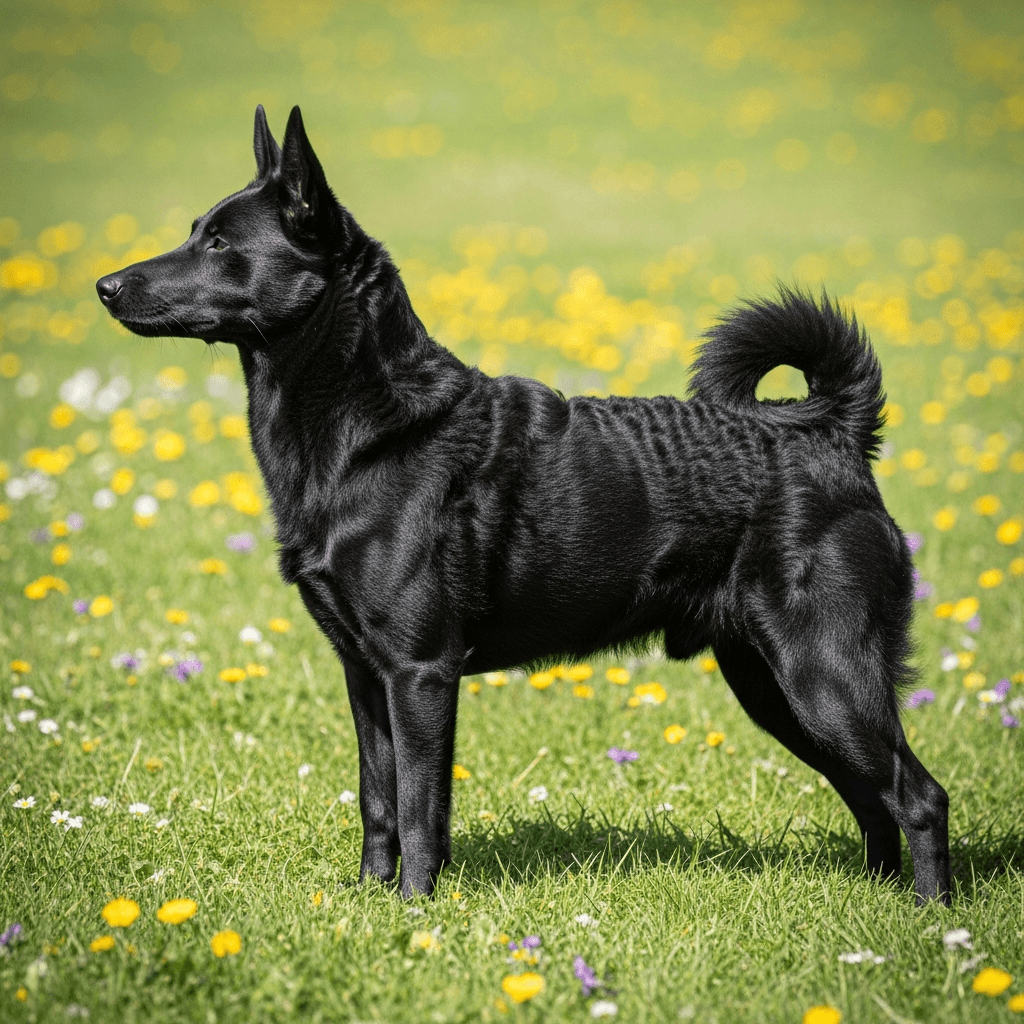
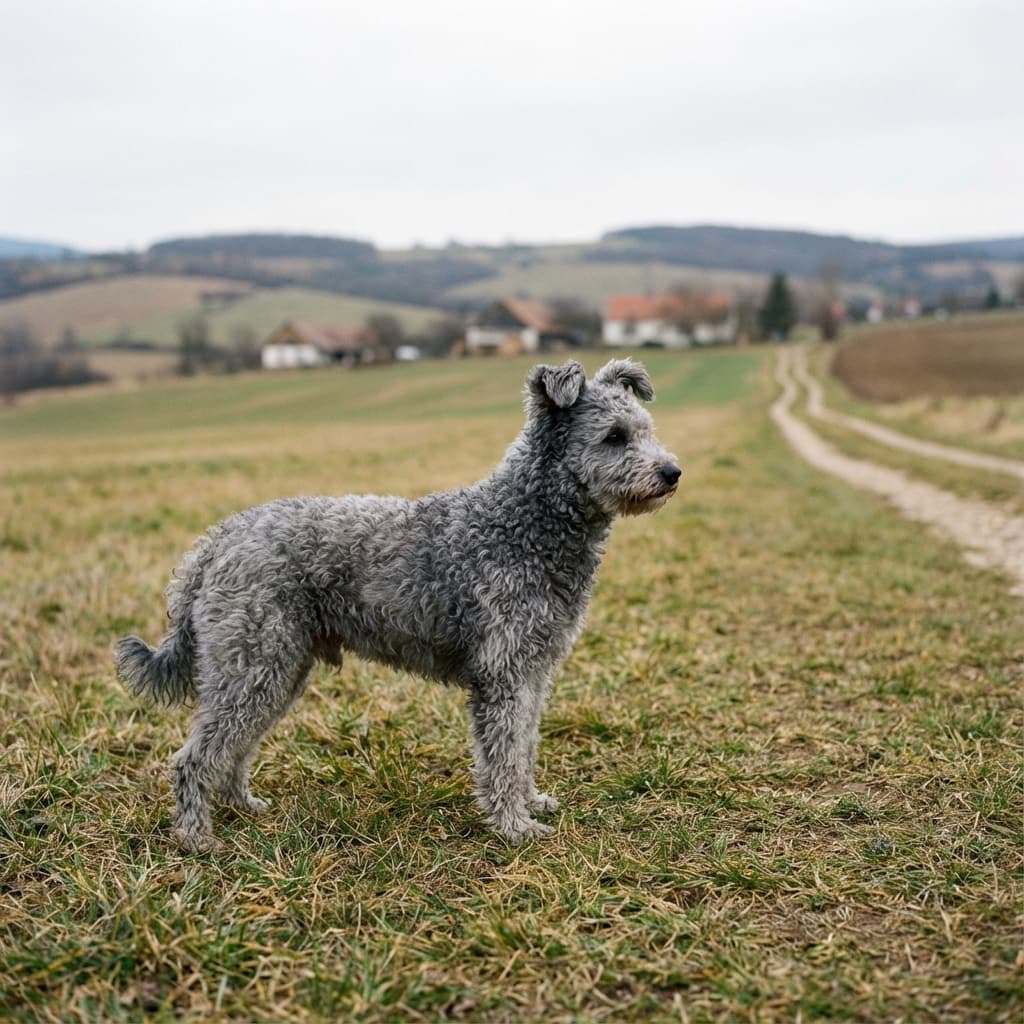
The Pumi is a medium-sized dog with a distinctive, cheerful appearance that immediately attracts attention with its unique silhouette and curly coat. Its body structure is square – the length of the body is equal to the height at the withers, giving it a harmonious and compact silhouette.
Breed dimensions:
- Height at the withers: Males: 41-47 cm, Females: 38-44 cm
- Weight: Males: 10-15 kg, Females: 8-13 kg
Head and expression: The Pumi has an elongated muzzle and a characteristic, narrow, long head that gives it a terrier-like appearance. Particularly distinctive are its high-set, erect ears, the upper third of which is folded forward – this feature makes the Pumi look as if it is in a constant state of alertness. The eyes are dark brown, lively, and shiny, full of intelligence and curiosity, which gives the dog an extremely intelligent and friendly expression.
Coat and coloration: The Pumi's coat is its most recognizable feature – it is wavy and curly, of medium length (4-7 cm), with a dense undercoat that provides protection against various weather conditions. The hair forms characteristic curls and is quite coarse to the touch, giving the Pumi a bear-like, fluffy appearance.
The coloration of the Pumi can be very diverse, although solid colors are preferred:
- Gray (from light to dark)
- Black
- Fawn (from cream to red)
- White
Body structure: The Pumi has a well-muscled, compact body with strong, straight limbs that are parallel and well-built. This structure allows for dynamic, energetic movement – the Pumi moves lightly and nimbly, which is essential in herding work. The tail is high-set, curled over the back or rear, with protruding, coarse hair.
The overall appearance of the Pumi combines charm and strength – it is a dog that looks both friendly and confident, perfectly reflecting its temperament. Its extraordinary appearance makes the Pumi a unique representative of herding dogs that does not go unnoticed!
Pumi is a breed with a unique temperament, known for its lively, energetic, and brave nature. Often referred to as a clown due to its funny and playful disposition, Pumi brings an incredible amount of joy and positive energy into the home.
Family bond: Pumi is extremely devoted to its family and forms deep, strong bonds with its members. This is a dog that loves to be around its pack and enjoys participating in all family activities. It is an excellent companion dog that will become an integral part of family life.
Alertness and guarding: By nature, Pumi is very alert and suspicious of strangers, making it an excellent guard dog. Its keen sense of observation allows it to quickly notice everything happening in its surroundings. However, it requires proper socialization from puppyhood to avoid becoming overly fearful or aggressive towards unfamiliar people and situations. A well-socialized Pumi is a confident, friendly dog ready for new challenges.
Intelligence and training: Pumi is an extremely intelligent breed that quickly learns new commands and tasks. It is easy to train and excels in various dog sports and activities, such as agility, obedience, or trick dog. Its high intelligence is coupled with a natural willingness to cooperate with humans, making training a true pleasure.
Hunting instinct: Pumi has a moderate hunting instinct, which means it may chase small animals – from rodents to birds. In the past, this breed was used not only for herding work but also for controlling predators and rodents, which is still evident in its behavior.
Noisiness: One of Pumi's characteristic traits is its tendency to be quite loud. This is a dog that quickly responds with barking to stimuli – whether it's an approaching car, a stranger, or an unusual sound. This can be an advantage (an excellent alarm) but also a challenge in an urban environment or an apartment. Owners should be consistent in training to teach Pumi to control its barking.
Activity and energy: Pumi is a dog full of energy that requires a lot of movement and mental stimulation. Without proper activity, it may develop behavioral problems, such as excessive barking, destructiveness, or frustration. Owners should provide regular exercise, play, and intellectual challenges.
Summary: With proper care, training, and socialization, Pumi can become a wonderful companion that brings an incredible amount of joy, energy, and loyalty to its owners' lives. This is a dog for active, patient, and consistent individuals who can appreciate its unique temperament!
Pumi is a breed that generally enjoys good health and longevity. The average lifespan of a Pumi is between 12 and 14 years, which is a very good result for a medium-sized dog. Proper care, a healthy diet, and regular physical activity can help extend life and keep the dog in good condition.
Most common health issues: Although Pumi is a relatively healthy breed, it can be prone to certain genetic conditions:
- Hip dysplasia (HD) – a genetic defect leading to improper development of the hip joint, which can cause pain and lameness
- Elbow dysplasia (ED) – a similar condition affecting the elbow joints
- Patellar luxation – dislocation of the kneecap, which can cause discomfort and mobility issues
- Degenerative myelopathy (DM) – a neurodegenerative disease affecting the spinal cord, leading to progressive loss of mobility
- Eye problems – various eye conditions, including cataracts and progressive retinal atrophy (PRA)
Health prevention: To minimize the risk of health problems, Pumi owners should:
- Regularly check the dog's health with a veterinarian – at least once a year
- Provide a proper diet and physical activity to maintain a healthy weight
- Conduct genetic tests with breeders before purchasing a puppy (especially for dysplasia HD/ED)
- Monitor joint condition and mobility, especially in older dogs
- Regularly check eyesight and respond to the first signs of eye problems
Tolerance to weather conditions: Pumi tolerates both warm and cold temperatures well, thanks to its dense, curly coat with an undercoat. However, it is important to avoid prolonged exposure to extreme conditions – both in heat and severe frost. On hot days, provide the dog with access to shade and fresh water, and in winter, monitor its well-being during long walks.
Summary: Proper health care for Pumi, including regular veterinary check-ups, a healthy diet, and appropriate activity, can significantly contribute to its long, healthy, and happy life. Investing in health prevention is the best way to ensure Pumi the highest quality of life!
The coat of the Pumi requires regular grooming to maintain its healthy appearance, natural curl, and good condition. The characteristic, curly coat, which is 4-7 cm long, is one of the most recognizable features of this breed, but it requires proper care to retain its charm.
Grooming frequency: Pumi owners should brush their dog's coat at least once a month to remove dead hair and prevent tangling. Regular brushing helps maintain the natural curl of the hair and ensures a healthy appearance of the coat.
Coat grooming technique:
- Brushing: Use a brush with long teeth or a comb to gently detangle the curls and remove dead hair. Avoid excessive brushing, which can damage the natural curl.
- Moistening the coat: After brushing, it is recommended to moisten the coat with water and allow it to air dry. This process helps maintain the natural curl and structure of the hair.
- Bathing: Pumi does not require frequent baths – it is sufficient to bathe them a few times a year or as needed (e.g., after getting dirty). Use gentle dog shampoos that do not damage the natural structure of the coat.
- Trimming: In some cases, owners choose to trim the coat to make grooming easier – especially around the ears, paws, and anal area. A professional groomer can help maintain the appropriate appearance.
General hygiene:
- Ears: Regularly check the Pumi's ears for redness, odor, or discharge. Erect ears with folded tips may be prone to dirt accumulation.
- Teeth: Brush the dog's teeth several times a week to prevent tartar buildup and gum disease. Use dog toothpaste.
- Nails: Regularly trim the nails, especially if the Pumi does not wear them down naturally during walks. Overgrown nails can cause discomfort and walking issues.
Summary: Proper grooming of the Pumi not only enhances its appearance but is also crucial for the dog's health and well-being. Regular care for the coat, ears, teeth, and nails is the foundation of a happy and healthy life for your Pumi!
The Pumi is a breed with very high needs for physical activity and mental stimulation. This energetic dog comes from a long line of herding dogs that have worked daily for many hours for centuries – this energy and need for movement are still strongly present in its genes.
Minimum exercise requirements: The Pumi should be taken out daily for long walks, which should last from 1 to 2 hours a day. This is the minimum that will provide the dog with the appropriate amount of exercise and stimulation. Walks should be active – the Pumi loves a fast pace, running, and exploring new places.
Additional activities: The Pumi is a dog that loves various forms of activity:
- Agility: Thanks to its intelligence, agility, and willingness to cooperate, the Pumi excels in agility – obstacle courses that combine physical effort with mental challenges.
- Frisbee and fetching: The Pumi loves fetch games – throw a ball, frisbee, or other toys for the dog to run and expend energy.
- Jogging and running: If you are a runner, the Pumi will happily be your companion during running training.
- Swimming: Many Pumis love water – swimming is a great form of exercise that engages the whole body.
- Dog sports: Obedience, trick dog, nose work – the Pumi excels in various sports disciplines.
Mental stimulation: In addition to physical activity, the Pumi also needs intellectual challenges:
- Interactive toys: Puzzles, treat-dispensing toys, scent games – anything that engages the dog's mind.
- Command and trick training: Regular training sessions where the dog learns new commands keep its mind in constant motion.
- Exploring new places: Going to new places, discovering new scents and stimuli is an excellent form of stimulation.
Consequences of lack of activity: A Pumi that does not receive the appropriate amount of exercise and stimulation may develop behavioral problems:
- Excessive noise and barking
- Destructive behaviors (chewing furniture, destroying objects)
- Frustration and anxiety
- Difficulty concentrating during training
Socialization with other dogs: The Pumi enjoys the company of other dogs and can have a great time with peers at dog parks, in parks, or during organized play. Regular interactions with other dogs are important for its mental and social health.
Summary: The Pumi is a dog for active people who love spending time outdoors and are willing to dedicate at least 1-2 hours a day to activities with their dog. If you are looking for a jogging, climbing, agility, or long hiking companion – the Pumi is the perfect choice!
Pumi is a remarkably intelligent breed that quickly learns new commands and tricks. Its high intelligence, combined with a natural willingness to cooperate with humans, makes it easy to train – but it also requires consistency and the right approach.
Early start to training: Due to its independent and energetic nature, training for Pumi should begin as early as possible – ideally during the puppy stage (8-12 weeks). Early training provides the dog with a solid foundation and helps develop good behavioral habits.
Training methods – positive reinforcement: Pumi responds excellently to methods based on positive reinforcement:
- Treats: Use high-quality food rewards as motivation for learning.
- Praise and petting: Pumi loves praise and attention from its owner – this is a strong motivator.
- Toys and games: For Pumi, a reward in the form of play (e.g., throwing a ball) can be as effective as a treat.
Consistency and firmness: Although Pumi is easy to train, owners should be consistent and firm in their training methods. Pumi is an intelligent dog that quickly senses inconsistencies – if you allow it to do something forbidden once, it will quickly exploit that loophole. However, avoid scolding and aggression – positive reinforcement is always more effective.
Early socialization – the key to success: Socialization is crucial for Pumi to learn proper interactions with other dogs, people, and new situations:
- Regularly expose the puppy to new stimuli: different places, sounds, smells
- Allow it to meet other dogs and people in controlled conditions
- Teach it confidence in new situations
A well-socialized Pumi is a confident, friendly, and open dog ready for new challenges.
Barking control: Pumi tends to be quite vocal, so it is important to teach it to control barking from a young age:
- Teach the commands Quiet or Stop
- Reward the dog when it stops barking on command
- Avoid reinforcing barking (e.g., reacting to every bark)
Regular training sessions: Pumi learns best during short, dynamic training sessions:
- Sessions should last 10-15 minutes
- Train 2-3 times a day to keep the dog engaged
- Avoid long, monotonous sessions – Pumi may get bored
- End each session on a positive note
Basic commands to teach:
- Sit – basic control command
- Stay – teaches the dog patience and self-control
- Come – a key safety command
- Lie down – helps calm the dog
- Quiet – barking control
Dog sports and advanced training: Once the basics are mastered, Pumi excels in advanced disciplines:
- Agility – obstacle courses
- Obedience – compliance
- Trickdog – learning tricks
- Nosework – scent games
Summary: With proper training, socialization, and consistency, Pumi can become a wonderful companion that is obedient, confident, and well-behaved in various situations. Training is not just about learning commands – it’s about building a deep bond between you and your dog!
Proper nutrition for Pumi is key to its health, good condition, and longevity. A suitable diet provides the dog with energy for daily activities, supports joint health, coat condition, and overall vitality.
Caloric requirements: Pumi is a dog with medium caloric needs, which depend on its age, weight, activity level, and metabolism:
- Adult Pumi (10-15 kg, active): about 800-1200 kcal per day
- Puppies: require more calories per kilogram of body weight due to growth
- Seniors: may need fewer calories due to lower activity
Choosing food – quality matters: Owners should choose high-quality dog food that is appropriate for the age, weight, and activity level of the Pumi:
- Protein: The food should contain high-quality animal protein (chicken, beef, fish) as the main ingredient – at least 20-25% for adult dogs.
- Healthy fats: Fats provide energy and support skin and coat health – look for sources like chicken fat, salmon oil.
- Carbohydrates: Easily digestible carbohydrates (rice, sweet potatoes, oats) provide energy and fiber.
- Vitamins and minerals: The food should contain a complete set of vitamins and minerals that support bone, joint, and immune system health.
Feeding frequency: It is recommended to feed two meals a day (morning and evening) to maintain energy balance and prevent overeating:
- Puppies (2-6 months): 3-4 meals a day
- Adolescents (6-12 months): 2-3 meals a day
- Adults (12+ months): 2 meals a day
Weight control – avoiding obesity: Pumi should maintain a healthy, slim physique. Obesity can lead to health problems such as joint dysplasia, diabetes, or heart disease:
- Regularly check the dog's weight (e.g., monthly)
- Adjust the amount of food according to activity level – if the dog is very active, it may need more calories
- Avoid overfeeding – stick to the manufacturer's recommendations for the food
- Limit treats to 10% of daily caloric needs
Foods forbidden for dogs: Never feed Pumi human food that may be toxic or harmful to it:
- Chocolate and cocoa
- Onions and garlic
- Grapes and raisins
- Avocado
- Cooked bones (they can splinter)
- Sweets containing xylitol
- Alcohol, coffee, and tea
Hydration – access to fresh water: Owners should ensure the dog has constant access to fresh, clean water. Regularly change the water in the bowl (at least once a day) and wash the bowl to prevent bacterial growth.
Supplements and additives: In most cases, high-quality commercial food provides all the necessary nutrients. However, if you are considering adding supplements (e.g., for joints, coat), consult with a veterinarian to avoid overdosing.
Summary: A balanced diet, regular meals, and weight control are the foundation of a long, healthy, and happy life for your Pumi. Investing in high-quality food is an investment in your dog's health and well-being!
Characteristic Traits
Pros
- Cheerful and friendly character
- Excellent herding skills
- Strong family bonds
- Ideal for active individuals
- Very intelligent and easy to train
- Excellent guard dog.
Cons
- Requires a lot of exercise and mental stimulation
- Can be noisy
- Distrustful of strangers
- Requires consistent training and socialization.
Behavioral Ratings
Breed History
Pumi is a breed with a rich history, rooted in Hungary, a country known for its long tradition of herding dogs. The creation of this breed is the result of careful selection and crossbreeding that led to the development of a unique dog with exceptional herding traits and a terrier-like temperament.
Origins of the breed – 17th and 18th centuries: Pumi was developed in the 17th and 18th centuries when Hungarian shepherds sought ways to improve existing herding dogs. Traditional herding dogs of the puli type – with their characteristic corded coats and excellent herding skills – were crossed with terriers imported from Germany and France.
These terriers contributed new traits to the gene pool:
- Upright ears with folded tips – a characteristic feature of Pumi
- Terrier-like temperament – courage, alertness, energy
- Elongated muzzle – a more terrier-like head appearance
- Excellent sense of smell – the ability to track and hunt predators
Thanks to this combination, Pumi gained a unique temperament – it combines the herding diligence and loyalty of the puli with the courage and sharpness of mind of a terrier.
Herding work: Initially, Pumi was used by Hungarian shepherds for herding livestock – sheep, cattle, pigs, and even horses. Its natural agility, energy, and intelligence made it excel in this role. Unlike many other herding dogs, Pumi was also used for controlling predators and rodents that threatened the flocks – hence its terrier hunting instinct.
Official recognition – early 20th century: Pumi was officially recognized as an independent breed in the early 20th century (around 1920-1930), when canine experts began to distinguish it from other Hungarian herding breeds, such as the puli and pumi. In 1935, the International Canine Federation (FCI) officially registered Pumi as a separate breed.
Breed development and popularity: For decades, Pumi remained primarily a local breed, popular in Hungary. Its versatility – as a herding dog, rodent hunter, and guardian – made it valued by farmers and shepherds. However, over time, Pumi began to gain recognition beyond Hungary's borders.
In recent decades of the 20th and 21st centuries, Pumi has gained international popularity:
- Dog sports: Its intelligence, agility, and willingness to cooperate have made it a favorite in agility, obedience, and other sports disciplines.
- Family dog: The cheerful character, loyalty, and energy of Pumi have attracted the attention of active families looking for an energetic companion.
- International recognition: In 2016, the American Kennel Club (AKC) officially recognized Pumi as a breed, increasing its visibility in the United States.
Pumi today: Today, Pumi is known worldwide as an energetic, intelligent, and loyal companion, thriving both as a family dog and in sports. It is chosen by active owners who value the company of a high-energy, intelligent dog with a unique appearance.
This breed still retains its herding roots – many Pumi continue to work on farms, assisting in managing herds. At the same time, Pumi is gaining recognition in various sports disciplines and as an excellent family dog.
Summary: The history of Pumi is a story of careful selection, versatility, and adaptation. From its humble beginnings as a herding dog on the Hungarian plains, Pumi has grown into a internationally valued breed that combines herding diligence, terrier courage, and extraordinary charm!