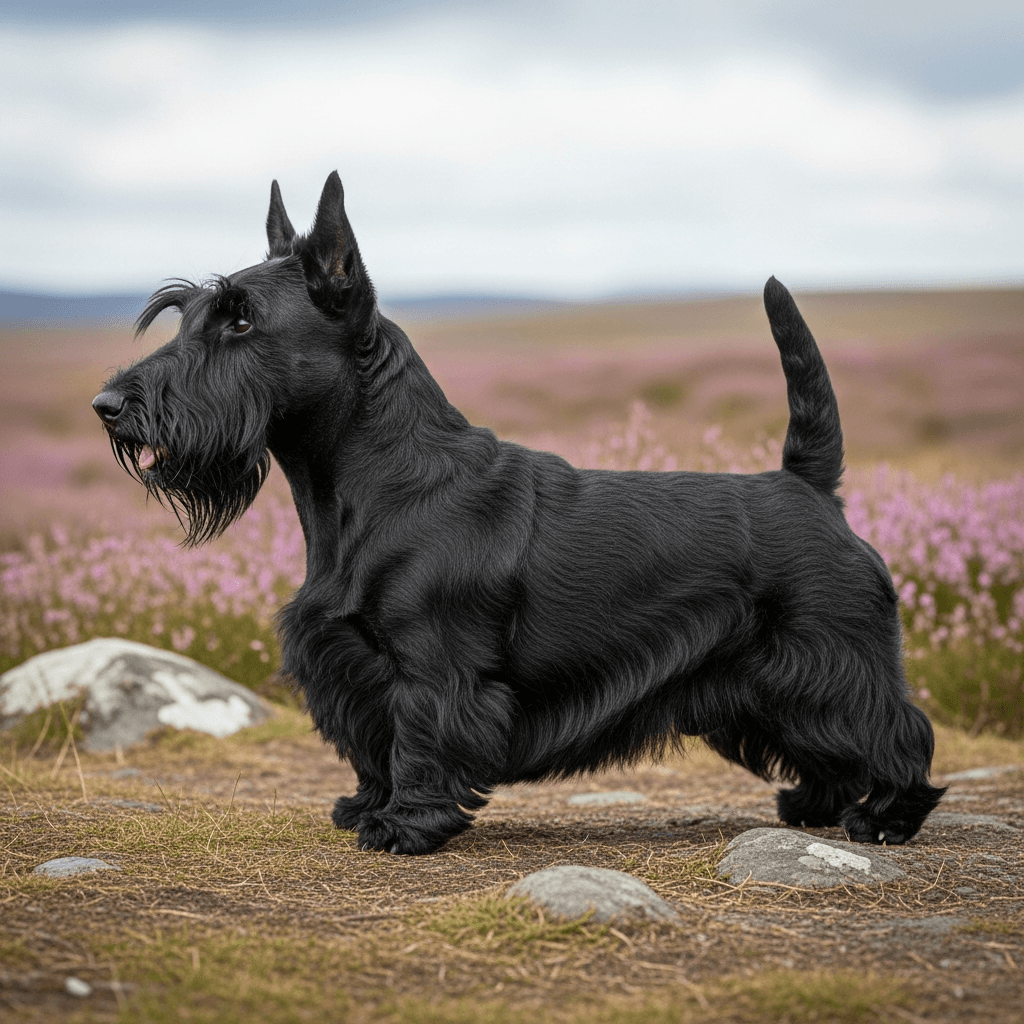
Scottish Terrier
FCI Group
3• FCI 73
Size
Small
Origin Country
GB
Height
25-28 cm
Weight
8.5-10.5 kg
Lifespan
12-14 years
Temperament
Overview
The Scottish Terrier, commonly known as Scottie, is a unique breed with deep roots in the picturesque Scottish Highlands. This unusual dog stands out with its distinctive appearance – stocky, strong build, short legs, and a proudly carried, long head. The height at the withers ranges from 25 to 28 cm, while the weight oscillates between 8.5 and 10.5 kg. These dimensions are ideal for both apartment dwellers and homeowners with gardens.
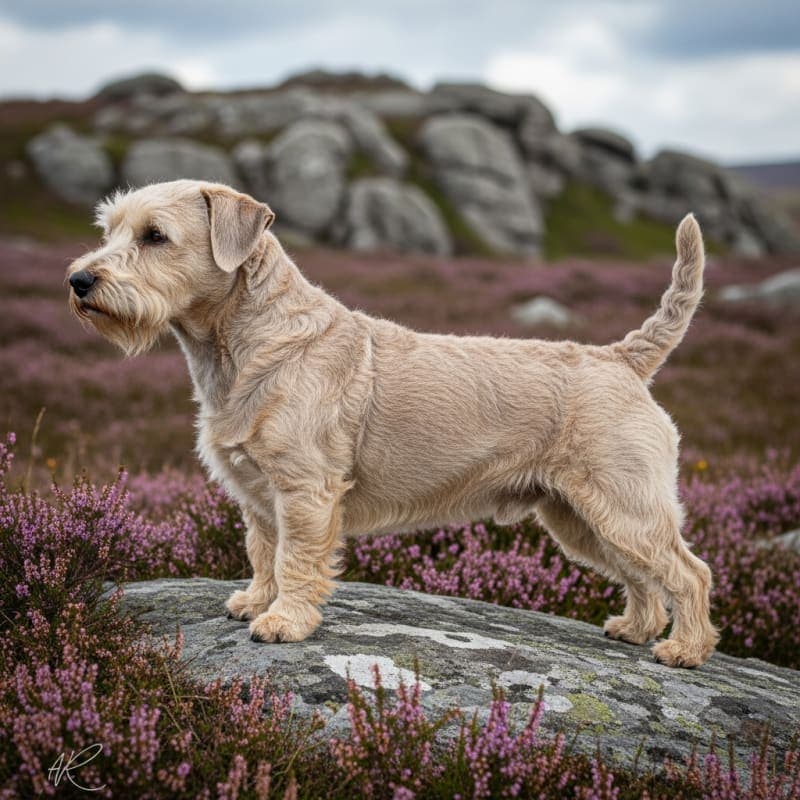
The coat of the Scottie deserves special attention. It is double-layered – the outer layer consists of rough, hard hair with a unique texture, while the undercoat remains short, dense, and soft as velvet. This fur structure provides excellent protection against the rain, wind, and cold typical of Scottish moors. The breed comes in three elegant colors: black (the most classic), wheaten (warm and golden), and brindle (with black stripes on a gray or silver background).
In terms of temperament, the Scottish Terrier is a true gentleman with character. His attachment to family is deep and unconditional, although he remains reserved towards strangers by nature. This is not about timidity – the Scottie simply keeps his distance, observes, and assesses the situation with admirable prudence. At the same time, he is extremely brave, independent, and full of determination, making him both an excellent guardian and a companion with a strong personality.
Although he is not an overly affectionate dog, the Scottish Terrier can express his feelings in a subtle yet meaningful way. His love manifests in quiet companionship, a watchful gaze, and a readiness to defend his loved ones in any situation. However, it is important to remember that his strong will and certain tendency to dominate require consistency and patience from the caregiver in the training process.
Though small, the Scottie carries within him the soul of a true hunter. His past as a working dog has left a lasting mark – he develops a strong territorial instinct, a desire to track, and a readiness to confront intruders (be it a rattlesnake in an American garden or a vole on a Scottish moor). Therefore, he needs regular stimulation both physically (walks, play, scent exercises) and mentally (training, puzzles, interactive toys). Unmet energy and intelligence can lead to boredom, which in turn can result in undesirable behaviors.
The Scottish Terrier is a dog that leaves no one indifferent. His unique appearance, dignified character, and unwavering loyalty attract lovers of breeds with strong personalities. If you are looking for a life companion who will be both elegant and brave, the Scottie may be the perfect choice. In the following sections, you will learn details about his health, grooming, training needs, and fascinating history.
Scottish terriers have a distinctive, recognizable appearance that reflects centuries of adaptation to working in the challenging terrain of Scottish moors. Their silhouette is compact, low, and strongly built, with short, muscular legs – all designed for effective movement in burrows and dense underbrush while hunting foxes, badgers, and vermin.
Head structure and expression:
- The head is proportionately long relative to the body size, creating a characteristic, aristocratic profile
- The skull is nearly flat, with a distinct but not excessive stop
- The eyes are almond-shaped and deep brown, conveying a keen, intelligent, and sometimes slightly disdainful gaze
- The ears are pointed, erect, and relatively small, set high on the skull, giving the dog a watchful, ready-for-action expression
- The beard and eyebrows are thick and prominent, framing the muzzle and adding a ruggedness to the facial expression
Body, tail, and coat:
The body of the Scottish terrier is massive and deep for its small stature, with a broad chest and strong, straight back. The tail is of medium length, thick at the base, and tapers towards the end, carried proudly, either upright or with a slight curve – it should never be curled over the back.
The coat is one of the breed's greatest assets. It is dense, double, and has an exceptionally rough texture. The outer coat layer is about 5 cm long and has a wiry hardness, while the undercoat remains soft and fluffy dense. This structure provides excellent protection against rain, wind, and cold. The colors are:
- Black – the most classic and iconic for the breed
- Wheaten – warm, golden, ranging from light blonde to a deeper honey shade
- Brindle – black or dark stripes on a gray, silver, or sandy background
All of this combines to create an image of a dog that is not only beautiful and elegant but also functional and adapted to challenging fieldwork conditions. This is the appearance of a typical terrier – low-set, stocky, with a look that says: I may be small, but I can handle any challenge.
Scottish terriers are dogs with a remarkably complex and characterful personality, combining traits of loyalty, courage, independence, and a certain degree of Scottish stubbornness. They are deeply attached to their guardians and family members, forming strong, lasting bonds filled with mutual respect.
Character and temperament traits:
- Intelligence and resourcefulness – Scotties are smart, analytical dogs capable of solving problems independently, which can be both an advantage and a challenge during training.
- Reservation towards strangers – this is not fearfulness, but rather natural caution and distance. Scotties observe unfamiliar people from a distance before deciding to make contact. This makes them excellent guardians of the home, responding to sounds and movements on the property.
- Strong hunting instinct – the legacy of generations of hunting ancestors manifests in their readiness to track, chase, and confront small animals (cats, squirrels, rabbits, rodents). During walks, it is advisable to keep the dog on a leash or allow it to run only in a safe, fenced area.
- Stubbornness, determination, and dominance – Scotties have a strong will and their own opinions. They are not dogs that blindly follow every command. They require consistent, wise upbringing from puppyhood, based on positive reinforcement and building mutual respect.
- Courage bordering on recklessness – despite their small size, Scotties do not back down from larger opponents. History has recorded instances of these dogs fighting badgers or foxes many times their size. They are true knights in small bodies.
In relationships with family, Scotties are affectionate, loyal, and protective, although they do not express their feelings as openly as some other breeds. Their love is quiet but deep – expressed through companionship, vigilance, and readiness to defend their loved ones in any situation. They do well with children, provided that the children are gentle enough and respect their need for space (Scotties do not like to be poked, pulled by the ears or tail).
With other dogs, it can vary – much depends on socialization during the puppy stage. Some Scotties are friendly and tolerant, while others may show dominance or conflict, especially towards dogs of the same sex. Early, positive socialization is crucial.
In summary, the Scottish terrier is a dog for experienced guardians who will appreciate its independence, dignity, and a certain degree of Scottish tenacity. In return, they receive a companion that is loyal, intelligent, and full of character, who will remain faithful until the end of their days.
The Scottish Terrier usually enjoys good health and, with proper care, lives on average from 12 to 14 years, although there are individuals that exceed 15 years of age. Like any breed, the Scottie is susceptible to certain conditions characteristic of its genetics and body structure.
Most common health problems:
- Scottie cramp – a neurological condition characterized by periodic, uncontrolled muscle spasms, especially in the hind limbs, triggered by exertion, stress, or excitement. It is not epilepsy, and the symptoms subside after rest. Although it looks dramatic, it rarely poses a life threat and can be managed with a proper diet and avoidance of strong stimuli.
- Idiopathic epilepsy – may occur in some individuals, requiring veterinary diagnostics and pharmacotherapy in more severe cases.
- Cancers – unfortunately, the breed has a higher risk of developing various types of cancers, especially mast cell tumors, melanomas, lymphomas, and bladder cancers. Early detection increases the chances of effective treatment, which is why regular veterinary check-ups are crucial.
- Heart diseases – especially valve defects, which may develop with age. Annual cardiology examinations, particularly in older dogs, allow for early intervention.
- Skin and food allergies – Scotties can be sensitive to certain food ingredients (e.g., grains, chicken, beef) and environmental allergens. Symptoms include itching, skin redness, and hair loss. They require diagnostics and often a specialized hypoallergenic diet.
- Cataracts and other eye conditions – may appear with age, affecting vision sharpness.
- Hip dysplasia – rarer in small breeds but possible. It can lead to limping and pain, especially in older individuals.
- Dermatological problems – the coarse coat and specific skin type make Scotties susceptible to bacterial and fungal infections, especially with improper grooming.
Obesity – a silent killer of health:
Due to their small size and voraciousness, Scottish Terriers have a clear tendency towards obesity. Being overweight puts strain on joints, the heart, and internal organs, shortening life and reducing its quality. Owners should closely monitor food portions, avoid excessive treats, and ensure regular physical activity for their dog. A lean Scottie is a healthy Scottie.
Prevention and care:
Key preventive measures include:
- Regular veterinary visits (at least once a year, twice a year after the age of 7)
- Current vaccinations and deworming
- Dental health checks (terriers are prone to tartar buildup)
- Monitoring any changes in behavior, appetite, and activity
- A balanced diet and appropriate body weight
With attentive care and cooperation with a good veterinarian, the Scottish Terrier can enjoy a long, active, and happy life alongside its family.
Scottish terriers require regular and quite labor-intensive grooming to ensure their characteristic coat looks as it should and fulfills its protective functions. The double coat – a rough, hard outer layer plus a soft, dense undercoat – is beautiful but requires systematic care.
Daily and weekly tasks:
- Daily brushing or at least 3-4 times a week – necessary to prevent matting (especially on the paws, beard, and underarms), remove dead hair, and distribute natural oils throughout the coat. Use a brush with stiff bristles or a metal comb.
- Cleaning the beard and whiskers after every meal – the hair around the muzzle easily gets dirty with food and water, leading to matting, unpleasant odors, and bacterial growth. Regularly wipe the beard with a damp cloth.
- Checking and cleaning the ears once a week – Scottie ears are prone to wax buildup and infections. Use special dog ear cleaning solutions and gently wipe with a damp cotton ball.
Professional grooming – trimming and clipping:
Scotties require regular visits to a groomer every 8–12 weeks to maintain the classic breed silhouette. There are two methods for maintaining the coat:
- Trimming (plucking) – a traditional method involving the manual plucking of dead guard hairs. This keeps the coat hard, rough in texture, and vibrant in color. It is the preferred method for show dogs, although it requires skill and time.
- Clipping with clippers – a quicker and cheaper solution for dogs not participating in shows. The coat becomes slightly softer and lighter in color but retains the characteristic shape of the breed.
The groomer should also trim the hair on the paws, around the eyes, and ears, giving the dog an elegant, well-groomed appearance.
Bathing:
Bathing should occur as needed, usually every 4–6 weeks. Use a shampoo designed for rough-coated terrier breeds – mild but effective in removing dirt and grease. After bathing, thoroughly dry the dog with a towel and a hairdryer (if tolerated) to avoid colds and the development of skin fungus.
Additional grooming treatments:
- Nail trimming every 3–4 weeks – overly long nails make walking difficult, cause pain, and can lead to posture problems. Use a special dog guillotine or seek the services of a veterinarian/groomer.
- Oral hygiene – brushing teeth 2–3 times a week prevents tartar buildup, gum disease, and bad breath. Use dog toothpaste and a toothbrush.
- Eye checks – remove discharge from the corners of the eyes with a damp cotton ball, especially in dogs with thick eyebrows.
- Skin checks – during brushing, check the skin for redness, lumps, parasites (ticks, fleas), wounds, or infections.
Proper grooming is not just a matter of aesthetics – it affects skin health, the dog's comfort, and prevents many dermatological issues. A well-groomed Scottie is a happy Scottie, proudly presenting itself both at home and on walks.
Despite their small size, Scottish terriers are dogs with a high energy level and need for exercise, which is a natural inheritance from their hunting past. They are not marathon runners or dogs for long bike rides, but they require daily moderate to medium physical activity to maintain their physical and mental health.
Minimum exercise requirement:
At least 60 minutes of activity per day is recommended, divided into 2–3 walks and play sessions. This can include:
- Walks – at least twice a day, in varied terrain (park, forest, city streets). Scotties love to sniff and explore, which stimulates both their body and mind.
- Fetch games – balls, frisbees, toys – most Scotties enjoy carrying items in their mouths and bringing them back to their owner.
- Interactive games – searching for treats hidden in the house or garden, Kong toys filled with food, scent mats.
- Obedience training and tricks – stimulate the mind and build a positive relationship with the owner.
Hunting instinct and safety:
Scotties have a strong instinct to track and chase, which means that during off-leash walks, they may dart off in pursuit of a squirrel, cat, bird, or other critter. Therefore:
- Off-leash walks should take place only in safe, enclosed areas (garden, dog park).
- Even a well-trained Scottie may ignore a recall if they are tracking an interesting scent.
- Always use a sturdy leash and harness (better than a collar, which can constrict the throat during pulling).
Mental activity is just as important as physical activity:
Scottish terriers are intelligent and need intellectual challenges. Lack of mental stimulation leads to boredom, frustration, and destructive behaviors (chewing furniture, digging in the garden, barking). Solutions include:
- Dog puzzle toys.
- Training new commands and tricks.
- Learning nosework.
- Rotating toys to keep them interesting.
Adaptation to living conditions:
Scotties can live both in a house with a garden and in an apartment, provided they receive the appropriate amount of exercise and stimulation. They are not dogs that will be satisfied with a quick trip to the lawn – they need real walks, exploration, and adventures.
Regular exercise not only keeps Scotties in good physical condition but also improves mood, reduces stress, and prevents behavioral problems. A tired Scottie is a happy, balanced household companion.
Training a Scottish Terrier can be a challenge even for experienced dog owners, mainly due to its independent, stubborn, and confident character. The Scottie has its own opinion on most matters and is not one of the breeds that blindly follow every command. Nevertheless, with the right approach, consistency, and patience, you can raise an obedient and well-adjusted dog.
Key training principles for Scotties:
- Start early – training should begin from the first days of the puppy's stay in its new home. The earlier you establish the rules, the easier it will be to enforce them in the future.
- Consistency is key – Scotties quickly pick up on inconsistencies in the rules. If you allow them to jump on the couch once and then forbid it the next time, it will create confusion. All household members must follow the same rules.
- Positive reinforcement – reward desired behaviors with treats, praise, and play. Scotties respond much better to motivation than to coercion or punishment.
- Avoid punishment and a heavy hand – using physical punishment, yelling, or force leads to a loss of trust, stress, and resistance. A Scottie may become distrustful, aggressive, or completely shut down to cooperation.
- Short, varied training sessions – Scotties quickly get bored with monotonous repetitions. Sessions should last 5–10 minutes, be varied, and end on a positive note (successful execution of the command + reward).
- Patience and a sense of humor – there will be moments when the dog spectacularly ignores you. Stay calm, don’t take it personally, and try again later.
Basic commands to teach:
- Sit – the foundation for further training.
- Lie down – calms the dog and teaches self-control.
- Stay – useful in dangerous situations (e.g., before crossing the street).
- Come (recall) – crucial for safety, although for Scotties, it is the hardest to enforce in the face of strong stimuli (e.g., tracking).
- Leave it – prevents eating dangerous things during walks.
- Quiet – helps control barking.
Socialization – an absolute priority:
Early and extensive socialization (from 8 to 16 weeks of age) is crucial for the balanced character of an adult Scottie. The puppy should have positive experiences with:
- Different people (children, seniors, people in hats, with strollers, on bicycles).
- Other dogs (various breeds, sizes, temperaments).
- Different environments (city, park, forest, beach, crowds, cars, trams).
- Different sounds (vacuum cleaner, washing machine, thunder, fireworks – audio recordings can help).
Breed-specific challenges:
- Dominance and stubbornness – Scotties may try to take control in the relationship. Don’t allow this from the start. You are the leader, but a wise and fair leader, not a tyrant.
- Selective deafness – especially when they sense something interesting. This requires a lot of work on recall and very high-value rewards (e.g., beef, cheese).
- Reluctance to repeat – if the dog has mastered a command, don’t make it do it 50 times in a row. Change the exercise to maintain interest.
Consider professional help:
If you are having difficulties training your Scottie (e.g., aggression, separation anxiety, destructive behaviors), consult a certified behaviorist or dog trainer specializing in terriers. Early intervention prevents the establishment of undesirable patterns.
In summary, training a Scottish Terrier requires time, patience, consistency, and a positive attitude. It is not a breed for novice owners, but for experienced and determined individuals, the reward is immense – a well-trained Scottie is a dog that is intelligent, loyal, and full of admirable character.
The Scottish Terrier's diet should be carefully balanced and tailored to its age, weight, activity level, and health status. Although Scotties are small dogs, they tend to be greedy eaters and can easily gain weight, leading to serious health problems. Therefore, proper nutrition is one of the pillars of a long and happy life for this breed.
Basic nutrition guidelines:
- High-quality food – choose food labeled as complete and balanced, with meat as the first ingredient. Avoid foods full of grains, fillers, and artificial additives.
- Control portions – strictly follow the manufacturer's recommendations regarding portion sizes. Due to the small size of Scotties, it is easy to overfeed them – an excess of even 50 g per day can lead to obesity within a few months.
- Regular meals – best 2–3 times a day at consistent times. Adult dogs can be fed twice (morning and evening), while puppies and seniors may require three meals.
- Fresh water always available – especially on warm days, after exercise, and during dry food feeding. Change the water daily.
Types of food:
- Dry food (kibble) – convenient, long-lasting, supports oral hygiene (through mechanical cleaning of teeth). Choose kibble suitable for small breeds.
- Wet food (cans, pouches) – tastier, more hydrating, but more expensive and spoils faster. Can be mixed with dry food.
- BARF diet (raw meat and bones) – requires knowledge and time, but many owners claim it improves coat condition, dental health, and overall well-being. Consult with a veterinary nutritionist before introducing it.
- Hypoallergenic food – if Scottie has food allergies (itching, vomiting, diarrhea, skin problems), veterinarians may recommend food with a limited number of ingredients or hydrolyzed protein.
Ingredients to avoid:
- Grains (corn, wheat, soy) – can trigger allergies in sensitive dogs.
- Artificial colors, flavors, preservatives (BHA, BHT, ethoxyquin).
- Excess fat – leads to obesity and pancreatic problems.
- Toxic products for dogs: chocolate, grapes, raisins, onions, garlic, xylitol, avocado, alcohol, caffeine.
Snacks and treats:
Snacks should not make up more than 10% of the daily caloric intake. Choose healthy options:
- Dried meat (beef, chicken, turkey – without spices and salt).
- Vegetables (carrots, cucumber, broccoli – raw or steamed).
- Fruits in small amounts (apple, pear, blueberries – without seeds).
- Specialized dental treats.
Preventing obesity:
Obesity is a serious health problem in Scotties – it strains the heart, joints, liver, and shortens lifespan. To prevent it:
- Weigh your dog regularly (monthly) and monitor its weight.
- Check body condition – ribs should be felt under a layer of fat but should not be visible. The waist should be visible from above.
- If the dog is gaining weight, reduce portions by 10-15% and increase physical activity.
- Avoid feeding from the table – human food is usually too fatty and salty for dogs.
Nutrition according to age:
- Puppies (2-12 months) – puppy food for small breeds, rich in protein and calcium, 3-4 meals a day.
- Adult dogs (1-7 years) – adult food for small breeds, 2 meals a day.
- Seniors (7+ years) – food for older dogs, easier to digest, with lower calorie content, 2-3 meals a day.
A thoughtful, balanced diet is a investment in a long, healthy life for your Scottie. If you have doubts about nutrition, consult with a veterinarian or animal nutritionist – they will tailor the diet to your dog's individual needs.
Characteristic Traits
Pros
- Strong attachment to family
- Excellent guardian of home and property
- Brave and self-confident
- Elegant double-layered coat
- Adapted to apartment and house living.
Cons
- Stubborn and independent character
- Requires consistent upbringing
- Tendency to obesity
- Prone to certain breed-specific diseases
- Needs regular coat grooming.
Behavioral Ratings
Breed History
The history of the Scottish Terrier is deeply rooted in the rugged, misty moors of the Scottish Highlands, where for centuries it has been an indispensable companion to hunters and farmers in the fight against pests. Its roots date back at least to the 15th-16th century, although the precise origin is difficult to determine – the term terrier was then used generally for small hunting dogs that tracked and hunted game in burrows.
The birth of the breed as a distinct category:
The modern Scottish Terrier, as we know it today, began to take shape in the second half of the 19th century, when Scotland and England experienced a boom in dog shows. By that time, there were many varieties of small Scottish terriers (Skye Terrier, Dandie Dinmont Terrier, West Highland White Terrier, and others), which were often crossbred and did not have a strict breed classification.
Key dates and individuals:
- 1879 – Captain Gordon Murray is regarded as the father of the modern breed. He began systematic breeding of dogs with distinctive features: short legs, long head, rough coat, black coloration.
- 1882 – the Scottish Terrier Club was established in Scotland, just a year after the first breed standard was written. This was a groundbreaking moment – the breed was officially recognized and separated from other Scottish terriers.
- 1883 – John Naylor brought the first Scottish Terriers to the United States, where they quickly gained popularity among the elite as companion and show dogs.
- Early 20th century – the breed was officially recognized by the American Kennel Club (AKC) and the Kennel Club (UK). Breeding lines began to emerge in the USA, Canada, and throughout Europe.
The golden age of popularity:
In the 1930s and 1940s, the Scottish Terrier reached its peak popularity, especially in the United States. It became a favorite of Hollywood stars and politicians. The most famous example is President Franklin Delano Roosevelt and his beloved Scottie named Fala, who accompanied the president during World War II and became a symbol of loyalty. Fala was so popular that he was honored with his own statue in the FDR memorial in Washington, D.C.
Other U.S. presidents who owned Scotties include Dwight Eisenhower (Caacie) and George W. Bush (Barney and Miss Beazley). This made the breed a symbol of dignity, independence, and the American middle class.
Role in pop culture:
The Scottie has appeared in countless advertisements, films, cartoons, and games (remember the dog from the Monopoly game?). Its image has become an iconic symbol of Scotland, alongside kilts, bagpipes, and whisky. It is often portrayed as a distinguished, loyal, yet somewhat stubborn dog – just like the stereotypical Scot.
Modern times:
Although the breed's popularity has somewhat declined compared to its peak in the mid-20th century, the Scottie still enjoys recognition as a great companion and show dog. It is valued for:
- Independent, dignified character
- Loyalty and attachment to family
- Elegant appearance
- Adaptability to life in both city and countryside
Breeders around the world continue to work on preserving the classic traits of the breed – healthy structure, rough coat, and typical temperament. Scotties regularly participate in shows (Westminster Kennel Club Dog Show, Crufts) and win awards in the terrier category.
Historical curiosities:
- The Scottie was the mascot of the Scottish army during both world wars, symbolizing courage and determination.
- During World War II, many Scotties served as courier and guard dogs.
- The breed has survived many difficult moments in history, including breeding restrictions during wartime, epidemics of canine diseases, and changing fashions in dog breeds.
Today, the Scottish Terrier remains a living monument to Scottish tradition and culture – a small dog with a big heart, dignified character, and a history that stretches back hundreds of years. For enthusiasts of the breed, the Scottie is not just a pet, but a living piece of history.